
Study of Boric Acid Suppositories
1. Aim
To calculate the ingredient requirement for a historical boric acid suppository teaching formula and study the moulding and observation stages. Any physical preparation requires instructor approval and an authenticated formula. The route, mould calibration, displacement value, and current clinical acceptability must be specified in your college lab manual and instructor's method sheet. [1, 2, 3]
2. Requirements
The East Point College of Pharmacy manual lists boric acid and cocoa butter. For a supervised demonstration, the equipment may include a balance, suppository mould, dish, water bath, spatula, clean tile, and protective packaging. The actual mould capacity, lubricant, ingredient grades, batch size, heating conditions, and acceptance tests must be specified in your college lab manual and instructor's method sheet. Wear a coat, eye protection, and suitable gloves; prevent boric acid dust and contact with hot equipment. A paper calculation or supplied image set is appropriate if the local procedure is unavailable. [2, 3]
3. Theory
A suppository is a solid unit containing a drug within a base that softens, melts, or dissolves after placement in a body cavity. In the cited teaching formula, boric acid is dispersed through cocoa butter rather than dissolved. Continuous gentle mixing as the base starts to set helps reduce sedimentation. Mould capacity is normally calibrated with base alone, then corrected for the volume displaced by the drug. A visually smooth unit cannot prove that each unit contains the intended mass. [2]
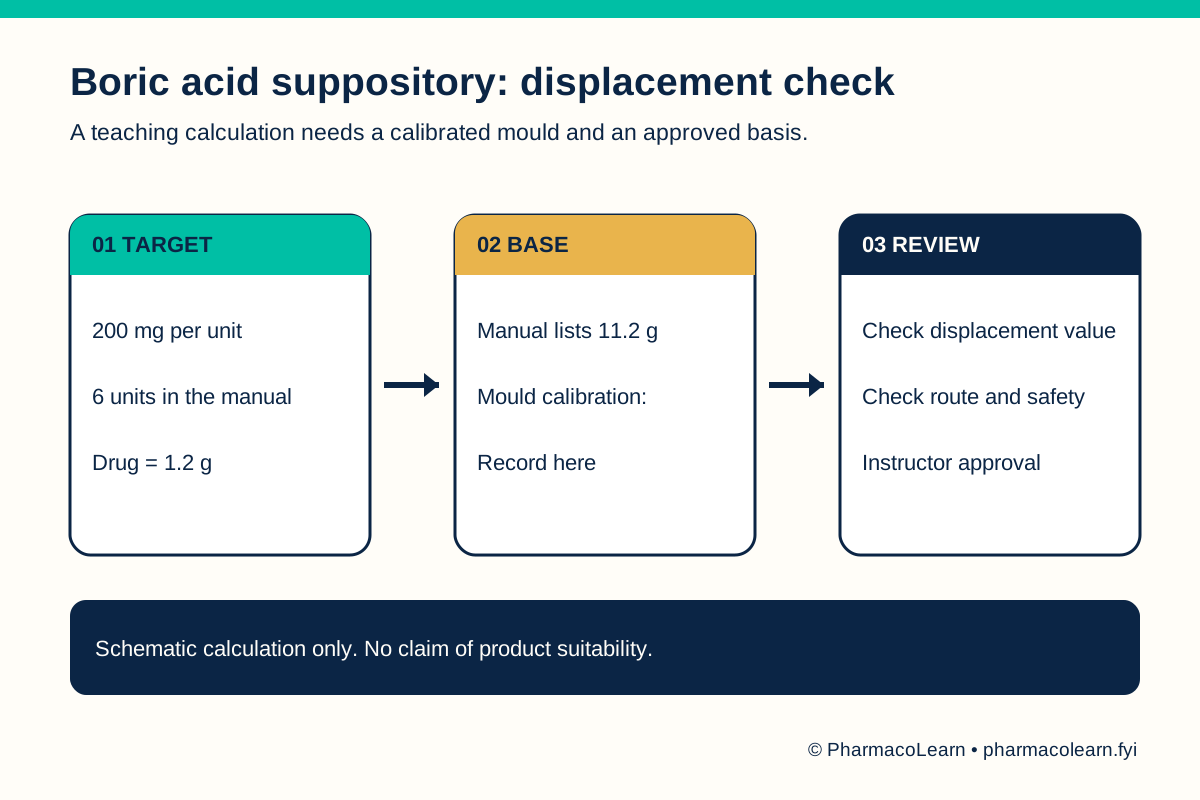
The manual plans six units to supply five, allowing one extra for process loss. It lists 200 mg boric acid per unit and 11.2 g cocoa butter for the six-unit working batch, but it does not give a fully documented mould calibration or displacement calculation in that experiment. Those data must be checked before any actual weighing of base. Boric acid dust may irritate the respiratory tract, and chemical-safety sources identify reproductive-hazard concerns. No teaching sample is to be inserted or used by a patient. [2, 3]
4. Procedure
- Obtain the authenticated teaching formula, mould calibration, displacement value, target number of units, and local boric-acid handling instructions. Record missing details here. [1, 2, 3]
- Calculate the boric acid required for the planned number of cavities. Compare the manual's cocoa-butter amount with the amount derived from a verified mould capacity and displacement value. Do not use 11.2 g solely because it appears in a worksheet. [2]
- Check the condition and cleanliness of the mould. The lubricant type and whether it is needed for the selected mould must be specified in your college lab manual and instructor's method sheet. [2]
- If physical work is authorized, have the instructor confirm the measured ingredients. Use the approved water-bath method to soften the cocoa butter without overheating. The permitted temperature and time must be specified in your college lab manual and instructor's method sheet. [2]
- Incorporate the boric acid into a portion of softened base using the approved dust-control method, then mix it through the rest of the base. Keep the dispersion moving gently while filling the mould so that solids do not settle. [2, 3]
- Allow the units to set under the specified conditions. Remove them using the approved mould method, inspect for cracks, air holes, and uneven surfaces, and record the number recovered. [2]
- Record unit masses and any required content or uniformity tests. The acceptance limits are to be recorded from the assigned current monograph or approved college method in the student record. Label all units teaching sample, not for patient use and follow the approved waste route. [2, 3]
5. Calculation, graph, or images as appropriate
| Record item | Historical manual entry [2] | Calculation or observation |
|---|---|---|
| Boric acid per unit | 200 mg | Record here against authenticated source |
| Units planned | Six to supply five | Actual recovered Record here |
| Boric acid for six units | 1.2 g | 200 mg × 6 = 1200 mg = 1.2 g |
| Cocoa butter for six units | 11.2 g in working table | Calculated amount Record here from mould and displacement data |
| Unit mass and appearance | Criteria record from the assigned current monograph or approved college method | Record here |
Worked calculation: If the cited teaching amount of 200 mg boric acid per unit is used for six planned cavities, the required boric acid is 200 mg × 6 = 1200 mg, or 1.2 g. The five intended units would account for 1000 mg in total; the sixth is an allowance for loss, not an extra patient unit. The cocoa-butter mass cannot be verified from unit count alone because mould capacity and displacement must first be established. [2]
6. Result
State whether the work was a calculation or an approved supervised moulding exercise. Record actual weighed amounts, number recovered, unit masses, surface observations, and deviations here until measured. Do not claim dose uniformity or suitability for clinical use from appearance alone. [2, 3]
7. References
- Pharmacy Council of India. Pharm.D. Regulations, 2008, Appendix A. Lists Boric acid suppositories after the powder practicals.
- East Point College of Pharmacy. Pharmaceutics Practical Manual, Experiment 26: Boric Acid Suppositories. Gives the historical per-unit and working quantities and the moulding stages.
- National Library of Medicine, PubChem. Boric Acid: Laboratory Chemical Safety Summary. Summarizes dust and reproductive-hazard concerns.
Back to Pharmaceutics Practicals · All Pharm D Practicals · Pharm D
Theory notes: Pharmaceutics