
Explosive Powder: Incompatibility Recognition Exercise
1. Aim
To recognize the incompatibility behind the historical Pharmaceutics practical called Explosive Powder and document a safe response to a hazardous powder prescription. This is a paper and label-review exercise. No reactive powder is prepared, blended, divided, or packaged. [1, 2, 3]
2. Requirements
Use the PCI syllabus, an instructor-supplied historical prescription sheet, current safety data sheets, a blank incompatibility record, and a calculator. No chemicals are required for the student exercise. The original teaching example involves a strong oxidizer and organic materials; the exact recipe, quantities, and dispensing method are intentionally excluded because combining them can create a fire or explosion hazard. A supervising pharmacist or laboratory instructor must determine any institution-specific response. [2, 3, 4]
3. Theory
An oxidizer can intensify combustion of another material. A finely divided combustible powder gives a large contact area, and friction or other energy input can trigger a dangerous reaction. The historical manuals use the term "explosive powder" to teach this incompatibility. That name is a warning, not a preparation target for an unsupervised student. Official chemical-safety information identifies potassium chlorate as a strong oxidizer that can form explosive mixtures with combustible materials and may ignite from friction. [2, 3, 4]
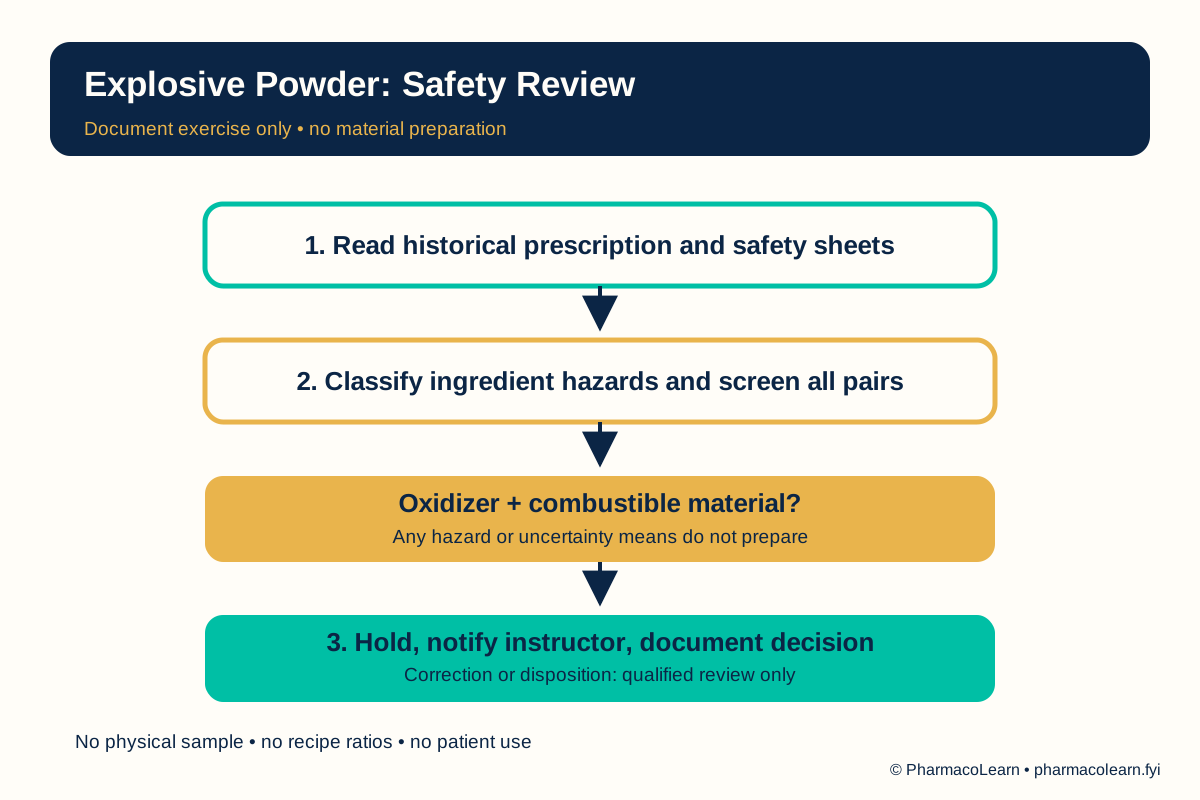
The useful skill is to screen all ingredients before weighing or mixing, identify incompatible pairs, isolate the prescription, and obtain an approved replacement or correction from the instructor or prescriber through the appropriate professional process. Adding a diluent, using gentler mixing, or changing packaging without a validated method does not establish safety. The historical source discusses such methods, but this article does not reproduce them as instructions. [2, 3, 4]
4. Procedure
- Read the assigned historical prescription as a document only. Do not fetch, weigh, grind, sieve, or place any listed materials together. Record the title and source of the prescription. [1, 2]
- For each listed ingredient, consult its current safety data sheet and mark its hazard class. If an ingredient identity, grade, or hazard class is unclear, record the uncertainty here and stop the assessment for that item. [3, 4]
- Compare every distinct pair of ingredients for oxidizer and combustible or reducing-material incompatibility. Record the source for each classification and any uncertainty. Do not infer that a smaller quantity is safe. [3, 4]
- If a hazardous pair is present, mark the prescription do not prepare and notify the supervising instructor. Any correction, substitute formulation, and final disposition are determined by the qualified reviewer and recorded in the student record. This page proposes no correction, decides no disposition, and stops, substitutes, or dispenses no medicine. [3, 4]
- Complete the pairwise-check table below using an instructor-supplied abstract case. Do not record a live recipe, preparation ratio, or mixing sequence in the student notebook. [2, 3]
- Review how an incompatible prescription should be documented: source, date, ingredient classes, identified hazard, person informed, and final approved decision. Leave all actual outcome fields blank until the instructor provides them. [3, 4]
- File the record as an incompatibility exercise. No physical sample or patient-use label is produced. [1, 2]
5. Calculation, graph, or images as appropriate
| Document-check item | Student record |
|---|---|
| Number of distinct ingredient entries | Record here |
| Oxidizer identified from a current safety sheet | Record here |
| Combustible or reducing material identified | Record here |
| Pairwise compatibility decision and cited source | Record here |
| Instructor notified and approved disposition | Record here |
| Physical sample made | No |
Worked pair-count example: For an abstract prescription with three ingredient entries labelled A, B, and C, the number of distinct pairs to screen is n(n - 1)/2 = 3(3 - 1)/2 = 3 pairs: A with B, A with C, and B with C. This calculation ensures no pair is missed. It does not calculate a safe formulation, and it gives no permission to combine materials. If any pair is hazardous or its safety is unresolved, the preparation remains on hold. [3, 4]
6. Result
Report the number of pairs screened, the evidence used to classify each pair, in the student record. The instructor's final disposition is decided by the qualified reviewer and recorded in the student record. This page proposes no correction, decides no disposition, and stops, substitutes, or dispenses no medicine. The expected product of this exercise is a documented decision, not a powder. Do not claim that any historical mixture is safe to compound or dispense. [2, 3, 4]
7. References
- Pharmacy Council of India. Pharm.D. Regulations, 2008, Appendix A. Lists Explosive powder among the Year 1 Pharmaceutics powder practicals.
- East Point College of Pharmacy. Pharmaceutics Practical Manual, Experiment 23: Explosive Powder. Historical teaching example; this article does not adopt its preparation directions.
- National Library of Medicine, PubChem. Potassium Chlorate: Laboratory Chemical Safety Summary. Describes strong oxidizing and friction-sensitive mixture hazards.
- Occupational Safety and Health Administration. Hazard Classification Guidance: Oxidizing Liquids and Solids. Explains how oxidizers can intensify the combustion of other materials.
Back to Pharmaceutics Practicals · All Pharm D Practicals · Pharm D
Theory notes: Pharmaceutics