
← Pharmaceutical Organic Chemistry practicals | Pharm.D. Year 1 Practicals
Preparation of 2,4,6-Tribromoaniline by Bromination
1. Aim
To study the supervised bromination of aniline and record the isolation and percentage yield of 2,4,6-tribromoaniline. This is the 2,4,6-tribromoaniline option under PCI Pharmaceutical Organic Chemistry item I.3, which alternatively names p-bromoacetanilide. The local option and authorized method must follow your college lab manual and instructor's method sheet. [1, 2]
2. Requirements
Aniline, an approved brominating reagent, the specified solvent and quench, reaction and filtration equipment, balance, drying equipment, suitable hood, gloves, coat, eye protection, and separately labelled hazardous-waste containers are required for an instructor-run practical. Bromine is highly hazardous, so a class may instead use a supplied demonstration dataset or an instructor-prepared sample. The reagent identity, concentration, quantities, solvent, control of addition and temperature, and waste treatment are to be recorded from the instructor-approved demonstration protocol or dataset in the student record. [2, 3]
3. Theory
The amino group on aniline strongly activates its aromatic ring and directs substitution toward the positions next to and opposite it. Under appropriate bromination conditions, substitution at positions 2, 4, and 6 gives 2,4,6-tribromoaniline. This is electrophilic aromatic substitution, with three ring hydrogens replaced by bromine atoms. A one-mole-to-one-mole relationship between aniline and final product supports yield arithmetic when aniline is the limiting starting material. [2]
Product appearance and mass alone are not proof of identity. Any melting-point or other identity comparison must use the approved method and a verified reference criterion. The exact reaction setup is deliberately tied to local supervision because bromine and aniline present serious exposure hazards. [2, 3, 4]
4. Procedure
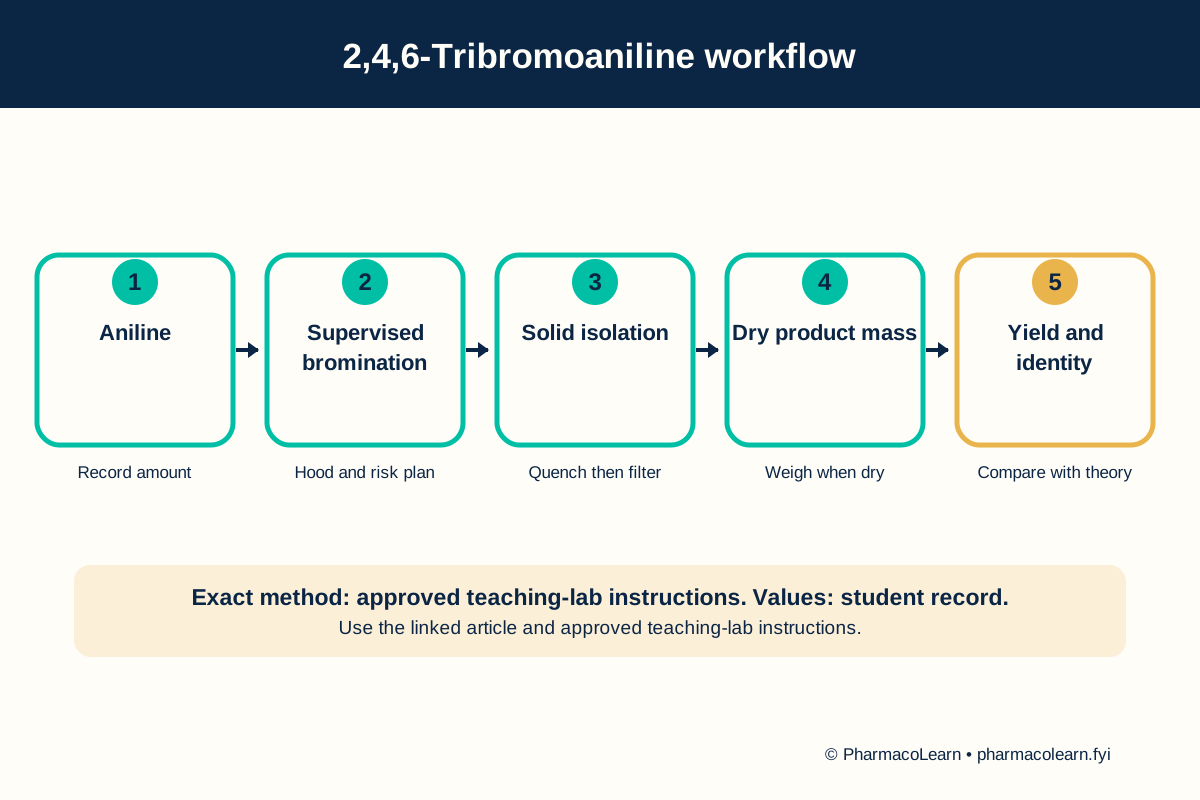
- Confirm that the assigned PCI option is 2,4,6-tribromoaniline. Review the institution's authorized protocol, chemical safety data, spill response, and waste route with the instructor before any chemical is issued. [1, 3]
- Record the aniline amount and the approved brominating reagent's identity. Exact concentrations and volumes are to be recorded from the instructor-approved demonstration protocol or dataset in the student record. [2]
- Set up the supervised reaction in the specified hood with the approved temperature-control and stirring arrangement. The instructor directs reagent addition and monitors the response. [2, 3]
- Record the observed color and precipitate changes, reaction time, and temperature without treating appearance alone as proof of completion. The endpoint is to be recorded from the instructor-approved demonstration protocol or dataset in the student record. [2]
- When instructed, apply the approved quench and isolation sequence. Filter and wash the solid using the specified equipment and liquid. The quench, wash, and waste treatment are to be recorded from the instructor-approved demonstration protocol or dataset in the student record. [2, 3]
- Dry and weigh the product according to the approved endpoint. Record appearance and any assigned identity or purity evidence. [2]
- Calculate theoretical mass from the confirmed limiting reagent and compare it with dry product mass. If the practical is taught from a demonstration dataset, label every value as supplied or pre-assumed. [2]
5. Calculation, graph, or images as appropriate
| Observation | Actual laboratory record |
|---|---|
| Aniline amount | Record here |
| Brominating reagent and conditions | Record here |
| Color and solid formation | Record here |
| Dry product mass | Record here |
| Identity or purity evidence | Record here |
Pre-assumed values for a paper calculation only, not a procedure: Assume aniline is limiting at 0.500 g, and a hypothetical dry product mass is 1.25 g. Using 93.13 g/mol for aniline and 329.81 g/mol for 2,4,6-tribromoaniline, moles of aniline = 0.500 ÷ 93.13 = 0.00537 mol. Theoretical product mass = 0.00537 × 329.81 = 1.77 g. Percentage yield = 1.25 ÷ 1.77 × 100 = 70.6% after rounding. These figures are illustrative and are not reagent instructions or an observed result. [4, 5]
6. Result
Report actual isolated mass, calculated yield, and any identity evidence only after the instructor-approved work or supplied dataset. The actual result must be recorded here. Safety note: Bromine can harm the eyes, skin, and respiratory tract; aniline can be absorbed through the skin and affect the blood. Handle both only under qualified teaching-lab supervision with the approved hood, protective equipment, spill plan, and hazardous-waste system. [3, 4]
7. References
- Pharmacy Council of India. Pharm.D. Regulations, 2008, Pharmaceutical Organic Chemistry practical list.
- East Point College of Pharmacy. Pharmaceutical Organic Chemistry Practical Manual, experiment on 2,4,6-tribromoaniline.
- Centers for Disease Control and Prevention. Bromine: Chemical Fact Sheet.
- Centers for Disease Control and Prevention, NIOSH. Pocket Guide to Chemical Hazards: Aniline.
- National Library of Medicine, PubChem. 2,4,6-Tribromoaniline.
Back to Pharmaceutical Organic Chemistry practicals | Pharm.D. Year 1 Practicals · All Pharm D Practicals · Pharm D
Theory notes: Pharmaceutical Organic Chemistry