
← Pharmaceutical Organic Chemistry practicals | Pharm.D. Year 1 Practicals
Preparation of Benzanilide by Benzoylation
1. Aim
To prepare and isolate benzanilide from aniline and benzoyl chloride, and calculate a theoretical and percentage yield. This is the benzanilide option under PCI Pharmaceutical Organic Chemistry item I.2, “Benzanilide / phenyl benzoate (Benzoylation).” The option chosen for a particular class must follow your college lab manual and instructor's method sheet. [1, 2]
2. Requirements
Aniline, benzoyl chloride, an approved aqueous base, water, reaction vessel, stirring device, cooling arrangement, filtration equipment, balance, drying equipment, protective coat, gloves and eye protection, fume hood, and segregated waste containers are needed. A melting-point apparatus may be included for a specified purity check. Reagent grade, base identity and concentration, quantities, addition rate, time, temperature, wash liquid, and drying endpoint are to be recorded from the instructor-approved demonstration protocol or dataset in the student record. [2, 3]
3. Theory
Benzanilide is an amide. In the Schotten-Baumann approach, the nitrogen of aniline reacts with benzoyl chloride to make the amide. A basic aqueous phase helps neutralize the acid formed, while stirring brings the reacting components into contact. One mole of aniline can form one mole of benzanilide when the other reagents are sufficient. Precipitation and filtration isolate a crude solid, which can then be washed and dried. A product mass does not alone confirm chemical identity or purity. [2]
The available East Point Pharm.D. practical manual contains a benzanilide exercise but has inconsistent reagent wording in that section. For that reason, the instructor-approved recipe and reagent labels must be checked before handling chemicals. This article follows the Tata Institute of Fundamental Research teaching explanation for the reaction identity. [2, 3]
4. Procedure
- Confirm that the selected PCI option is benzanilide and review the approved method, chemical labels, safety data, and waste plan with the instructor. [1, 2]
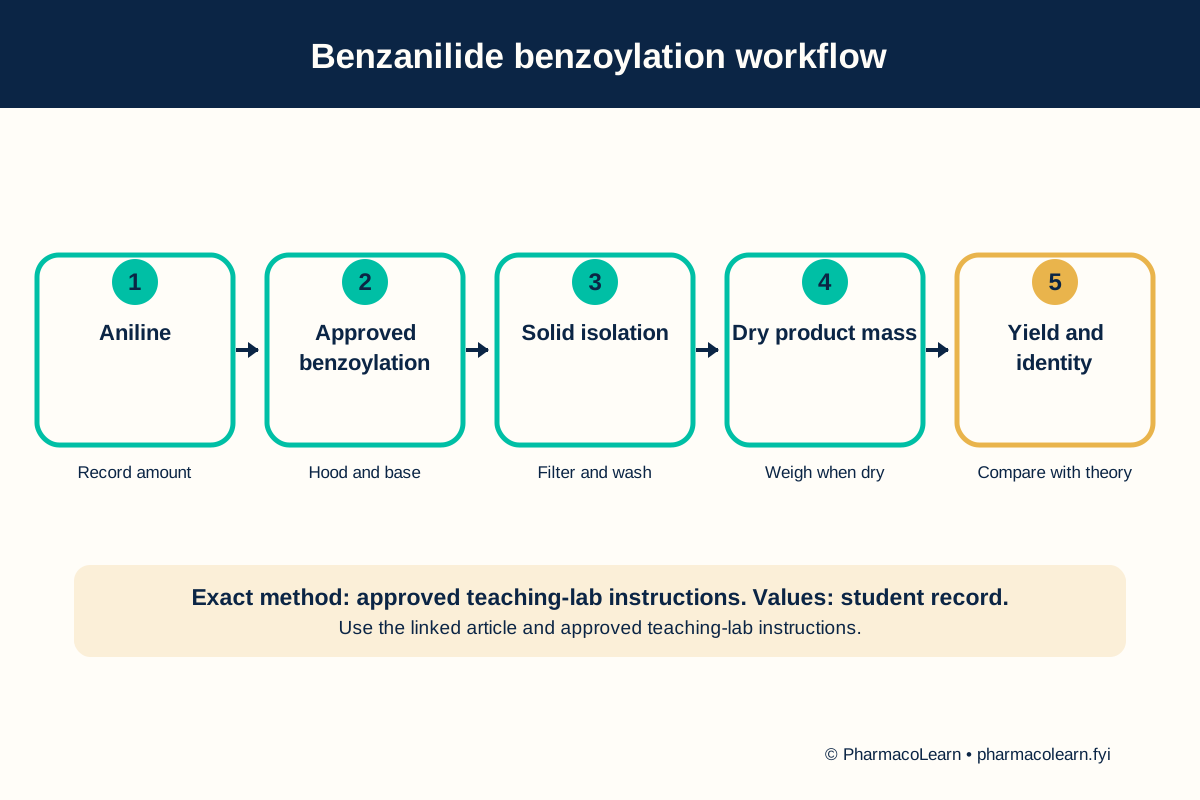
- Label the vessel and record the actual aniline and benzoyl chloride quantities. Prepare the specified basic medium. All quantities and concentrations are to be recorded from the instructor-approved demonstration protocol or dataset in the student record. [2]
- In a fume hood, combine reagents in the approved sequence while stirring and controlling heat. The approved addition order, cooling method, and reaction time are to be recorded from the instructor-approved demonstration protocol or dataset in the student record. [2]
- Continue mixing until the method's completion criterion is met. Record formation of any precipitate and the observed mixture appearance. [2]
- Isolate the solid using the assigned filtration method. Wash it as specified to remove soluble impurities. Wash liquid and volume are to be recorded from the instructor-approved demonstration protocol or dataset in the student record. [2]
- Dry the solid to the approved endpoint, then record mass and appearance. If required, perform the assigned identity or purity check. [2, 3]
- Determine the limiting reagent from the actual recorded inputs and calculate theoretical yield and percentage yield. Submit the observations and waste record for instructor review. [2]
5. Calculation, graph, or images as appropriate
| Observation | Actual laboratory record |
|---|---|
| Aniline mass or amount | Record here |
| Benzoyl chloride amount | Record here |
| Base identity and concentration | Record here |
| Precipitate and appearance | Record here |
| Dry benzanilide mass | Record here |
| Identity or purity check | Record here |
Pre-assumed values for arithmetic only, not a lab prescription: Suppose 0.500 g aniline is the limiting reagent, benzoyl chloride is sufficient, and the hypothetical dry benzanilide mass is 0.800 g. Using 93.13 g/mol for aniline and 197.23 g/mol for benzanilide, moles of aniline = 0.500 ÷ 93.13 = 0.00537 mol. The 1:1 theoretical benzanilide amount is 0.00537 mol, giving 0.00537 × 197.23 = 1.06 g theoretical mass. Percentage yield = 0.800 ÷ 1.06 × 100 = 75.6% after rounding. Actual reagent quantities and limiting reagent must be recorded here. [4, 5]
6. Result
Report the actual isolated dry mass, percentage yield, appearance, and the identity check if assigned. No real batch measurements are available here, so the experimental result must be recorded here. Safety note: Aniline can be absorbed through skin and can seriously affect the blood. Benzoyl chloride is irritating and reactive. This experiment requires teaching-lab supervision, a hood, suitable gloves, eye protection, controlled addition, and designated waste handling. [2, 6]
7. References
- Pharmacy Council of India. Pharm.D. Regulations, 2008, Pharmaceutical Organic Chemistry practical list.
- Tata Institute of Fundamental Research, Homi Bhabha Centre for Science Education. Synthesis and Analysis of Amides.
- East Point College of Pharmacy. Pharmaceutical Organic Chemistry Practical Manual. The benzanilide section has inconsistent reagent wording; verify the local approved recipe.
- National Library of Medicine, PubChem. Aniline.
- National Library of Medicine, PubChem. Benzanilide.
- Centers for Disease Control and Prevention, NIOSH. Pocket Guide to Chemical Hazards: Aniline.
Back to Pharmaceutical Organic Chemistry practicals | Pharm.D. Year 1 Practicals · All Pharm D Practicals · Pharm D
Theory notes: Pharmaceutical Organic Chemistry