
← Pharmaceutical Organic Chemistry practicals | Pharm.D. Year 1 Practicals
Preparation of Dibenzylideneacetone by Condensation
1. Aim
To prepare dibenzylideneacetone, also called dibenzalacetone, by condensation of benzaldehyde with acetone, isolate the product, and calculate percentage yield. This is synthesis item I.4 in the PCI Year 1 Pharmaceutical Organic Chemistry practical list. The institution's exact method must follow your college lab manual and instructor's method sheet. [1, 2]
2. Requirements
Benzaldehyde, acetone, an approved aqueous base and solvent, reaction vessel, stirrer, temperature control, filtration equipment, balance, drying equipment, and, if assigned, melting-point equipment are required. Use a coat, suitable gloves, eye protection, a fume hood, and labelled organic and alkaline waste containers. The base identity and concentration, reagent quantities, solvent, reaction temperature, duration, recrystallization liquid, and purity criterion are to be recorded from the instructor-approved demonstration protocol or dataset in the student record. [2, 3]
3. Theory
This crossed aldol, or Claisen-Schmidt, condensation uses the enolizable acetone and benzaldehyde, which has no alpha hydrogen. Base promotes carbon-carbon bond formation, followed by dehydration. Two molecules of benzaldehyde react with one molecule of acetone to give one molecule of dibenzylideneacetone overall. The yellow solid can separate from the mixture and be collected. A crude mass is not a purity result; residual solvent, base, starting material, or a related condensation product can affect both appearance and yield. [2, 3]
The calculation must respect the 2:1 benzaldehyde-to-acetone relationship. Whichever reactant gives less theoretical product is limiting. A melting-point observation, if required by the approved teaching method, supports characterization but should not be treated as proof by itself. [2]
4. Procedure
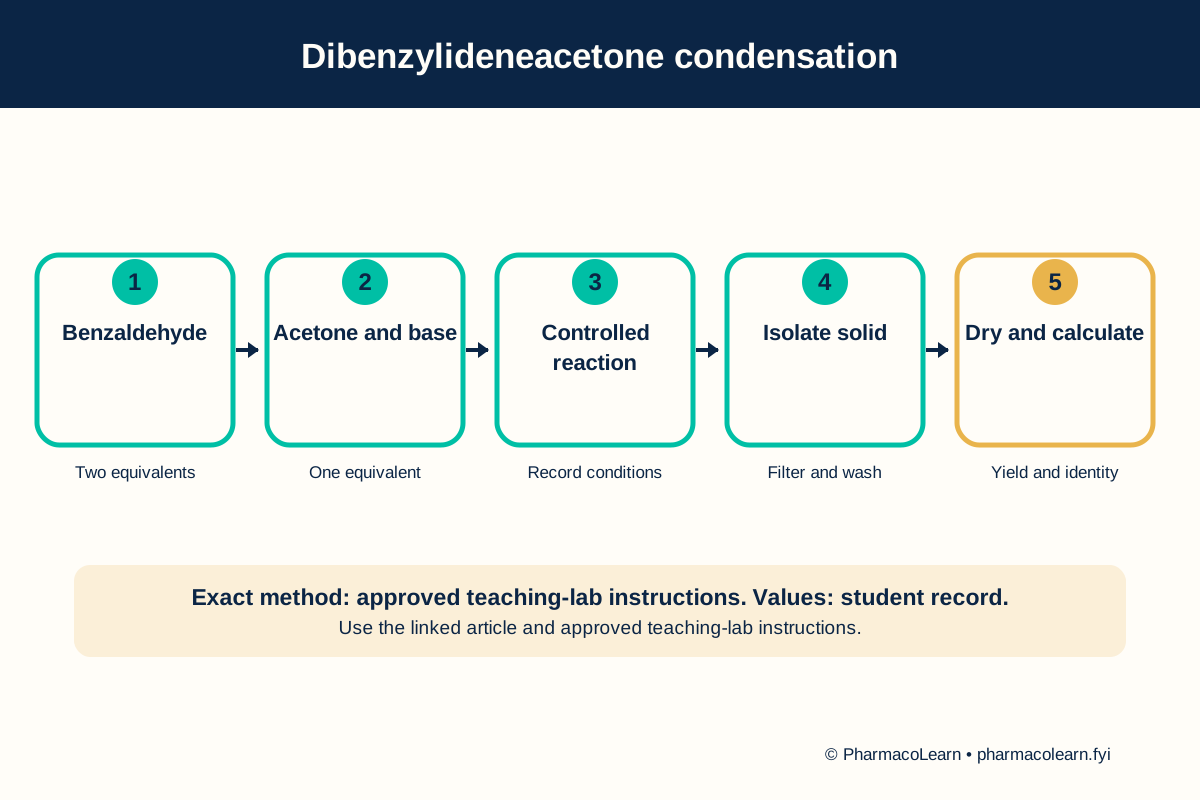
- Review the approved protocol and safety data with the instructor. Label the reaction vessel and waste containers; confirm that a hood and temperature-control method are available. [2]
- Record the actual benzaldehyde and acetone amounts and the base solution's identity. Exact quantities and concentration are to be recorded from the instructor-approved demonstration protocol or dataset in the student record. [2]
- Combine the reagents in the approved order while stirring and controlling heat. Record the start time, measured temperature, and appearance. The addition sequence and limits are to be recorded from the instructor-approved demonstration protocol or dataset in the student record. [2, 3]
- Continue the reaction for the authorized period, noting formation of any yellow solid. An observed color alone is not a completion test. [2]
- Isolate the solid by the assigned filtration method, wash to remove soluble residue, and recrystallize only if the local instructions call for it. [2]
- Dry the product to the specified endpoint and measure its mass. Record appearance and any assigned melting-point result. [2]
- Calculate the limiting reagent, theoretical product mass, and percentage yield. Submit the record and dispose of all liquid and solid waste as directed. [2]
5. Calculation, graph, or images as appropriate
| Observation | Actual laboratory record |
|---|---|
| Benzaldehyde amount | Record here |
| Acetone amount | Record here |
| Base, solvent, time, temperature | Record here |
| Product appearance and dry mass | Record here |
| Purity check, if assigned | Record here |
Pre-assumed values for arithmetic only, not a reagent recipe: Suppose benzaldehyde is limiting at 1.00 g and acetone is in sufficient excess. Benzaldehyde has molar mass 106.12 g/mol and dibenzylideneacetone has molar mass 234.29 g/mol. Benzaldehyde amount = 1.00 ÷ 106.12 = 0.00942 mol. The 2:1 ratio gives 0.00471 mol theoretical product, or 0.00471 × 234.29 = 1.104 g. If a hypothetical dry mass is 0.75 g, percentage yield = 0.75 ÷ 1.104 × 100 = 67.9%, after rounding. Actual inputs and results must be recorded here. [4, 5]
6. Result
Report the isolated dry product mass, percentage yield, appearance, and any assigned characterization. No actual sample data are supplied here; the experimental result must be recorded here. Safety note: Acetone and organic solvent vapors are flammable, and base can irritate or burn skin and eyes. This is a supervised teaching-lab procedure using a hood and controlled heating, without an open flame. [2, 3]
7. References
- Pharmacy Council of India. Pharm.D. Regulations, 2008, Pharmaceutical Organic Chemistry practical list.
- Tata Institute of Fundamental Research, Homi Bhabha Centre for Science Education. Synthesis of Dibenzalacetone.
- East Point College of Pharmacy. Pharmaceutical Organic Chemistry Practical Manual, Experiment 6.
- National Library of Medicine, PubChem. Benzaldehyde.
- National Library of Medicine, PubChem. Dibenzalacetone.
Back to Pharmaceutical Organic Chemistry practicals | Pharm.D. Year 1 Practicals · All Pharm D Practicals · Pharm D
Theory notes: Pharmaceutical Organic Chemistry