
← Pharmaceutical Organic Chemistry practicals | Pharm.D. Year 1 Practicals
Nitration of Salicylic Acid
1. Aim
To study nitration of salicylic acid, record the assigned product identity, and calculate a conditional yield if a verified mono-nitrated product dataset is provided. This is PCI Pharmaceutical Organic Chemistry synthesis item I.11. The PCI line does not name an isomer, and the selected method and product must follow your college lab manual and instructor's method sheet. [1, 2]
2. Requirements
For an approved instructor demonstration: salicylic acid, the institution's selected nitrating system, cooled reaction vessel, thermometer, stirring equipment, hood, suitable gloves, coat, eye and face protection, work-up equipment, and segregated hazardous-waste containers. A verified dataset or instructor-prepared sample can support the exercise without student nitration. Reagent identity, concentration, quantity, temperature, reaction time, quench, purification, and product-isomer test are to be recorded from the instructor-approved demonstration protocol or dataset in the student record from the approved method and risk assessment. [2, 3]
3. Theory
Nitration replaces a ring hydrogen of salicylic acid with a nitro group through electrophilic aromatic substitution. The hydroxyl and carboxyl groups influence substitution, and more than one positional product may be possible under different conditions. Therefore, “nitrated salicylic acid” is a reaction class, while a named isomer requires actual identity evidence. Some university curricula describe 5-nitrosalicylic acid as a product of a particular nitration route, but that does not prove that every local experiment yields the same isomer. [2, 3, 4]
An ideal mono-nitration converts one mole of salicylic acid into one mole of a mono-nitrated product. Percentage yield is meaningful only if the actual starting amount, limiting reagent, dry product mass, and assigned isomer identity are confirmed. Strong nitrating mixtures can release heat and hazardous fumes. [2, 3]
4. Procedure
- Confirm the institution's route and intended product with the instructor. If no approved risk assessment is available, use a supplied dataset or sample record. [1, 2]
- Record the salicylic acid amount and nitrating reagent identity from the authorized record. Exact acid concentrations and quantities are to be recorded from the instructor-approved demonstration protocol or dataset in the student record. [2]
- For an instructor demonstration, observe the controlled addition and cooling from the designated safe position. Document the measured temperature trend and appearance without adjusting the reaction yourself. [2]
- Record the approved quench and isolation steps from the laboratory log. Quench order and temperature limits are to be recorded from the instructor-approved demonstration protocol or dataset in the student record. [2]
- If a solid is supplied, document its source, dry mass, appearance, and label separately from your own measurements. [2]
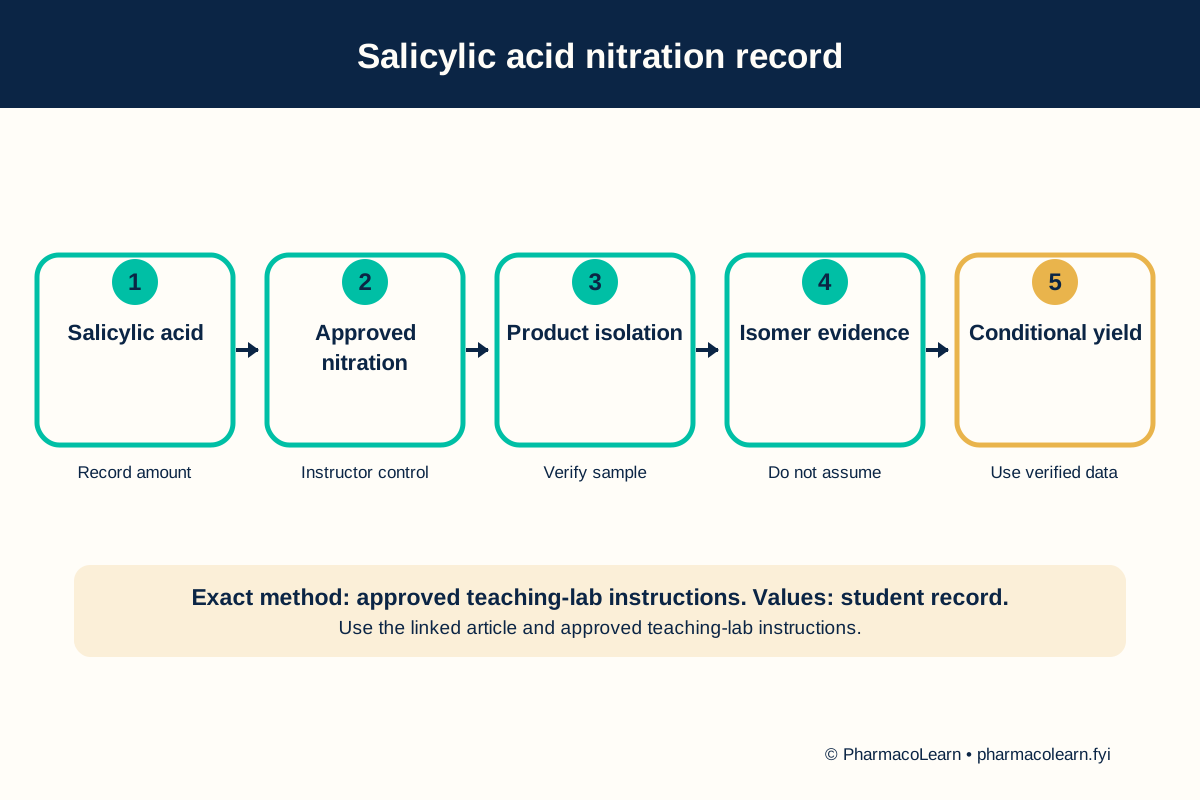
- Review the assigned melting-point, chromatography, or other isomer identification evidence. Do not label an isomer from colour alone. [3, 4]
- Calculate a conditional yield only when the starting material, product formula, and dry isolated mass are verified. [4]
5. Calculation, graph, or images as appropriate
| Observation | Actual demonstration or dataset record |
|---|---|
| Salicylic acid amount | Record here |
| Nitrating system and safety controls | Record here |
| Isolated product and dry mass | Record here |
| Product isomer evidence | Record here |
Pre-assumed values for a paper calculation only, not a procedure: Assume 0.500 g salicylic acid is limiting, the identified product is a mono-nitrated salicylic acid with molar mass 183.12 g/mol, and its hypothetical dry mass is 0.400 g. Salicylic acid amount = 0.500 ÷ 138.12 = 0.00362 mol. Theoretical mono-nitrated product mass from the unrounded mole value = 0.663 g. Percentage yield from the unrounded theoretical mass = 60.3%, after rounding. This arithmetic does not identify the positional isomer or prescribe a nitration. [4, 5]
6. Result
Report the verified product identity, dry mass, and conditional yield, or state that identification is incomplete. The actual result must be recorded here. Safety note: Nitrating reagents and heat release require a qualified instructor, hood, temperature control, protective equipment, and an approved quench and waste plan. This article is not an operational recipe. [2, 3]
7. References
- Pharmacy Council of India. Pharm.D. Regulations, 2008, Pharmaceutical Organic Chemistry practical list.
- GSFC University. Chemical Engineering Course Curriculum, practicals on nitration of salicylic acid.
- Sri Venkateswara College. Green Routes to Nitration of Arenes: An Enquiry.
- National Library of Medicine, PubChem. 5-Nitrosalicylic Acid.
- National Library of Medicine, PubChem. Salicylic Acid.
Back to Pharmaceutical Organic Chemistry practicals | Pharm.D. Year 1 Practicals · All Pharm D Practicals · Pharm D
Theory notes: Pharmaceutical Organic Chemistry