
← Pharmaceutical Organic Chemistry practicals | Pharm.D. Year 1 Practicals
Preparation of Benzophenone Oxime
1. Aim
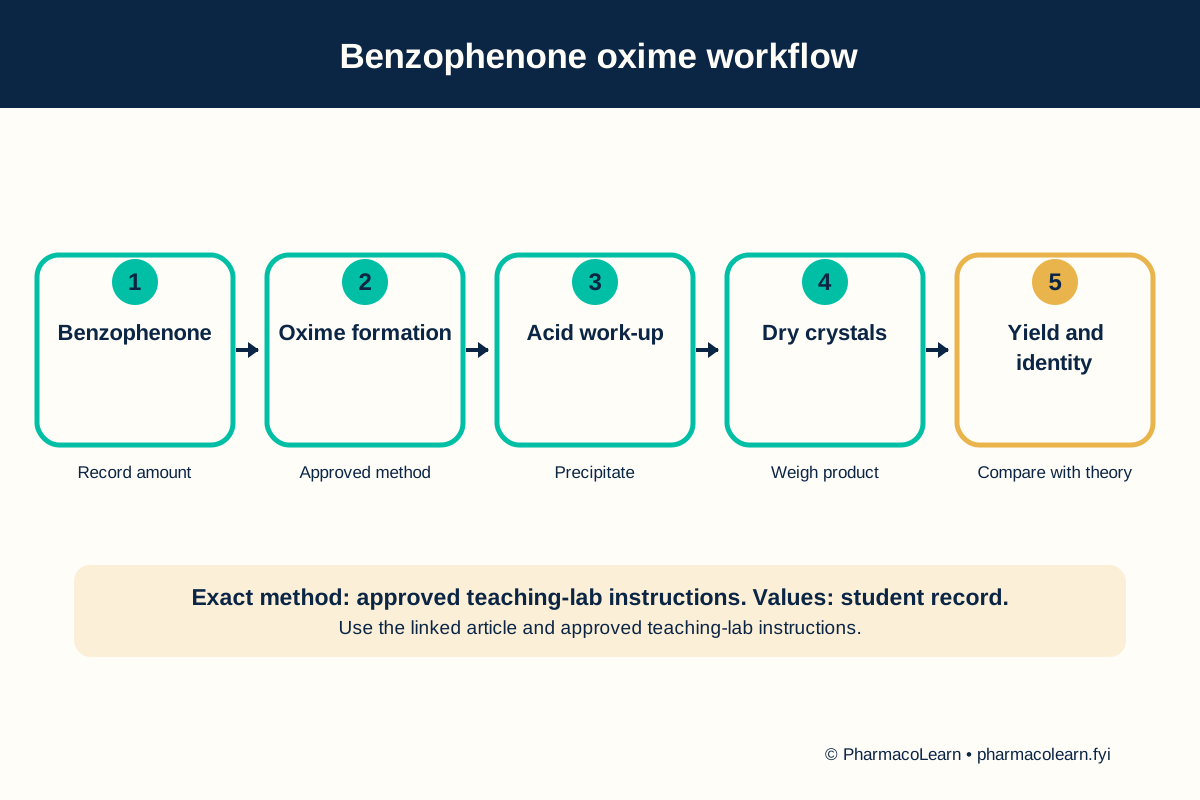
To prepare benzophenone oxime from benzophenone, isolate the product, and calculate its percentage yield. This is PCI Pharmaceutical Organic Chemistry synthesis item I.10. The exact institutional procedure and product acceptance criteria are to be recorded from the instructor-approved demonstration protocol or dataset in the student record. [1, 2]
2. Requirements
Benzophenone, hydroxylamine hydrochloride, the approved base and acid work-up, suitable solvent and water, a reflux flask and condenser if the local method uses them, controlled heat, cooling bath, filtration and drying equipment, balance, protective coat, eye protection, suitable gloves, fume hood, and labelled waste containers are required. The local solvent, reagent concentrations and volumes, heating time, cooling and precipitation conditions, and purification steps are to be recorded from the instructor-approved demonstration protocol or dataset in the student record. [2]
3. Theory
An oxime forms when a ketone reacts with hydroxylamine. In this experiment, the carbonyl group of benzophenone is converted into an oxime group. Hydroxylamine hydrochloride is a salt; the approved base liberates the reactive hydroxylamine species. One mole of benzophenone can give one mole of benzophenone oxime in the idealized mass calculation. [2, 3]
The East Point manual uses heating and an acid work-up to obtain crystals, but its exact sequence must be checked against the institution's current safety instructions. Dry mass is needed for yield. Melting behaviour or another assigned test can support identity, although no single observation proves complete purity. The article does not cover a Beckmann rearrangement; that is a different reaction mentioned for context in the teaching manual. [2]
4. Procedure
- Confirm the approved recipe and risk controls with the instructor. Check the hood, condenser, heat source, protective equipment, and separate waste containers. [2]
- Label the flask and record benzophenone and hydroxylamine hydrochloride amounts. Record base and solvent identities; exact quantities are to be recorded from the instructor-approved demonstration protocol or dataset in the student record. [2]
- Combine and heat the reagents in the approved order. Monitor the specified temperature or reflux and note appearance changes. Reaction duration is to be recorded from the instructor-approved demonstration protocol or dataset in the student record. [2]
- Cool the mixture and carry out the instructed acid work-up to precipitate the oxime. Acid identity, concentration, addition rate, and endpoint are to be recorded from the instructor-approved demonstration protocol or dataset in the student record. [2]
- Filter the solid, wash it as directed, and dry it to the method's endpoint. Do not weigh a wet cake as final product. [2]
- Record mass, appearance, and any assigned identity or purity result. [2]
- Determine the limiting reagent and calculate theoretical and percentage yield; submit the observations and waste record. [2]
5. Calculation, graph, or images as appropriate
| Observation | Actual laboratory record |
|---|---|
| Benzophenone and hydroxylamine salt amounts | Record here |
| Base, solvent, heat, and work-up | Record here |
| Product appearance and dry mass | Record here |
| Identity or purity check | Record here |
Pre-assumed values for arithmetic only, not a reagent instruction: Assume 1.00 g benzophenone is limiting and 0.750 g dry oxime is isolated. Benzophenone has molar mass 182.22 g/mol; benzophenone oxime has molar mass 197.23 g/mol. Starting amount = 1.00 ÷ 182.22 = 0.00549 mol. Theoretical oxime mass = 0.00549 × 197.23 = 1.08 g. Percentage yield = 0.750 ÷ 1.08 × 100 = 69.3%, after rounding. These figures are illustrative, not observed values. [3, 4]
6. Result
Report actual dry mass, percentage yield, appearance, and the assigned identity evidence. With no experimental data supplied, the result must be recorded here. Safety note: Hydroxylamine salts, base, acid, hot equipment, and solvent require supervised teaching-lab handling in a hood with appropriate protective equipment. Follow the local hazardous-waste route and do not use the product outside the lab. [2]
7. References
- Pharmacy Council of India. Pharm.D. Regulations, 2008, Pharmaceutical Organic Chemistry practical list.
- East Point College of Pharmacy. Pharmaceutical Organic Chemistry Practical Manual, Experiment 5.
- National Library of Medicine, PubChem. Benzophenone.
- National Library of Medicine, PubChem. Benzophenone Oxime.
Back to Pharmaceutical Organic Chemistry practicals | Pharm.D. Year 1 Practicals · All Pharm D Practicals · Pharm D
Theory notes: Pharmaceutical Organic Chemistry