
← Pharmaceutical Organic Chemistry practicals | Pharm.D. Year 1 Practicals
Preparation of Picric Acid: Document-Based Safety Study
1. Aim
To study PCI Pharmaceutical Organic Chemistry synthesis item I.12, “Preparation of picric acid,” through a supervised documentary exercise that identifies the product, explains why a dry product should not be prepared in a routine student session, and records a safe teaching decision. No synthesis is performed from this article. [1, 2]
2. Requirements
The PCI practical list, the NIOSH picric acid hazard record, the institution's chemical-hygiene and emergency procedures, a deidentified instructor-provided inventory or incident scenario, an observation sheet, and a supervisor are required. No picric acid, nitrating chemicals, reaction glassware, heating device, or drying equipment is issued for this exercise. If the institution separately authorizes a live demonstration, its specialist protocol, risk assessment, and storage controls must follow your college lab manual and instructor's method sheet outside this article. [1, 2]
3. Theory
Picric acid is 2,4,6-trinitrophenol. Its formation involves extensive nitration of phenol, but its hazards make preparation and isolation unsuitable for a general procedural note. NIOSH identifies it as an explosive material and warns that crystallization of an aqueous solution can create an explosive mixture, especially where residues contact incompatible materials. Drying, scraping, opening a suspect container, or disturbing crystals can be dangerous. [2]
This exercise uses the syllabus item to teach hazard recognition and documentation. A chemical name, a visible yellow solid, or an old container label does not establish that a sample can be handled safely. The correct teaching outcome is a documented hold and referral to trained chemical-safety staff whenever container condition or moisture status is uncertain. [2]
4. Procedure
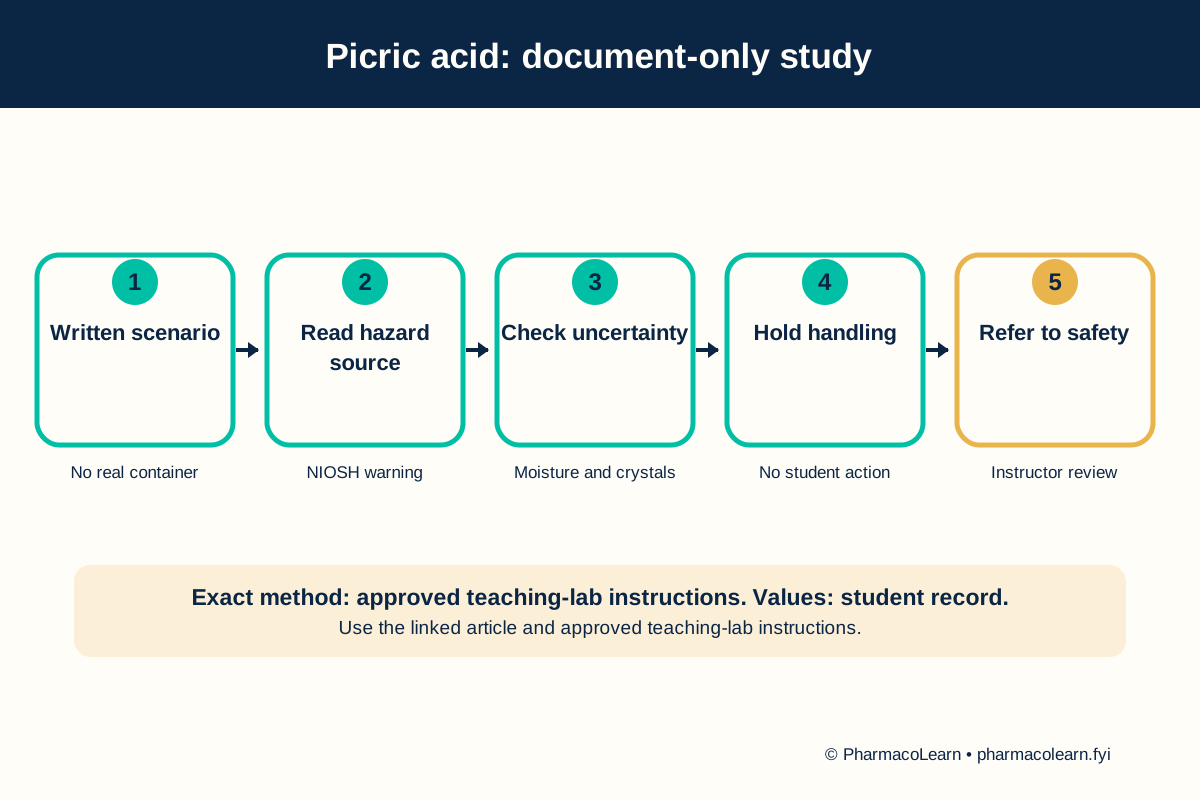
- Read the PCI item and the NIOSH picric acid entry with the instructor. Identify the product name and the major incompatibility and crystallization warnings. [1, 2]
- Receive a written, deidentified scenario only. Do not inspect, open, move, weigh, or photograph a real suspect container. [2]
- Record the scenario's stated container label, storage history, moisture status, visible residue description, and date, leaving any missing field blank in the student record. [2]
- Compare the documented conditions with the NIOSH warnings. Flag uncertainty about dryness, crystals, metal contact, or container integrity. [2]
- State the immediate teaching decision: hold all handling and refer the record to the instructor and institution's chemical-safety team. Do not suggest a student repair or disposal method. [2]
- Record what additional documentation the specialists would need. The institution's response procedure and staff contacts must follow your college lab manual and instructor's method sheet. [2]
- Submit the completed hazard observation and decision record for instructor review. [2]
5. Calculation, graph, or images as appropriate
| Document-only observation | Scenario record |
|---|---|
| Container or scenario identifier | Record here |
| Moisture and residue status | Record here |
| Incompatible-contact concern | Record here |
| Decision and specialist referral | Record here |
No yield calculation is appropriate because no synthesis or product isolation occurs. A mass calculation here would imply an operational preparation that this note does not support. The accompanying diagram is a decision flow for a written scenario, not a handling protocol. [2]
6. Result
The result is a completed written hazard assessment and referral decision; there is no prepared product or percentage yield. The scenario-specific finding must be recorded here. Safety note: Never handle a suspected dry or crystallized picric acid container as a student exercise. Refer it to qualified institutional safety personnel under the local emergency procedure. [2]
7. References
- Pharmacy Council of India. Pharm.D. Regulations, 2008, Pharmaceutical Organic Chemistry practical list.
- Centers for Disease Control and Prevention, NIOSH. Pocket Guide to Chemical Hazards: Picric Acid.
Back to Pharmaceutical Organic Chemistry practicals | Pharm.D. Year 1 Practicals · All Pharm D Practicals · Pharm D
Theory notes: Pharmaceutical Organic Chemistry