
← Pharmaceutical Organic Chemistry practicals | Pharm.D. Year 1 Practicals
Preparation of Salicylic Acid by Ester Hydrolysis
1. Aim
To prepare salicylic acid by hydrolysing methyl salicylate, isolate the acid, and calculate percentage yield. This covers the salicylic acid option in PCI Pharmaceutical Organic Chemistry item I.6, “Benzoic acid / salicylic acid (Hydrolysis of ester).” The selected option for a class is to be recorded from the instructor-approved demonstration protocol or dataset in the student record. [1, 2]
2. Requirements
Methyl salicylate, an instructor-approved aqueous alkali, an acid for work-up, water, a reaction flask with reflux condenser, controlled heat source, thermometer, pH indicator or meter, cooling bath, filtration and drying equipment, balance, protective coat, gloves, eye protection, and labelled waste containers are needed. Exact reagent identity, concentration, volume, reflux time, acidification endpoint, wash, and drying conditions are to be recorded from the instructor-approved demonstration protocol or dataset in the student record. [2]
3. Theory
Methyl salicylate is an ester. Alkaline hydrolysis breaks its ester linkage, giving a soluble salicylate salt and methanol. Acidification converts the salicylate salt into salicylic acid, which can crystallize on cooling. The process is often called saponification followed by acid work-up. One mole of methyl salicylate can give one mole of salicylic acid if the reaction and isolation are complete. [2]
The initial ester amount and the final dry mass establish a theoretical and observed yield. Before calculating percentage yield, verify that the ester was limiting and that the product is dry. pH, precipitation, and melting behaviour can support process monitoring but are not a substitute for the assigned identity and purity check. [2, 3, 4]
4. Procedure
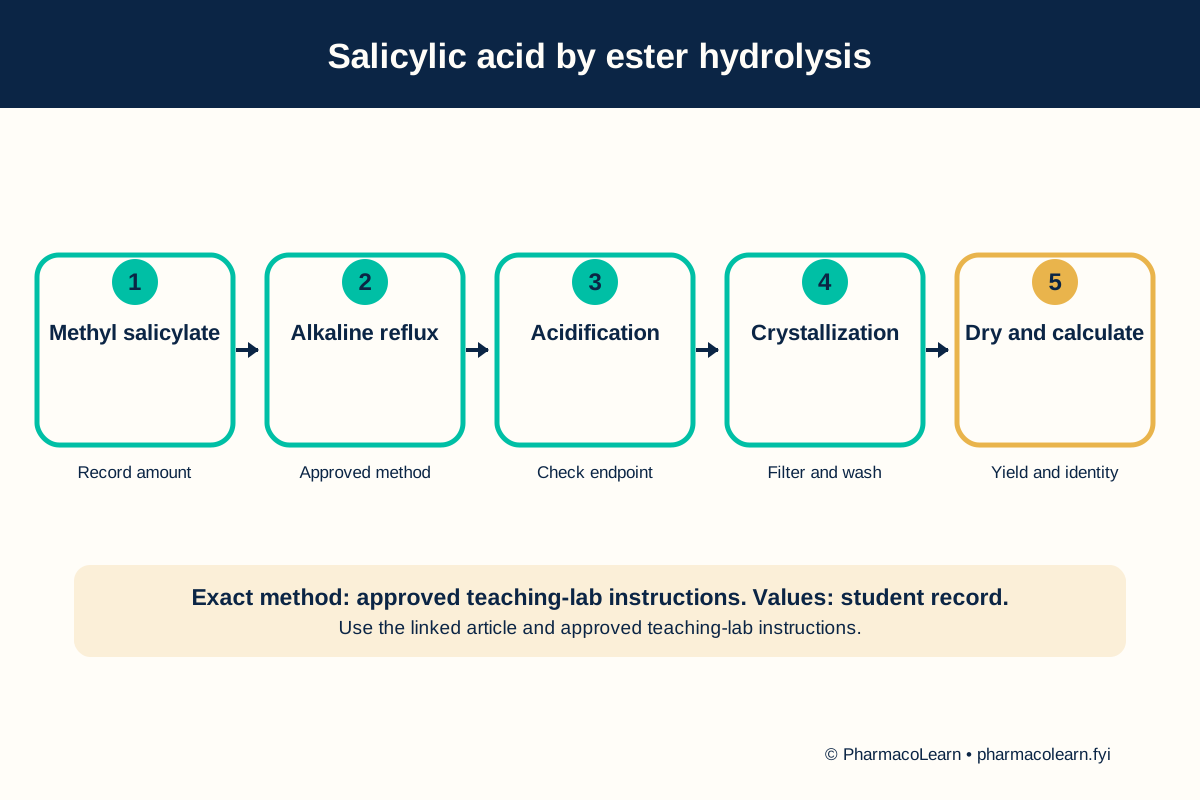
- Confirm the PCI option and the approved recipe with the instructor. Review the hazards of the ester, alkali, acid, hot liquid, and methanol-containing waste. [1, 2]
- Record the actual methyl salicylate and alkali quantities. Assemble the reflux apparatus using the approved heat source and check the condenser before heating. [2]
- Heat the mixture for the specified time while maintaining safe reflux. The concentration, temperature, and duration are to be recorded from the instructor-approved demonstration protocol or dataset in the student record. [2]
- Let the mixture cool, then apply the authorized acidification sequence under supervision. Record the pH endpoint and any salicylic acid precipitation. The endpoint is to be recorded from the instructor-approved demonstration protocol or dataset in the student record. [2]
- Cool as directed to complete crystallization. Collect the solid by the approved filtration method and wash it with the assigned liquid. [2]
- Dry to the specified criterion, weigh the product, and document its appearance and any assigned identity check. [2]
- Determine the limiting reagent from actual records and calculate theoretical mass and percentage yield. Dispose of acidic, alkaline, and organic wastes in assigned containers. [2]
5. Calculation, graph, or images as appropriate
| Observation | Actual laboratory record |
|---|---|
| Methyl salicylate mass or amount | Record here |
| Alkali, acid, and heating conditions | Record here |
| Acidification endpoint and crystals | Record here |
| Dry salicylic acid mass | Record here |
| Identity or purity observation | Record here |
Pre-assumed values for arithmetic only, not a procedure: Assume methyl salicylate is limiting at 1.00 g and the hypothetical dry salicylic acid mass is 0.700 g. With molar masses 152.15 g/mol and 138.12 g/mol respectively, ester amount = 1.00 ÷ 152.15 = 0.00657 mol. The 1:1 theoretical acid mass = 0.00657 × 138.12 = 0.908 g. Percentage yield = 0.700 ÷ 0.908 × 100 = 77.1%, after rounding. These figures are not measured data or reagent quantities for the lab. [3, 4]
6. Result
Report actual isolated dry mass, calculated yield, and the required characterization. Record the actual experimental result here. Safety note: Carry out heating and acidification only under teaching-lab supervision with a fume hood and suitable protective equipment. Alkali and acid can burn, hot glassware can injure, and methanol-containing waste is hazardous. The laboratory product is not for medicinal use. [2]
7. References
- Pharmacy Council of India. Pharm.D. Regulations, 2008, Pharmaceutical Organic Chemistry practical list.
- MiraCosta College. Chemistry 211 Experiment 3: Hydrolysis of Methyl Salicylate and Synthesis of Acetylsalicylic Acid.
- National Library of Medicine, PubChem. Methyl Salicylate.
- National Library of Medicine, PubChem. Salicylic Acid.
Back to Pharmaceutical Organic Chemistry practicals | Pharm.D. Year 1 Practicals · All Pharm D Practicals · Pharm D
Theory notes: Pharmaceutical Organic Chemistry