
← Pharmaceutical Organic Chemistry practicals | Pharm.D. Year 1 Practicals
Preparation of meta-Dinitrobenzene by Nitration
1. Aim
To study the supervised nitration of nitrobenzene to meta-dinitrobenzene, record isolation observations, and calculate a conditional yield. This is PCI Pharmaceutical Organic Chemistry synthesis item I.7, “M-dinitro benzene (Nitration).” Because the reaction involves strongly corrosive acids and toxic nitrobenzene, the institution may supply an instructor-generated dataset in place of student handling. Exact local conditions must follow your college lab manual and instructor's method sheet. [1, 2]
2. Requirements
For an approved instructor-run demonstration: nitrobenzene, the institution's specified nitrating mixture, cooled reaction equipment, thermometer, controlled stirring, quench and isolation equipment, balance, drying setup, fume hood, appropriate chemical-resistant gloves, coat, face and eye protection, and designated hazardous-waste containers. For a dataset exercise: a verified record of starting and dry product masses. Acid identities, concentrations, volumes, temperatures, addition rate, work-up, and exposure controls are to be recorded from the instructor-approved demonstration protocol or dataset in the student record from the approved risk assessment; none is supplied here as a recipe. [2, 3]
3. Theory
Nitrobenzene already contains one strongly electron-withdrawing nitro group. In electrophilic aromatic substitution, that group deactivates the ring and favours further substitution at the meta position. Nitration can therefore form 1,3-dinitrobenzene as the major intended isomer. The reaction is exothermic, and a product sample may contain other isomers or impurities. Appearance and mass do not establish isomer identity. [2, 4]
For theoretical yield, one mole of nitrobenzene can form one mole of dinitrobenzene if the other reagents are adequate. The mass calculation is an arithmetic exercise until actual starting amount, limiting reagent, and dry isolated mass are documented. [4, 5]
4. Procedure
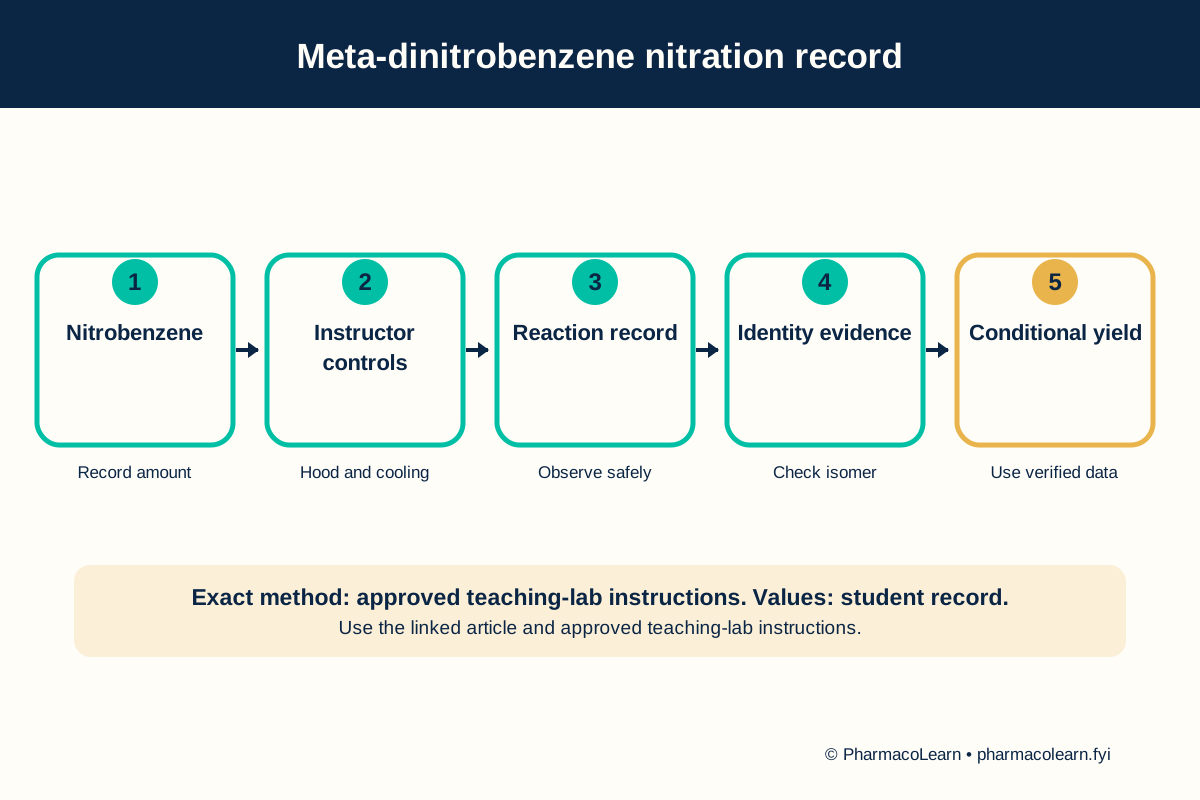
- Confirm the approved demonstration or dataset route with the instructor. Review acid, nitrobenzene, product, exposure, spill, and waste hazards before the session. [2, 3]
- If a demonstration is authorized, record the actual nitrobenzene amount, nitrating reagent identity, cooling method, and risk-control checks. All concentrations and volumes are to be recorded from the instructor-approved demonstration protocol or dataset in the student record. [2]
- Observe the instructor-controlled reaction from the designated safe position. Record addition order, temperature trend, and appearance from the verified lab record, without improvising adjustments. [2]
- After the instructor confirms completion, follow or review the approved quench and isolation record. Quench chemistry and thermal limits are to be recorded from the instructor-approved demonstration protocol or dataset in the student record. [2]
- Record the collected solid's appearance, wash, drying endpoint, and mass, or transcribe the supplied dataset with its source label. [2]
- Check any assigned melting-point or other isomer identification evidence. A yellow solid alone is not sufficient confirmation. [2, 4]
- Determine the limiting reagent and calculate theoretical mass and percentage yield only from verified or explicitly pre-assumed values. [4, 5]
5. Calculation, graph, or images as appropriate
| Observation | Actual demonstration or dataset record |
|---|---|
| Nitrobenzene amount | Record here |
| Nitrating method and controls | Record here |
| Temperature and product appearance | Record here |
| Dry product mass | Record here |
| Isomer identity evidence | Record here |
Pre-assumed values for a paper calculation only: Assume nitrobenzene is limiting at 0.500 g and a hypothetical dry product mass is 0.400 g. Using molar masses of 123.11 g/mol for nitrobenzene and 168.11 g/mol for 1,3-dinitrobenzene, starting amount = 0.500 ÷ 123.11 = 0.00406 mol. Theoretical product mass = 0.00406 × 168.11 = 0.683 g. Percentage yield = 0.400 ÷ 0.683 × 100 = 58.6%. This calculation does not prescribe a reaction scale and does not prove product identity. [4, 5]
6. Result
Report actual or supplied dry mass, yield, and identity evidence with its data source. The experimental result must be recorded here. Safety note: Nitration mixtures can react violently if mishandled; nitrobenzene can be absorbed through skin. Qualified teaching-lab supervision, a hood, controlled cooling, suitable protective equipment, and a documented waste plan are essential. Do not attempt this procedure from the article alone. [2, 3]
7. References
- Pharmacy Council of India. Pharm.D. Regulations, 2008, Pharmaceutical Organic Chemistry practical list.
- Kurukshetra University. Chemistry Practical II, course CHEM204, m-dinitrobenzene from nitrobenzene.
- Centers for Disease Control and Prevention, NIOSH. Pocket Guide to Chemical Hazards: Nitrobenzene.
- National Library of Medicine, PubChem. 1,3-Dinitrobenzene.
- National Library of Medicine, PubChem. Nitrobenzene.
Back to Pharmaceutical Organic Chemistry practicals | Pharm.D. Year 1 Practicals · All Pharm D Practicals · Pharm D
Theory notes: Pharmaceutical Organic Chemistry