
← Pharmaceutical Organic Chemistry practicals | Pharm.D. Year 1 Practicals
Preparation of 1-Phenylazo-2-naphthol by Diazotization and Coupling
1. Aim
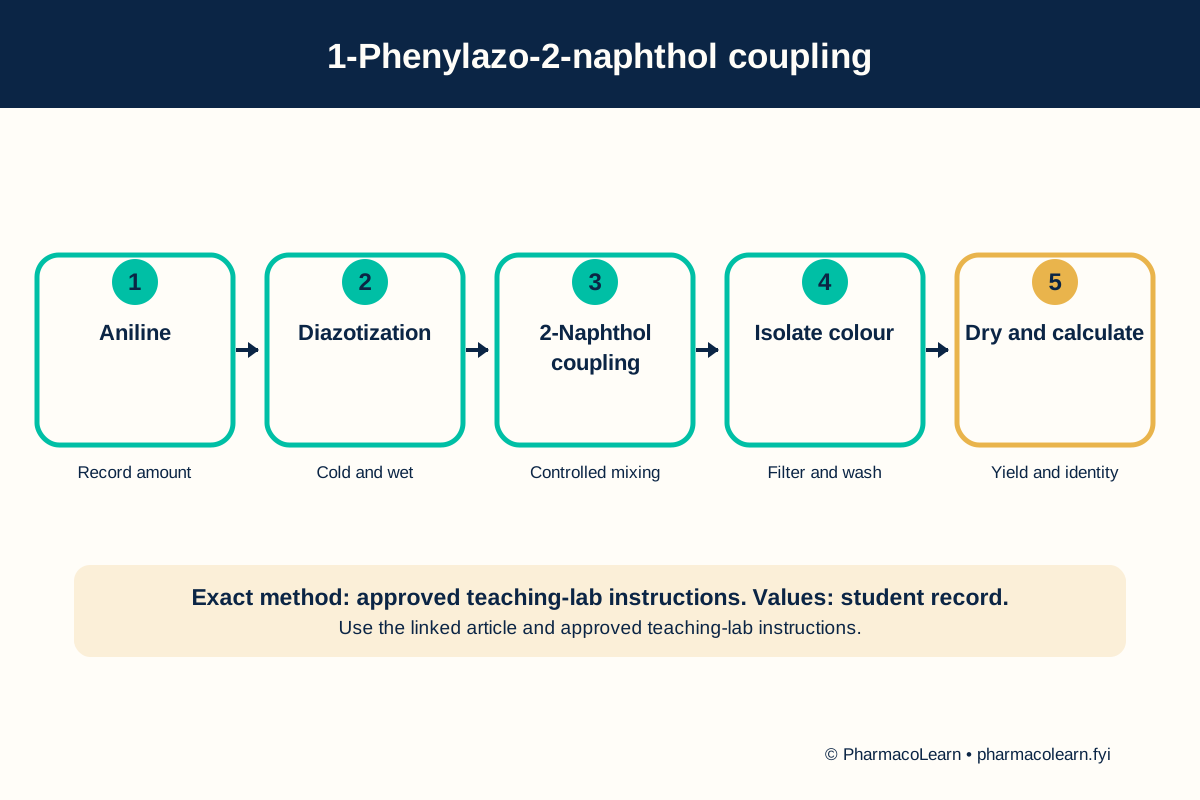
To prepare 1-phenylazo-2-naphthol from aniline through diazotization followed by coupling with 2-naphthol, then isolate the coloured product and calculate yield. This is PCI Pharmaceutical Organic Chemistry synthesis item I.5. The local reagents and conditions are to be recorded from the instructor-approved demonstration protocol or dataset in the student record. [1, 2]
2. Requirements
Aniline, sodium nitrite, an approved mineral acid, 2-naphthol, the specified alkaline coupling medium, water, ice, reaction vessels, thermometer, stirrer, filtration and drying equipment, balance, and segregated waste containers are needed. Use a fume hood, coat, gloves suitable for the reagents, and eye protection. The acid and base identity, concentrations, quantities, cooling range, addition rate, and purification method are to be recorded from the instructor-approved demonstration protocol or dataset in the student record. [2, 3]
3. Theory
In acid, nitrite generates the diazotizing species that converts aniline into a diazonium intermediate. The intermediate is made and used under controlled, cold conditions because its stability depends on the environment. It couples with activated 2-naphthol to form an azo dye with an extended conjugated system and an orange-red appearance. The intended product has one phenylazo unit from one aniline molecule and one naphthol unit. Colour is useful as an observation, but colour alone does not establish identity or purity. [2, 3]
The theoretical yield can be calculated from the limiting one-to-one starting component. Actual yield requires a dry isolated mass, and any characterization method must be the one approved for the class. [2]
4. Procedure
- Read the approved method and safety data with the instructor. Set up a hood, cold bath, labelled vessels, and the specified waste containers. [2]
- Record the actual aniline, sodium nitrite, acid, and 2-naphthol quantities. Their concentrations and volumes are to be recorded from the instructor-approved demonstration protocol or dataset in the student record. [2]
- Prepare the aniline-containing acidic mixture and cool it as prescribed. Prepare nitrite solution separately; the sequence, temperature range, and rate of addition are to be recorded from the instructor-approved demonstration protocol or dataset in the student record. [2]
- Under supervision, form the diazonium intermediate at the specified temperature. Do not isolate or dry it; use it in the subsequent coupling stage as the approved method directs. [2, 3]
- Prepare the specified 2-naphthol coupling medium. Add the intermediate in the assigned order while stirring and maintaining the stated temperature and pH conditions. [2]
- Record colour and precipitate formation. Isolate, wash, and dry the coloured solid according to the approved method; capture all azo-containing waste separately. [2]
- Record dry mass and any assigned identity test. Determine the limiting reagent and calculate theoretical and percentage yield. [2]
5. Calculation, graph, or images as appropriate
| Observation | Actual laboratory record |
|---|---|
| Aniline and 2-naphthol amounts | Record here |
| Nitrite, acid, base, and cooling conditions | Record here |
| Colour and precipitate observations | Record here |
| Dry dye mass | Record here |
| Identity check, if assigned | Record here |
Pre-assumed values for calculation only: Suppose 0.500 g aniline is limiting, all other reagents are sufficient, and the hypothetical isolated dry dye mass is 0.900 g. Using aniline at 93.13 g/mol gives 0.500 ÷ 93.13 = 0.00537 mol. At one mole of dye per mole of aniline, theoretical 1-phenylazo-2-naphthol mass = 0.00537 × 248.28 g/mol = 1.33 g. Percentage yield = 0.900 ÷ 1.33 × 100 = 67.5%, after rounding. These are invented numbers for arithmetic, not observed values or reagent instructions. [4, 5]
6. Result
Record the actual dry product mass, colour, calculated yield, and identity evidence. The actual result must be recorded here until measured. Safety note: Aniline is toxic and can be absorbed through skin; acid and base can burn; diazonium mixtures require the approved cold, wet, supervised handling. Do not isolate or dry the intermediate. This is a teaching-lab activity, and the product is not for cosmetic or consumer use. [2, 3]
7. References
- Pharmacy Council of India. Pharm.D. Regulations, 2008, Pharmaceutical Organic Chemistry practical list.
- East Point College of Pharmacy. Pharmaceutical Organic Chemistry Practical Manual, Experiment 4.
- East Point College of Pharmacy. Organic Chemistry II Lab Manual, diazotization and coupling exercise.
- National Library of Medicine, PubChem. Aniline.
- National Library of Medicine, PubChem. 1-(Phenylazo)-2-naphthol.
Back to Pharmaceutical Organic Chemistry practicals | Pharm.D. Year 1 Practicals · All Pharm D Practicals · Pharm D
Theory notes: Pharmaceutical Organic Chemistry