
← Pharmaceutical Organic Chemistry practicals | Pharm.D. Year 1 Practicals
Systematic Qualitative Analysis of Nitrocompounds
1. Aim
To evaluate a coded organic sample or verified analytical record for a nitro group using controlled screening and independent confirmation. Nitrocompounds are the last named class in PCI Pharmaceutical Organic Chemistry practical section II. The sample identity, chosen tests, and acceptance criteria must be recorded here. [1, 2]
2. Requirements
Use a coded sample or instructor-provided dataset, a known nitrocompound control, a non-nitro negative control, a blank, recorded solubility and elemental observations, approved instrumental or supervised reduction-test data, clean labelled vessels, coat, gloves, eye protection, hood, and segregated waste containers. Exact reagent identities, concentrations, quantities, temperatures, reaction times, and derivative methods must be specified in your college lab manual and instructor's method sheet. This article supplies no reduction or Tollens-reagent recipe. [2, 3]
3. Theory
Nitrocompounds contain a nitro group bonded to carbon. The group may occur in aromatic or aliphatic compounds, and a physical appearance cannot establish it. Some qualitative schemes reduce an aromatic nitro group to an amine and then test the new amine. The East Point manual lists such reactions, but also includes hazardous silver-reagent and acid steps. For a general student note, a supervised result record or validated instrumental comparison is a safer confirmation route. [2, 3]
A neutral, water-insoluble, nitrogen-containing sample can be consistent with a nitrocompound, an anilide, or another class. Therefore, a solubility group is only a branch in an identification scheme. Controls, chemical identity evidence, and contradictory observations must be reviewed together. A negative test may reflect failed reagent, poor sample solubility, or a compound outside the test's scope. [2, 3]
4. Procedure
- Record sample or dataset identifier, physical state, and any hazard information from the instructor. Never taste or smell a sample. [2]
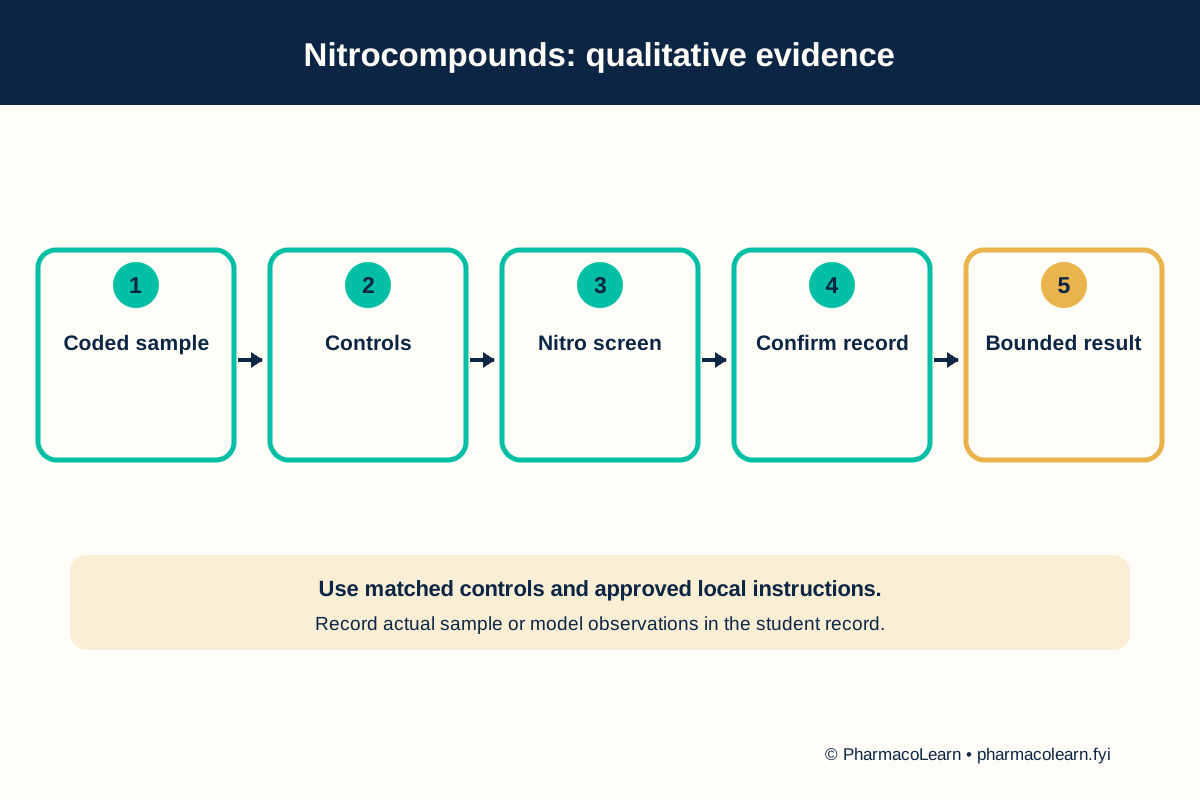
- Check that the known nitro and non-nitro controls and blank are documented. Missing controls must be recorded here. [2, 3]
- Record permitted solubility and elemental-analysis observations without claiming nitro identity from nitrogen alone. [2]
- Review the instructor-approved nitro-group screening result, its reagent validity, and the control responses. The local method must be specified in your college lab manual and instructor's method sheet. [2]
- Review an independent reduction-product, chromatographic, or spectral confirmation record. Do not perform a reduction from this article. [2, 3]
- Compare the unknown against both controls and document any conflicting results or possible alternative class, especially anilides. [2]
- State the supported conclusion or an inconclusive result and submit the hazardous-waste record if a supervised test was used. [2]
5. Calculation, graph, or images as appropriate
| Evidence item | Actual teaching record |
|---|---|
| Unknown and controls | Record here |
| Solubility and nitrogen evidence | Record here |
| Nitro-group screen and blank | Record here |
| Independent confirmation | Record here |
| Final classification | Record here |
Pre-assumed observations for interpretation only: Suppose the known nitro control gives the expected response, the negative control and blank do not, and a coded unknown matches the nitro control. If an independent instrument record also matches a nitro reference, the evidence supports a nitrocompound class. No compound name follows from this alone. No numerical calculation is required; actual observations must be recorded here. [2, 3]
6. Result
Report a nitrocompound classification only when controls and independent confirmation agree. Otherwise list the unresolved observations. The real result must be recorded here. Safety note: Some nitrocompounds are toxic and can be absorbed through skin. Silver residues and strong acid reductions introduce additional hazards. Use only instructor-approved methods in a teaching lab and keep all waste in the assigned containers. [2, 3]
7. References
- Pharmacy Council of India. Pharm.D. Regulations, 2008, Pharmaceutical Organic Chemistry practical section II.
- East Point College of Pharmacy. Pharmaceutical Organic Chemistry Practical Manual, functional group analysis group VII.
- University of Massachusetts Amherst. Qualitative Organic Analysis.
Back to Pharmaceutical Organic Chemistry practicals | Pharm.D. Year 1 Practicals · All Pharm D Practicals · Pharm D
Theory notes: Pharmaceutical Organic Chemistry