
← Pharmaceutical Organic Chemistry practicals | Pharm.D. Year 1 Practicals
Stereo Model Study: Methane
1. Aim
To use a stereo model to recognize the tetrahedral arrangement around carbon in methane. Methane is the first named topic in PCI Pharmaceutical Organic Chemistry practical section III. The actual model-kit pieces and assessment record must be recorded here. [1]
2. Requirements
Instructor-approved molecular model kit or a physical preassembled model, a turntable or clear viewing space, observation sheet, the PCI list, protective equipment required by the teaching room, and a supervisor. No reaction chemicals are required. Model scale, colour key, permitted handling, and assessment criteria must be recorded here. [2]
3. Theory
Methane has one central carbon bonded to four hydrogens. Four bonding directions spread in three dimensions rather than lying in one plane, producing a tetrahedral geometry. The ideal bond angle is about 109.5 degrees. A flat drawing can conceal which connections point toward or away from the viewer, whereas a model can be rotated to inspect all four directions. Because the four hydrogen substituents are identical, methane has no stereogenic carbon and no distinct mirror-image configuration. The model teaches geometry, not a chemical reaction or a measured bond angle. [2]
4. Procedure
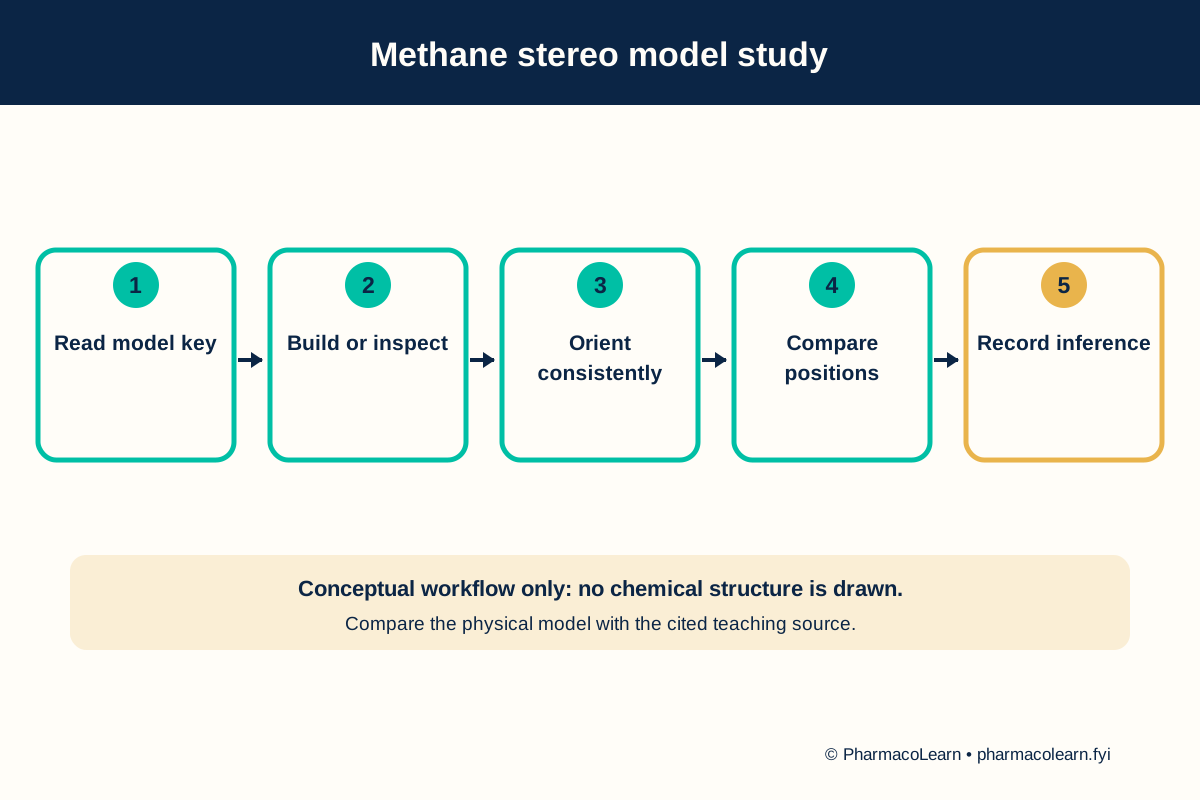
- Read the model-kit legend and identify the piece representing a four-direction carbon centre.
- Assemble or inspect the instructor-approved methane model with four identical terminal pieces.
- Rotate the model slowly and note whether all four directions can occupy a single plane.
- Compare the arrangement with the ideal tetrahedral reference in the cited teaching source.
- Check that exchanging two identical terminal pieces does not create a distinct chemical identity.
- Record the geometry and whether the model or a photograph was instructor supplied.
- Return all pieces to the kit and submit the observation record for review.
5. Calculation, graph, or images as appropriate
| Model observation | Actual teaching record |
|---|---|
| Four equivalent terminal positions | Record here |
| Three-dimensional arrangement | Record here |
| Approximate ideal angle | Record here |
| Distinct mirror-image form | Record here |
Pre-assumed observations for explanation only: a correctly assembled model has four equivalent directions that cannot all lie in one plane. The expected geometry is tetrahedral, with an ideal angle near 109.5 degrees. Actual kit observations must be recorded here. This section records shape or orientation rather than a synthesis yield. No reagent-volume or product-mass calculation is required.
6. Result
Report the named geometry or stereochemical relationship only after comparing the actual model with the cited reference and the instructor's labels. The submitted model result must be recorded here. Safety note: This is a supervised physical-model exercise. Keep small model parts away from the mouth, check for damaged pieces, and use the room's ordinary laboratory rules.
7. References
- Pharmacy Council of India, Pharm.D. Regulations, 2008.
- OpenStax, Carbon and Molecular Geometry.
- Colorado State University, Molecular Shapes.
Back to Pharmaceutical Organic Chemistry practicals | Pharm.D. Year 1 Practicals · All Pharm D Practicals · Pharm D
Theory notes: Pharmaceutical Organic Chemistry