
← Pharmaceutical Organic Chemistry practicals | Pharm.D. Year 1 Practicals
Systematic Qualitative Analysis of Anilides
1. Aim
To examine a coded organic sample for evidence consistent with an anilide and document the limits of the classification. Anilides are named in PCI Pharmaceutical Organic Chemistry practical section II. The exact unknown, hydrolysis route, and derivative or spectral acceptance criteria must be recorded here. [1, 2]
2. Requirements
Use a coded sample or instructor-provided analytical record, known anilide and non-anilide controls, clean labelled vessels, approved solubility media, verified hydrolysis and identity records if assigned, observation sheet, coat, gloves, eye protection, fume hood, and appropriate waste containers. Anilide examples include benzanilide and acetanilide, but those identities must never be inferred from the class name alone. Sample quantities, reagent concentrations, heating conditions, and derivative instructions must be recorded here. [2, 3]
3. Theory
An anilide is an amide derived from an aromatic amine such as aniline. Its nitrogen is attached to an aromatic ring and its carbonyl is part of an acyl group. Anilides are often relatively neutral solids, but physical appearance and insolubility overlap with many other organic compounds. A structured identification uses elemental and solubility evidence, evidence for an amide function, and a confirming derivative, hydrolysis product, or spectrum. [2, 3]
Hydrolysis may release the aromatic amine and the corresponding acid or salt under an approved method. The reaction must be interpreted against controls; neither a basic vapour nor a melting point alone proves an anilide. The East Point manual groups substituted amides with other neutral nitrogen-containing compounds, so a group assignment is a screening stage, not final identification. [2, 3]
4. Procedure
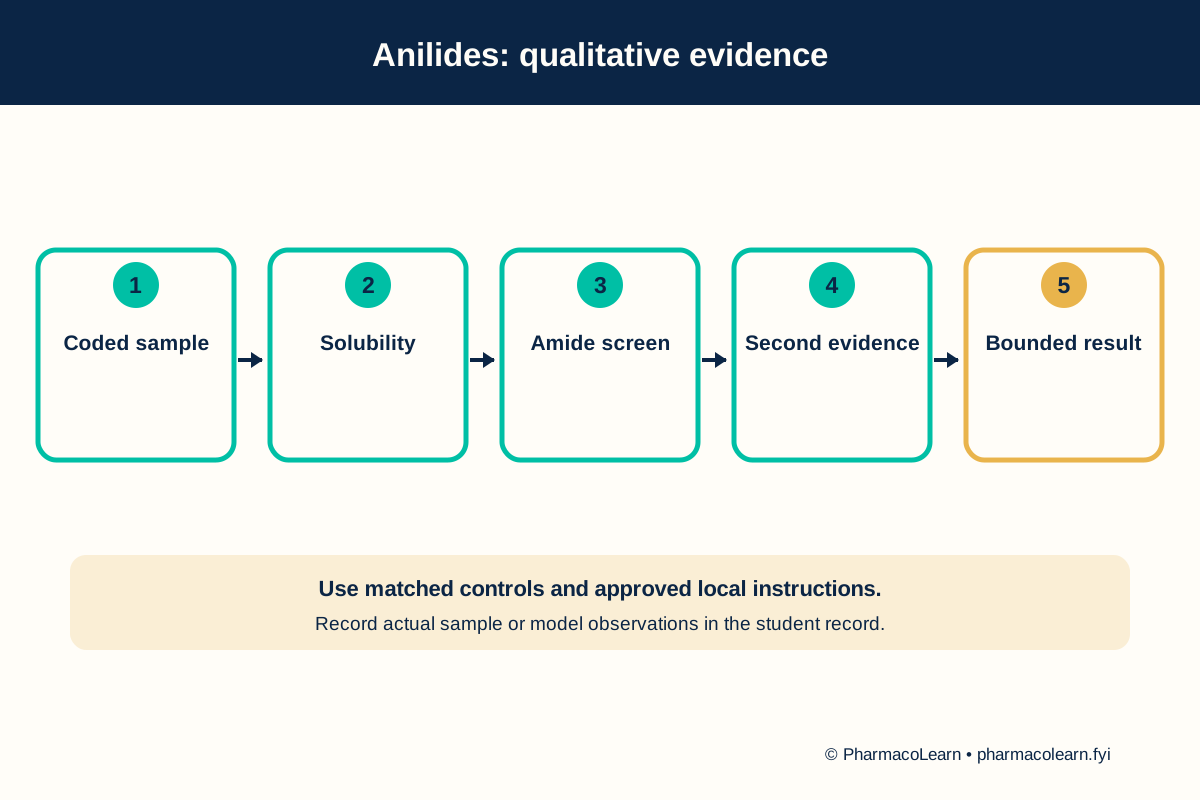
- Record the unknown code, physical state, appearance, and source of the sample. Do not taste or smell it. [2]
- Review the available sample safety information and confirm the local analysis sequence with the instructor. Exact test reagents and quantities must be specified in your college lab manual and instructor's method sheet. [2, 3]
- Compare permitted water, dilute-acid, and dilute-base solubility observations with known controls, recording each separately. [2]
- Review the approved amide-screen result and a blank. Do not classify the unknown from solubility alone. [2]
- If hydrolysis is assigned, perform or review only the supervised local method, then document evidence for both the aromatic amine and acyl-derived component. Work-up and identification methods must be specified in your college lab manual and instructor's method sheet. [2, 3]
- Compare a verified derivative, melting behaviour, or instrument record with a suitable reference and note any disagreement. [3]
- State whether the combined evidence supports an anilide, another amide, or an inconclusive result; dispose of organic and hydrolysis waste as directed. [2]
5. Calculation, graph, or images as appropriate
| Evidence item | Actual teaching record |
|---|---|
| Sample and control identifiers | Record here |
| Solubility pattern | Record here |
| Amide-screen result | Record here |
| Hydrolysis-product or spectral evidence | Record here |
| Final class inference | Record here |
Pre-assumed observations for interpretation only: Suppose a coded neutral solid has a solubility pattern matching the known benzanilide control, an independent amide indication, and a verified spectral comparison consistent with the same control. Those findings support an anilide classification. A similar melting point alone would be insufficient. No numerical calculation is required for this qualitative classification; real observations remain your college lab manual and instructor's method sheet. [2, 3]
6. Result
Report an anilide classification only when the independent tests and controls agree. Otherwise report the unresolved evidence. The actual sample result must be recorded here. Safety note: Unknowns, aromatic amines, acids, bases, and hot hydrolysis mixtures require supervised hood work and suitable protection. Do not identify any sample by odour or handle hydrolysis products without their safety assessment. [2, 3]
7. References
- Pharmacy Council of India. Pharm.D. Regulations, 2008, Pharmaceutical Organic Chemistry practical section II.
- East Point College of Pharmacy. Pharmaceutical Organic Chemistry Practical Manual, neutral nitrogenous compound group.
- University of Massachusetts Amherst. Qualitative Organic Analysis.
Back to Pharmaceutical Organic Chemistry practicals | Pharm.D. Year 1 Practicals · All Pharm D Practicals · Pharm D
Theory notes: Pharmaceutical Organic Chemistry