
← Pharmaceutical Organic Chemistry practicals | Pharm.D. Year 1 Practicals
Systematic Qualitative Analysis of Hydrocarbons
1. Aim
To classify a coded hydrocarbon sample as showing alkene-like unsaturation or a less reactive saturated or aromatic pattern, using controlled qualitative evidence. Hydrocarbons are explicitly named in PCI Pharmaceutical Organic Chemistry practical section II. Exact compound identity remains your college lab manual and instructor's method sheet. [1]
2. Requirements
Coded sample or instructor-provided reaction records, known alkane, alkene, and aromatic controls, reagent blank, approved dilute permanganate test reagent if authorized, clean tubes, droppers, hood, coat, eye protection, gloves, and manganese-containing waste vessel. Bromine handling is not required for this page. Sample amounts, reagent concentration, test time, and any instrumental confirmation must be recorded here. [2, 3]
3. Theory
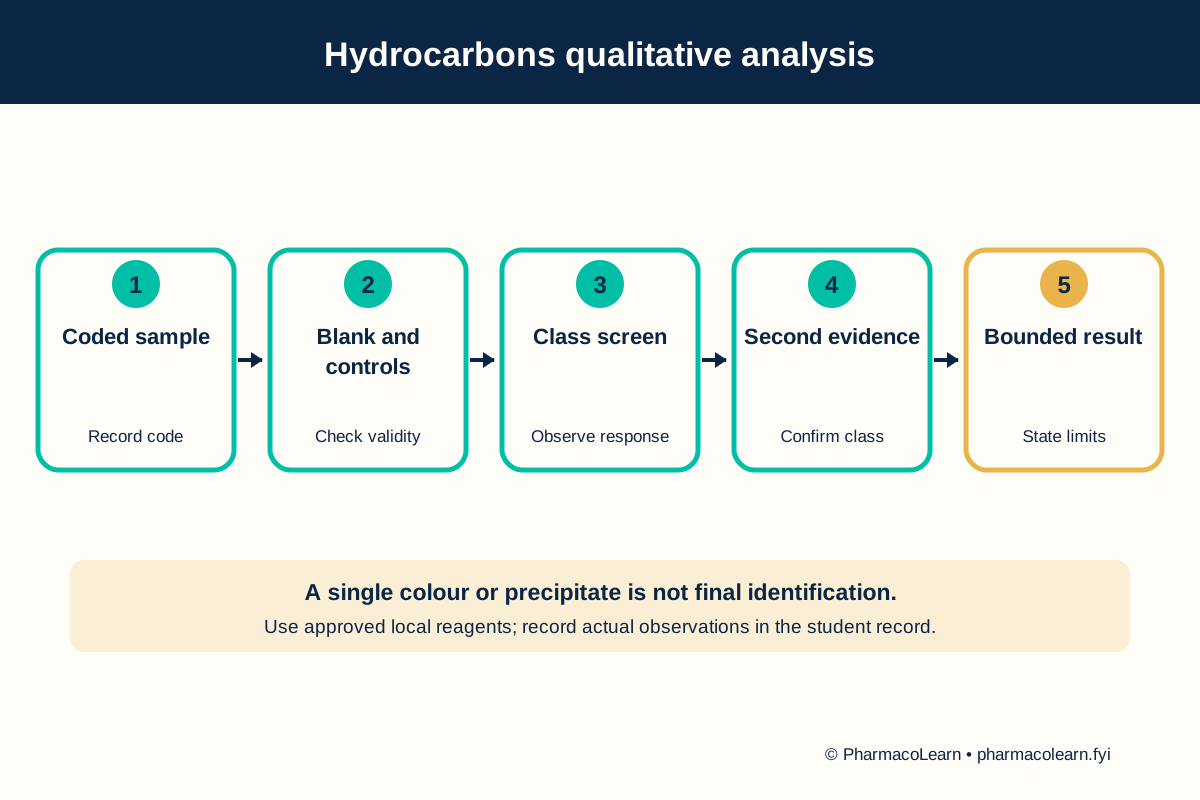
Hydrocarbons contain carbon and hydrogen but may be saturated, unsaturated, or aromatic. An alkene can react with dilute permanganate, sometimes causing loss of purple colour and formation of a brown manganese-containing solid. A negative test does not establish an alkane: an aromatic hydrocarbon may also resist this mild reaction, and poor mixing can create a false negative. Other oxidizable materials can give a positive response. Controls are needed to show that the reagent works and to separate true colour loss from dilution or phase separation. Final identification requires more than one class test. [2, 3]
4. Procedure
- Record sample code, physical state, and handling restrictions without smelling it.
- Prepare a blank plus known alkane, alkene, and aromatic control records or actual controls if authorized.
- Check the approved dilute permanganate reagent, hood, and manganese-waste route. Exact amounts are specified in your college lab manual and instructor's method sheet.
- Apply the reagent to separately labelled control and unknown portions, mixing in the approved way.
- Record purple-colour persistence, disappearance, any brown solid, and whether liquid phases remain separate.
- Compare the unknown with all controls and review a second authorized test or instrument record.
- Report only the supported pattern and note which hydrocarbon classes remain possible.
5. Calculation, graph, or images as appropriate
| Observation | Actual laboratory record |
|---|---|
| Reagent blank | Record here |
| Known alkene control | Record here |
| Known alkane control | Record here |
| Known aromatic control | Record here |
| Unknown observation | Record here |
Pre-assumed observations for interpretation only: the alkene control loses purple colour and develops a brown solid, while the blank, alkane, aromatic control, and unknown remain purple. The unknown lacks evidence of easily oxidized unsaturation under this test; alkane versus aromatic identity remains Record here. No numerical calculation is indicated for this qualitative classification. Record actual controls and the unknown in separate rows before making a result statement.
6. Result
Report the functional-group conclusion only to the level supported by the actual test pattern and a second authorized check. If controls fail or evidence conflicts, report an inconclusive result. The real specimen result must be recorded here. Safety note: Use a hood and protective equipment under teaching-lab supervision. Hydrocarbon samples can be flammable and permanganate is an oxidant. Keep flames away and collect manganese-containing waste separately. Do not substitute bromine tests without a separate risk assessment.
7. References
- Pharmacy Council of India, Pharm.D. Regulations, 2008.
- MiraCosta College, Chemistry 102 Experiment 2.
- Purdue University, Reactivity of Alkanes and Alkenes.
- East Point College of Pharmacy, Pharmaceutical Organic Chemistry Practical Manual.
Back to Pharmaceutical Organic Chemistry practicals | Pharm.D. Year 1 Practicals · All Pharm D Practicals · Pharm D
Theory notes: Pharmaceutical Organic Chemistry