
← Pharmaceutical Organic Chemistry practicals | Pharm.D. Year 1 Practicals
Systematic Qualitative Analysis of Esters
1. Aim
To screen a coded organic sample for an ester using a controlled ferric hydroxamate test and review supporting hydrolysis or identity evidence. Esters are named in PCI Pharmaceutical Organic Chemistry practical section II. The sample identity and reagent method must be recorded here. [1]
2. Requirements
Coded sample, institution-prepared alkaline hydroxylamine reagent and iron(III) reagent, known ester positive control, non-ester negative control, reagent blank, clean tubes, controlled bath if required, coat, eye protection, gloves, hood, and labelled hydroxylamine and iron-containing waste. Exact reagent concentrations, volumes, temperature, timing, and any derivative preparation are specified in your college lab manual and instructor's method sheet. [2, 3]
3. Theory
Under the approved alkaline conditions, some esters react with hydroxylamine to make a hydroxamic acid. Iron(III) then forms a coloured complex with the hydroxamate, providing a class screen. Direct reaction of the unknown with iron(III) alone can create a misleading colour, so a control for that background is needed. Amides and other acyl compounds can show related chemistry, and some esters respond weakly. A positive colour therefore supports an ester but does not establish a particular compound or purity. Hydrolysis and identification of the resulting acid and alcohol may give further evidence when safely assigned. [2, 3]
4. Procedure
- Record the code, physical state, and any permitted solubility information.
- Prepare blank, known ester control, negative control, and a direct iron(III) background check for the unknown.
- Confirm the approved hydroxylamine handling, hood, and waste route; reagent strengths and amounts are specified in your college lab manual and instructor's method sheet.
- Run the authorized ferric hydroxamate sequence on separately labelled portions and compare the colour with all controls.
- Record whether iron(III) alone gave a similar colour. If so, mark the ester inference inconclusive.
- Review a second authorized hydrolysis or instrumental result; do not identify products from odour.
- Document the supported class inference and dispose of reagents in the assigned hazardous-waste vessel.
5. Calculation, graph, or images as appropriate
| Observation | Actual laboratory record |
|---|---|
| Reagent blank | Record here |
| Known ester control | Record here |
| Unknown plus iron(III) alone | Record here |
| Unknown hydroxamate response | Record here |
| Second evidence | Record here |
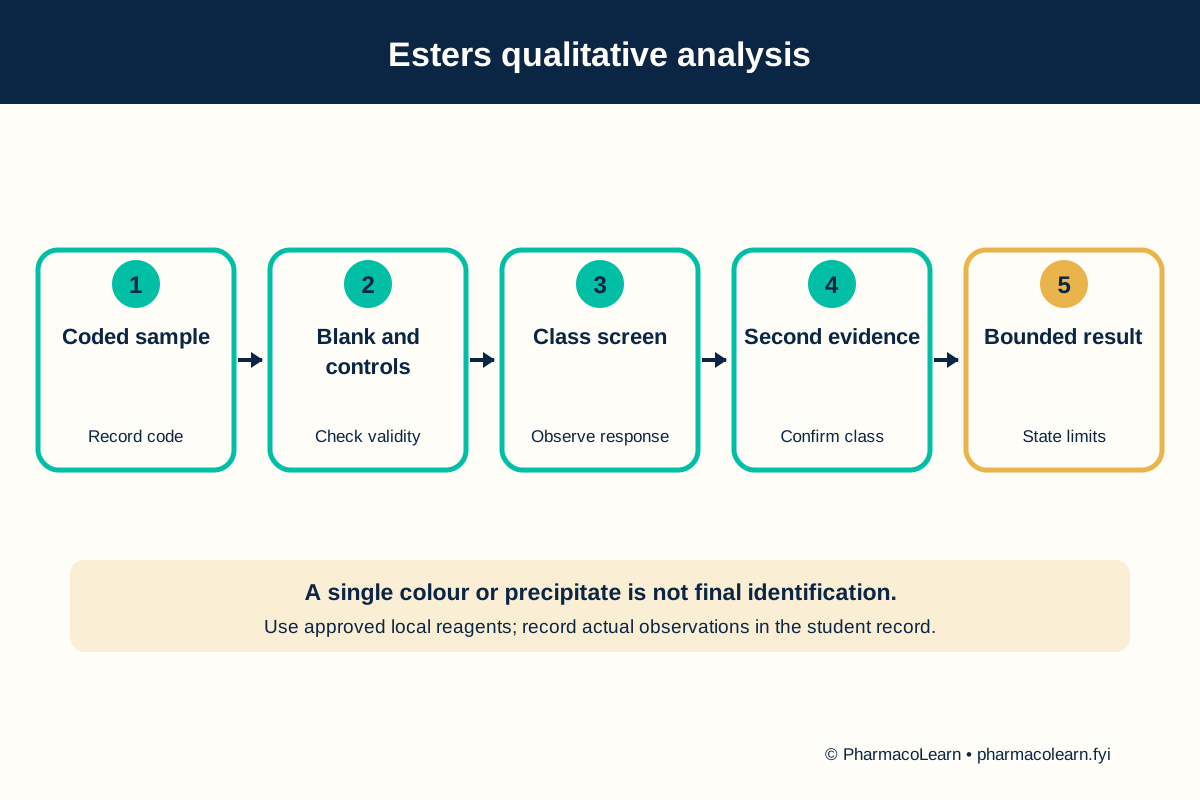
Pre-assumed observations for interpretation only: the known ester becomes red-violet, blank and negative controls do not, the unknown is negative with iron(III) alone but red-violet after the full test. This supports ester-like chemistry. Actual confirmation and compound identity must be recorded here. No numerical calculation is indicated for this qualitative classification. Record actual controls and the unknown in separate rows before making a result statement.
6. Result
Report the functional-group conclusion only to the level supported by the actual test pattern and a second authorized check. If controls fail or evidence conflicts, report an inconclusive result. The real specimen result must be recorded here. Safety note: Hydroxylamine reagents and acidic or alkaline solutions need supervised handling in a hood. Never sniff a sample to infer a fruity ester and never pour reagent waste into the sink without the approved local instruction.
7. References
- Pharmacy Council of India, Pharm.D. Regulations, 2008.
- University of Massachusetts Amherst, Qualitative Organic Analysis.
- California State University, Bakersfield, Qualitative Organic Analysis.
- East Point College of Pharmacy, Pharmaceutical Organic Chemistry Practical Manual.
Back to Pharmaceutical Organic Chemistry practicals | Pharm.D. Year 1 Practicals · All Pharm D Practicals · Pharm D
Theory notes: Pharmaceutical Organic Chemistry