
← Pharmaceutical Organic Chemistry practicals | Pharm.D. Year 1 Practicals
Systematic Qualitative Analysis of Alcohols
1. Aim
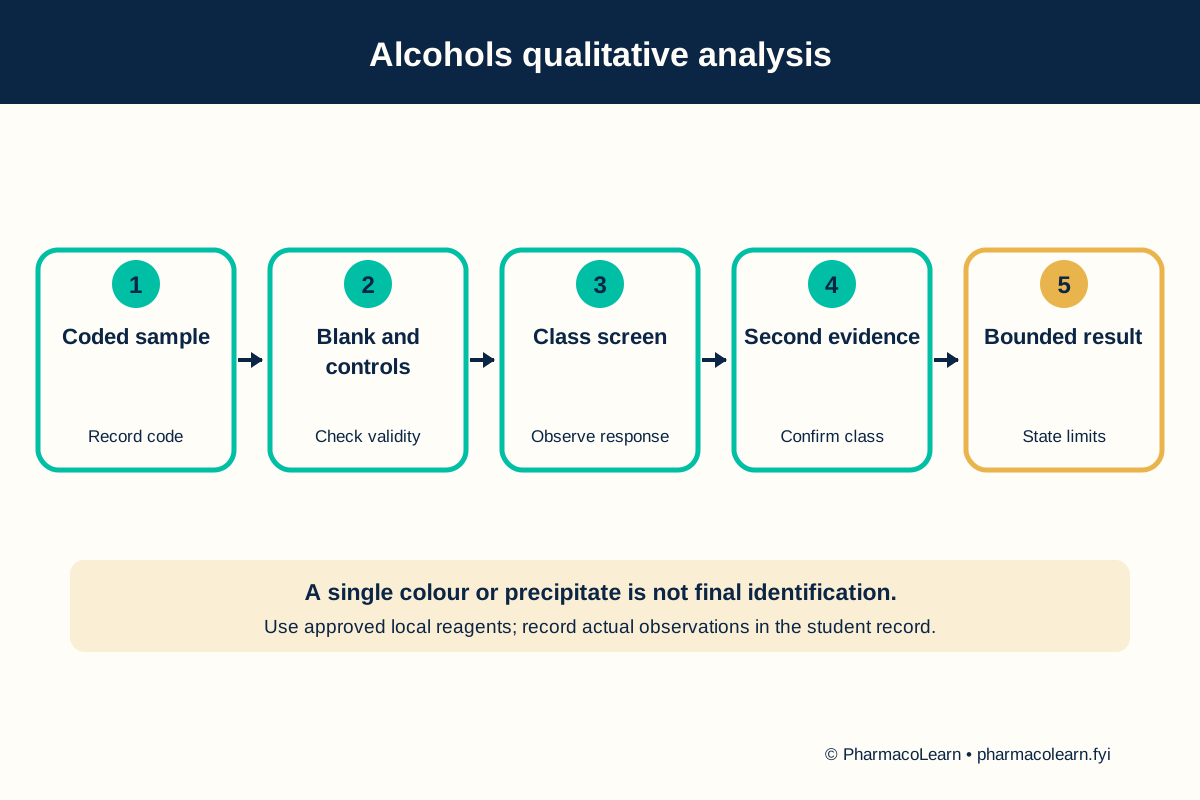
To test a coded sample for alcohol-group behaviour using a controlled ceric ammonium nitrate comparison and a second approved observation. Alcohols are a named class in PCI Pharmaceutical Organic Chemistry practical section II. The actual identity and alcohol subclass must be recorded here. [1]
2. Requirements
Coded sample, institution-prepared ceric ammonium nitrate reagent, known alcohol positive control, appropriate negative control, blank, clean tubes, droppers, water or approved solvent, coat, gloves, eye protection, hood, and labelled acidic oxidant waste. Reagent concentration, sample amount, solvent, and any subclass test or derivative method must be recorded here. [2, 3]
3. Theory
Alcohols contain a hydroxyl group attached to carbon. Ceric ammonium nitrate can form a coloured complex with many alcohols; a rapid red or red-brown change can serve as a screen when a known alcohol control responds. Other functional groups and solvent effects can interfere, and the test does not by itself distinguish primary, secondary, and tertiary alcohols. Solubility and a second approved classification method are needed for a defensible report. Chromic-acid oxidation is sometimes listed in teaching manuals, but it brings chromium hazards and is not required for this page. [2, 3]
4. Procedure
- Record the unknown code, physical state, and safe handling notes.
- Prepare a reagent blank, known alcohol control, and appropriate negative control.
- Check water or approved-solvent miscibility on a fresh portion, recording any two-layer behaviour.
- Add the institution-prepared ceric ammonium nitrate reagent to labelled portions under the approved method. Quantities and timing are specified in your college lab manual and instructor's method sheet.
- Compare immediate colour changes with the controls, noting whether colour appears in one or both layers.
- Review a second approved test or instrumental record if alcohol subclass or compound identity is required.
- Record the bounded inference and dispose of acidic cerium-containing waste as assigned.
5. Calculation, graph, or images as appropriate
| Observation | Actual laboratory record |
|---|---|
| Reagent blank | Record here |
| Known alcohol control | Record here |
| Negative control | Record here |
| Unknown colour and layers | Record here |
| Second evidence | Record here |
Pre-assumed observations for interpretation only: the blank remains yellow, the known alcohol becomes red-brown, the negative control does not change, and the unknown becomes red-brown. This supports an alcohol-like response. The exact alcohol and subclass remain your college lab manual and instructor's method sheet. No numerical calculation is indicated for this qualitative classification. Record actual controls and the unknown in separate rows before making a result statement.
6. Result
Report the functional-group conclusion only to the level supported by the actual test pattern and a second authorized check. If controls fail or evidence conflicts, report an inconclusive result. The real specimen result must be recorded here. Safety note: The reagent is acidic and oxidizing. Work under teaching-lab supervision with eye and skin protection, avoid solvent vapours, and segregate cerium-containing waste. Do not substitute an unreviewed chromic-acid test.
7. References
- Pharmacy Council of India, Pharm.D. Regulations, 2008.
- Harper College, Ceric Nitrate Test.
- California State University, Bakersfield, Qualitative Organic Analysis.
- East Point College of Pharmacy, Pharmaceutical Organic Chemistry Practical Manual.
Back to Pharmaceutical Organic Chemistry practicals | Pharm.D. Year 1 Practicals · All Pharm D Practicals · Pharm D
Theory notes: Pharmaceutical Organic Chemistry