
← Pharmaceutical Organic Chemistry practicals | Pharm.D. Year 1 Practicals
Systematic Qualitative Analysis of Carboxylic Acids
1. Aim
To identify evidence for a carboxylic acid group in a coded organic sample using an aqueous bicarbonate comparison and a second approved check. Carboxylic acids are explicitly listed in PCI Pharmaceutical Organic Chemistry practical section II. The actual compound must be recorded here. [1]
2. Requirements
Coded sample, approved sodium bicarbonate solution, water, known carboxylic acid positive control, phenol or other suitable negative control, blank, pH indicator, clean tubes or spot plate, droppers, coat, gloves, eye protection, and waste vessel. Reagent concentration, sample quantity, solvent, and any derivative method are specified in your college lab manual and instructor's method sheet. [2, 3]
3. Theory
A carboxylic acid can donate a proton to bicarbonate, producing a soluble carboxylate, water, and carbon dioxide gas. Visible bubbles may therefore support the acid class. Bubbles can also arise from contamination or a different acidic substance, while very small or insoluble samples can give weak responses. Comparing the unknown with a blank and controls matters more than simply seeing gas. An acid-base solubility pattern and an approved derivative or instrumental record help distinguish the class. pH alone cannot identify an unknown compound. [2, 3]
4. Procedure
- Record code, appearance, and any known handling restrictions; use a clean vessel for each test.
- Prepare bicarbonate blank, known acid positive control, and suitable negative control.
- Check a fresh portion in water and record solubility without using odour as evidence.
- Add the approved bicarbonate solution to separate control and unknown portions. Exact quantities are specified in your college lab manual and instructor's method sheet.
- Record the presence, timing, and persistence of bubbles against the blank and controls.
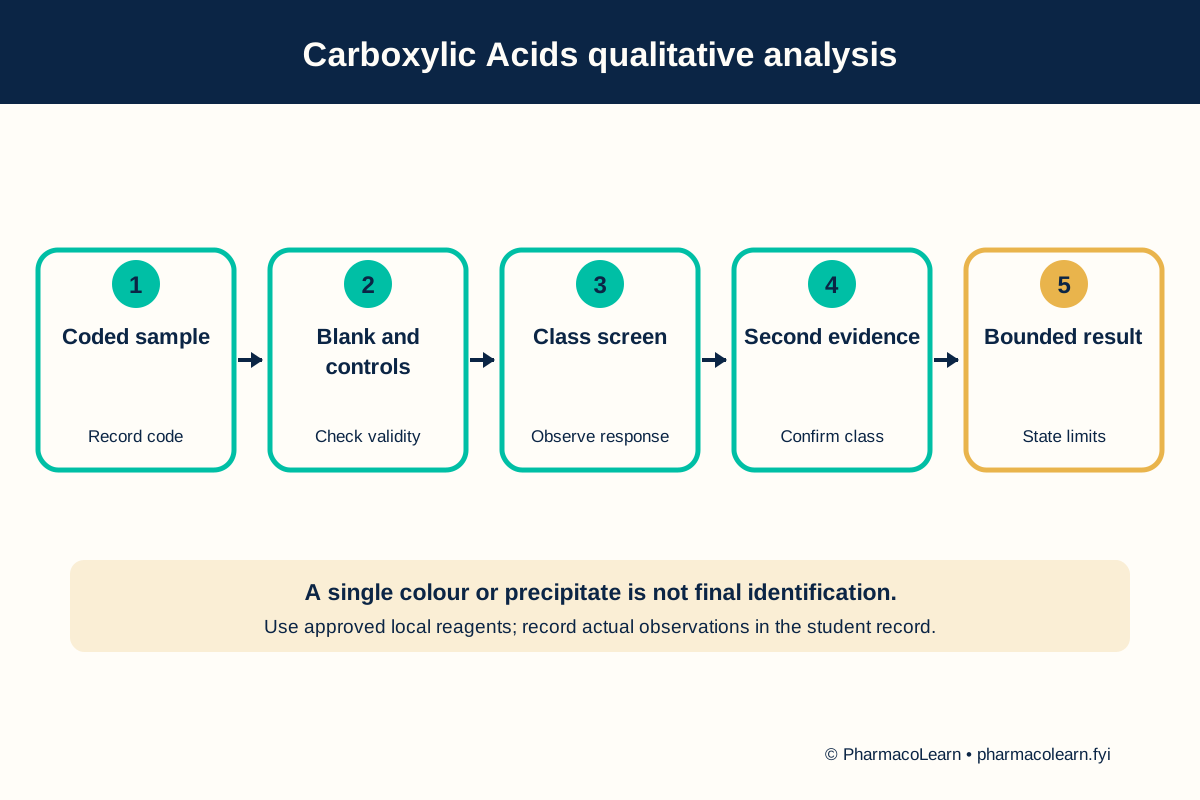
- Review pH and the approved second identification result, including any derivative result if assigned.
- Report the class inference and limits; dispose of acidic and organic waste as directed.
5. Calculation, graph, or images as appropriate
| Observation | Actual laboratory record |
|---|---|
| Bicarbonate blank | Record here |
| Known acid control | Record here |
| Negative control | Record here |
| Unknown gas observation | Record here |
| Second confirmation | Record here |
Pre-assumed observations for interpretation only: the blank and negative control do not bubble, the known acid bubbles, and the unknown bubbles reproducibly. This supports an acid reacting with bicarbonate; it does not identify which carboxylic acid is present. The real sample and second test must be recorded here. No numerical calculation is indicated for this qualitative classification. Record actual controls and the unknown in separate rows before making a result statement.
6. Result
Report the functional-group conclusion only to the level supported by the actual test pattern and a second authorized check. If controls fail or evidence conflicts, report an inconclusive result. The real specimen result must be recorded here. Safety note: Use only the approved small-scale test under teaching-lab supervision. Keep vessels open to avoid pressure buildup, use eye protection, and avoid direct contact with unknown acids.
7. References
- Pharmacy Council of India, Pharm.D. Regulations, 2008.
- California State University, Bakersfield, Qualitative Organic Analysis.
- Hostos Community College, Chemical Properties of Carboxylic Acids.
- East Point College of Pharmacy, Pharmaceutical Organic Chemistry Practical Manual.
Back to Pharmaceutical Organic Chemistry practicals | Pharm.D. Year 1 Practicals · All Pharm D Practicals · Pharm D
Theory notes: Pharmaceutical Organic Chemistry