
← Pharmaceutical Organic Chemistry practicals | Pharm.D. Year 1 Practicals
Systematic Qualitative Analysis of Aldehydes and Ketones
1. Aim
To screen a coded organic sample for a carbonyl group and distinguish an aldehyde from a ketone using separate approved evidence. Aldehydes and ketones form one explicitly named PCI practical section II class entry. Exact identity and subclass are specified in your college lab manual and instructor's method sheet. [1]
2. Requirements
Coded sample, manufacturer-prepared wet 2,4-dinitrophenylhydrazine reagent if permitted, known aldehyde and ketone controls, non-carbonyl negative control, blank, clean tubes, droppers, pH or solvent information, coat, gloves, eye protection, hood, and labelled hazardous-waste container. A second aldehyde-selective method or instrumental record is required. Reagent formulation, amounts, and identity thresholds are specified in your college lab manual and instructor's method sheet. [2, 3]
3. Theory
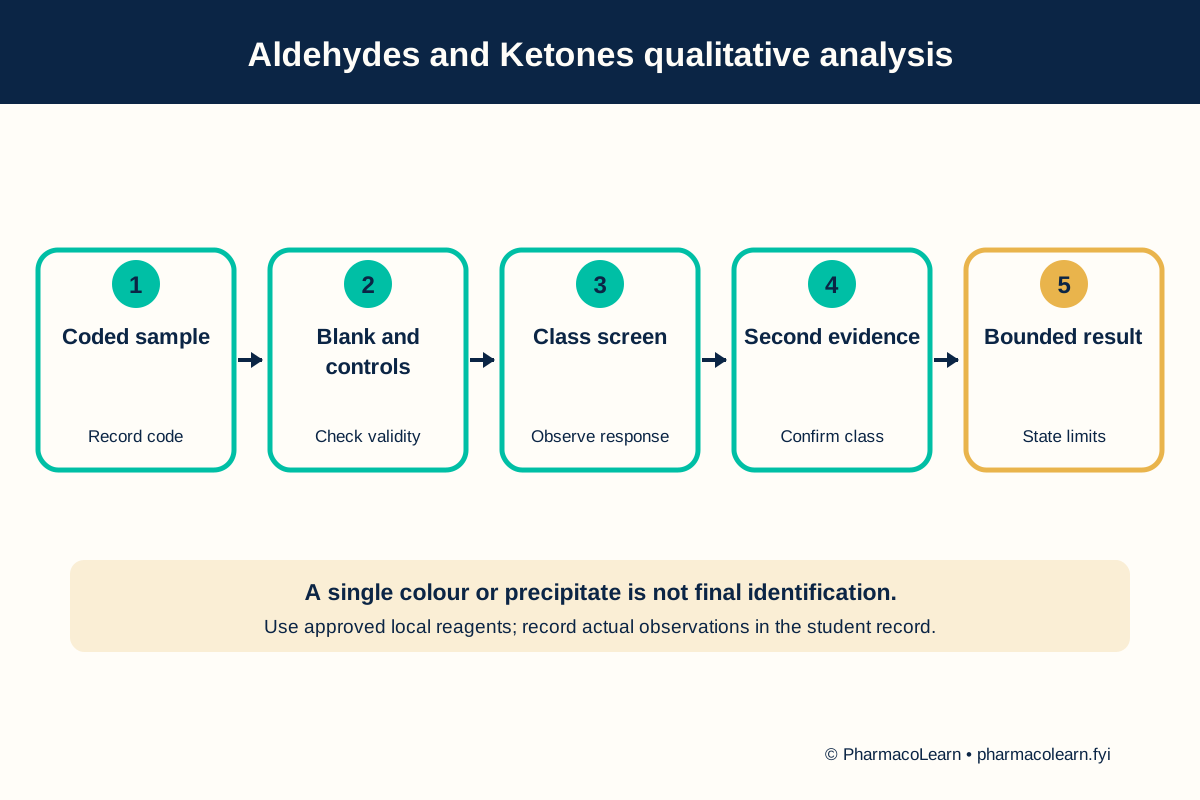
Both aldehydes and ketones have a carbonyl group that can react with 2,4-dinitrophenylhydrazine to form a coloured hydrazone precipitate. A positive result suggests a reactive carbonyl but does not separate aldehydes from ketones. A second approved test or spectroscopy is required for that distinction. Some other carbonyl-containing substances or sample impurities can interfere, and a negative result may reflect poor solubility or an unsuitable reagent. The classification should therefore depend on controls, specimen conditions, and the combined test pattern, not one colour change. [2, 3]
4. Procedure
- Record code, appearance, and permitted solubility observations.
- Prepare blank, known aldehyde, known ketone, and non-carbonyl control in separate labelled vessels.
- Confirm that the approved 2,4-dinitrophenylhydrazine reagent is wet and within its use period; exact formulation is specified in your college lab manual and instructor's method sheet.
- Run the carbonyl screen under the local hood procedure and record precipitate timing and colour against controls.
- Do not let reagent residues or derivatives dry. Route all test material to the assigned hazardous-waste vessel.
- Review the assigned aldehyde-selective result or verified instrument record to distinguish aldehyde from ketone.
- Report a carbonyl class and subclass only to the extent supported by both stages.
5. Calculation, graph, or images as appropriate
| Observation | Actual laboratory record |
|---|---|
| Blank and negative control | Record here |
| Known aldehyde response | Record here |
| Known ketone response | Record here |
| Unknown carbonyl response | Record here |
| Aldehyde-selective evidence | Record here |
Pre-assumed observations for interpretation only: both carbonyl controls form a precipitate, the blank and negative control do not, and the unknown forms a precipitate. The unknown is consistent with an aldehyde or ketone; without the second test its subclass remains your college lab manual and instructor's method sheet. No numerical calculation is indicated for this qualitative classification. Record actual controls and the unknown in separate rows before making a result statement.
6. Result
Report the functional-group conclusion only to the level supported by the actual test pattern and a second authorized check. If controls fail or evidence conflicts, report an inconclusive result. The real specimen result must be recorded here. Safety note: 2,4-dinitrophenylhydrazine materials must remain wet and under approved storage and disposal controls. Do not prepare, dry, scrape, or store a derivative from this note. Use a hood and protective equipment under teaching-lab supervision.
7. References
- Pharmacy Council of India, Pharm.D. Regulations, 2008.
- California State University, Bakersfield, Qualitative Organic Analysis.
- East Point College of Pharmacy, Pharmaceutical Organic Chemistry Practical Manual.
- Amrita Vishwa Vidyapeetham Virtual Lab, Detection of Functional Groups.
Back to Pharmaceutical Organic Chemistry practicals | Pharm.D. Year 1 Practicals · All Pharm D Practicals · Pharm D
Theory notes: Pharmaceutical Organic Chemistry