
← Pharmaceutical Organic Chemistry practicals | Pharm.D. Year 1 Practicals
Systematic Qualitative Analysis of Amines
1. Aim
To screen a coded sample for amine-like basicity using acid solubility and an approved second check. Amines are a named class in PCI Pharmaceutical Organic Chemistry practical section II. The amine subclass and sample identity are specified in your college lab manual and instructor's method sheet. [1]
2. Requirements
Coded sample, approved dilute acid and water, positive amine and negative controls, blank, pH paper or meter, clean tubes, droppers, coat, gloves, eye protection, fume hood, and labelled waste containers. Acid concentration, sample amount, solvent, and any subclass or derivative test are specified in your college lab manual and instructor's method sheet. No carbylamine test is required for this page. [2, 3]
3. Theory
Amines contain a nitrogen atom with a lone pair that can accept a proton. Many amines become more water soluble in dilute acid because an ammonium salt forms. The response depends on molecular structure and solvent, and other basic compounds can behave similarly. Therefore, acid solubility is a screening observation, not proof. A separate approved test or derivative is needed if the course asks for primary, secondary, tertiary, aliphatic, or aromatic classification. The East Point manual includes several amine tests, but some use hazardous reagents; this page uses the basicity screen and leaves the second method to the local laboratory. [2, 3]
4. Procedure
- Record the unknown code and physical appearance without smelling, tasting, or touching the sample.
- Prepare labelled blank, known amine control, and appropriate non-amine control in the hood.
- Check water solubility on a small separate portion using the approved amount.
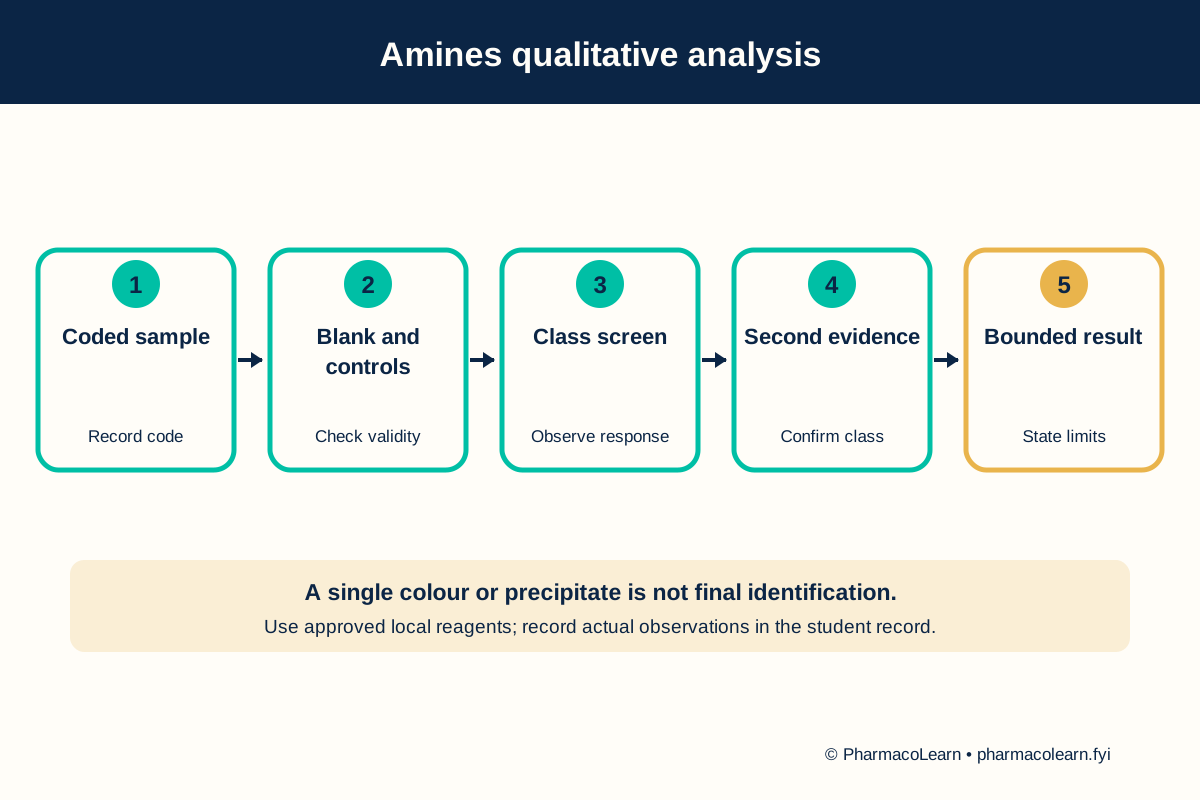
- Apply the dilute-acid solubility test to fresh portions of controls and unknown. Exact acid strength and volumes are specified in your college lab manual and instructor's method sheet.
- Record whether the sample dissolves or changes phase and compare with water-only behaviour.
- Review the approved second test or derivative evidence for amine class and subclass. Do not infer subclass from acid solubility alone.
- Report supported, unsupported, or inconclusive evidence and collect organic or acidic waste as directed.
5. Calculation, graph, or images as appropriate
| Observation | Actual laboratory record |
|---|---|
| Water-only behaviour | Record here |
| Known amine in dilute acid | Record here |
| Negative control in dilute acid | Record here |
| Unknown in dilute acid | Record here |
| Subclass confirmation | Record here |
Pre-assumed observations for interpretation only: a known amine dissolves in dilute acid but not water, the negative control stays insoluble, and the unknown follows the known amine. This supports a basic, salt-forming group. The presence and subclass of an amine remain your college lab manual and instructor's method sheet until a second authorized check is available. No numerical calculation is indicated for this qualitative classification. Record actual controls and the unknown in separate rows before making a result statement.
6. Result
Report the functional-group conclusion only to the level supported by the actual test pattern and a second authorized check. If controls fail or evidence conflicts, report an inconclusive result. The real specimen result must be recorded here. Safety note: Unknown amines can be volatile, irritating, or toxic. Work under teaching-lab supervision in a hood with suitable protection. Do not rely on odour, and do not run the chloroform-based carbylamine test from an unreviewed manual.
7. References
- Pharmacy Council of India, Pharm.D. Regulations, 2008.
- California State University, Bakersfield, Qualitative Organic Analysis.
- Amrita Vishwa Vidyapeetham Virtual Lab, Detection of Functional Groups.
- East Point College of Pharmacy, Pharmaceutical Organic Chemistry Practical Manual.
Back to Pharmaceutical Organic Chemistry practicals | Pharm.D. Year 1 Practicals · All Pharm D Practicals · Pharm D
Theory notes: Pharmaceutical Organic Chemistry