
← Pharmaceutical Organic Chemistry practicals | Pharm.D. Year 1 Practicals
Systematic Qualitative Analysis of Carbohydrates
1. Aim
To examine a coded sample for carbohydrate behaviour and distinguish a reducing-sugar response from a starch response using approved qualitative tests. Carbohydrates are a named class in PCI Pharmaceutical Organic Chemistry practical section II. The actual sample identity must be recorded here. [1]
2. Requirements
Coded aqueous sample, Benedict reagent, iodine reagent, known reducing-sugar and starch controls, negative control, blank, clean tubes, controlled water bath, pipettes, timer, coat, eye protection, gloves, and copper-containing waste vessel. Molisch reagent may be used only if the institution separately authorizes its concentrated-acid handling. Test volumes, heating time, reagent strength, and any derivative method are specified in your college lab manual and instructor's method sheet. [2, 3]
3. Theory
Carbohydrates include simple sugars and polysaccharides, so no single screen describes them all. Benedict reagent changes as certain sugars reduce copper under alkaline heating. An iodine response can indicate starch because iodine interacts with the helical amylose component. A sample may be positive in one test and negative in the other without contradiction. Some non-carbohydrate reducing substances can affect Benedict reagent, while a negative starch test does not exclude other carbohydrates. Known positive and negative controls are essential for interpreting the colour against reagent background. [2, 3]
4. Procedure
- Record sample code, appearance, solubility, and whether it is a supplied solution or a solid prepared under the approved method.
- Label separate blank, reducing-sugar control, starch control, negative control, and unknown portions.
- Run the approved Benedict test with controlled water-bath heating. Record the starting and final colour or precipitate.
- Cool and dispose of the copper-containing liquid in the assigned vessel. Do not pour it into general waste.
- On fresh portions, apply the approved iodine test and record the colour against the starch control.
- If a broad carbohydrate screen is assigned, follow the separately approved Molisch method with instructor control; exact acid steps are specified in your college lab manual and instructor's method sheet.
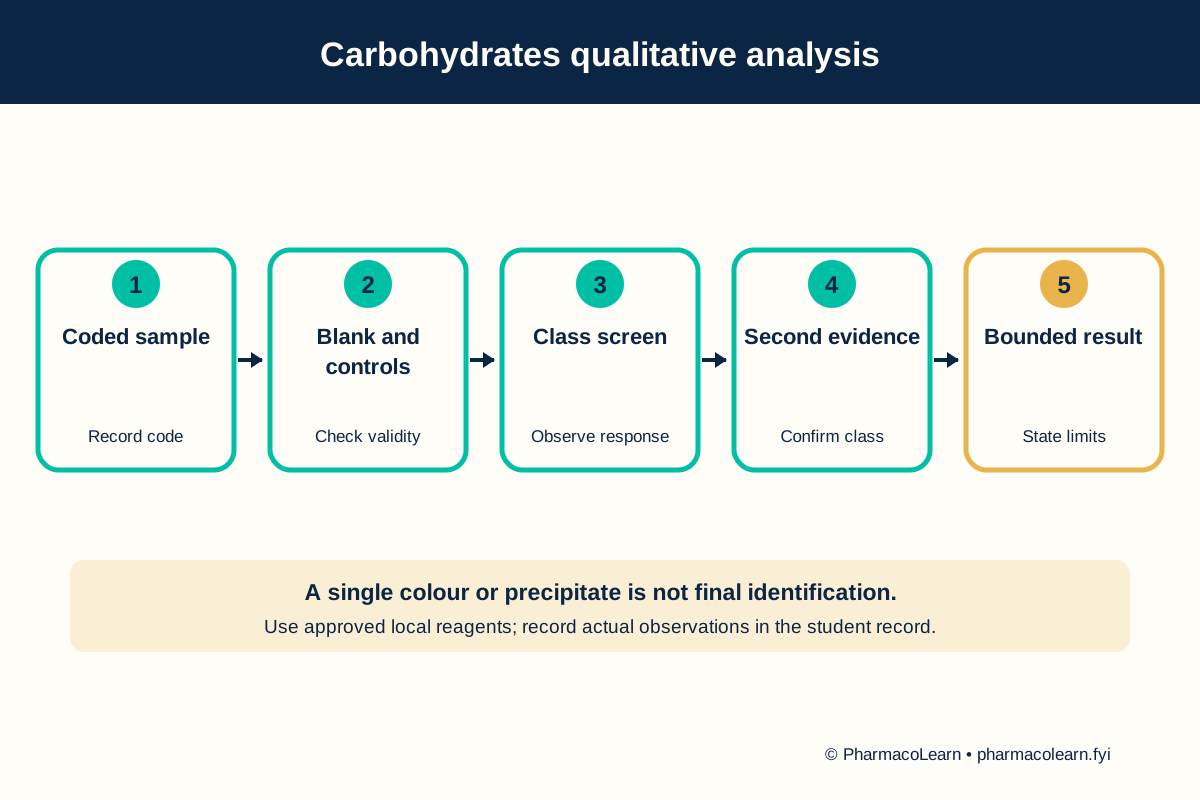
- Compare both tests with controls and report a bounded class inference, not a precise sugar identity.
5. Calculation, graph, or images as appropriate
| Observation | Actual laboratory record |
|---|---|
| Benedict blank and controls | Record here |
| Unknown Benedict response | Record here |
| Iodine starch control | Record here |
| Unknown iodine response | Record here |
| Broad screen if assigned | Record here |
Pre-assumed observations for interpretation only: the reducing-sugar control gives an orange precipitate with Benedict reagent, the starch control becomes blue-violet with iodine, and the unknown gives an orange Benedict precipitate but no blue-violet iodine response. This supports reducing activity without evidence for starch; it does not uniquely identify glucose. Actual observations must be recorded here. No numerical calculation is indicated for this qualitative classification. Record actual controls and the unknown in separate rows before making a result statement.
6. Result
Report the functional-group conclusion only to the level supported by the actual test pattern and a second authorized check. If controls fail or evidence conflicts, report an inconclusive result. The real specimen result must be recorded here. Safety note: Use a controlled bath and protective equipment under teaching-lab supervision. Benedict reagent contains copper; handle and dispose of it as directed. Concentrated-acid Molisch testing requires its own risk assessment.
7. References
- Pharmacy Council of India, Pharm.D. Regulations, 2008.
- Amrita Vishwa Vidyapeetham Virtual Lab, Qualitative Analysis of Carbohydrates.
- University of Wisconsin-Madison, Organic Compounds Lab.
- East Point College of Pharmacy, Pharmaceutical Organic Chemistry Practical Manual.
Back to Pharmaceutical Organic Chemistry practicals | Pharm.D. Year 1 Practicals · All Pharm D Practicals · Pharm D
Theory notes: Pharmaceutical Organic Chemistry