
← Pharmaceutical Organic Chemistry practicals | Pharm.D. Year 1 Practicals
Systematic Qualitative Analysis of Amides
1. Aim
To identify evidence for an amide in a coded organic sample using controlled alkaline hydrolysis and a second approved classification check. Amides are a named class in PCI Pharmaceutical Organic Chemistry practical section II. The identity of the sample and approved confirmatory derivative are specified in your college lab manual and instructor's method sheet. [1]
2. Requirements
Coded unknown, approved aqueous alkali, water bath if required, moist indicator paper or verified ammonia detector, known amide control, negative control, blank, clean tubes, holder, thermometer, coat, gloves, eye protection, fume hood, and labelled waste containers. The alkali identity, concentration, quantity, heating duration, and derivative method are specified in your college lab manual and instructor's method sheet. [2, 3]
3. Theory
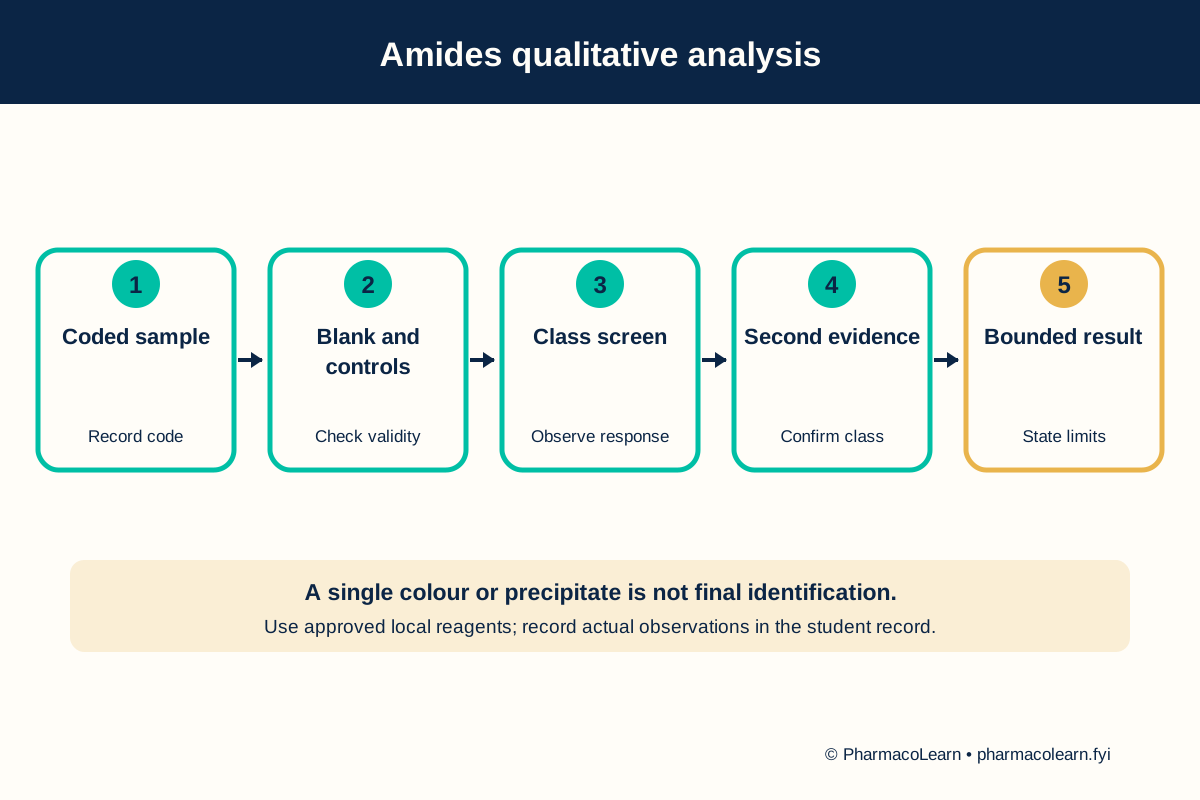
An amide has a carbonyl group linked to nitrogen. Under sufficiently strong alkaline hydrolysis, many primary amides can release ammonia while forming a carboxylate salt. A change in moist indicator paper near the tube mouth can suggest released basic vapour; the student must never sniff the tube. Urea and other nitrogen compounds may also give related observations, and some amides hydrolyse slowly. Therefore, a single positive result is not specific. Interpret the reaction alongside solubility, controls, and an approved derivative or identity comparison. The class result should be reported as supported, unsupported, or inconclusive. [2, 3]
4. Procedure
- Record the coded sample appearance and permitted solubility observations. Keep a separate blank and known controls.
- Check the approved alkali hydrolysis method and hood setup with the instructor. Follow your college lab manual and instructor's method sheet for exact conditions.
- Treat separate labelled portions of the unknown, positive control, and negative control in the same way.
- Warm only as the method directs, using a controlled bath. Keep the tube opening pointed away from people.
- Test vapour with moist indicator paper or the approved detector at the tube mouth. Do not inhale directly.
- Compare all responses with the controls and review the specified derivative or identification evidence.
- Record the class inference and uncertainty; cool, neutralize only if directed, and route waste correctly.
5. Calculation, graph, or images as appropriate
| Observation | Actual laboratory record |
|---|---|
| Blank indicator response | Record here |
| Known amide control | Record here |
| Negative control | Record here |
| Unknown indicator response | Record here |
| Second identification evidence | Record here |
Pre-assumed observations for interpretation only: the blank and negative control show no indicator change, the known amide control changes moist red paper to blue, and the unknown behaves like the control. This supports a nitrogen-releasing hydrolysis reaction, not an amide identity on its own. The actual second check remains Record here. No numerical calculation is indicated for this qualitative classification. Record actual controls and the unknown in separate rows before making a result statement.
6. Result
Report the functional-group conclusion only to the level supported by the actual test pattern and a second authorized check. If controls fail or evidence conflicts, report an inconclusive result. The real specimen result must be recorded here. Safety note: Alkali and hot mixtures can burn. Use the hood and protective equipment under teaching-lab supervision, never smell a reaction vessel, and do not substitute bromine-based tests.
7. References
- Pharmacy Council of India, Pharm.D. Regulations, 2008.
- California State University, Bakersfield, Qualitative Organic Analysis.
- Amrita Vishwa Vidyapeetham Virtual Lab, Detection of Functional Groups.
- East Point College of Pharmacy, Pharmaceutical Organic Chemistry Practical Manual.
Back to Pharmaceutical Organic Chemistry practicals | Pharm.D. Year 1 Practicals · All Pharm D Practicals · Pharm D
Theory notes: Pharmaceutical Organic Chemistry