
← Pharmaceutical Organic Chemistry practicals | Pharm.D. Year 1 Practicals
Preparation of ortho-Chlorobenzoic Acid from ortho-Chlorotoluene
1. Aim
To prepare 2-chlorobenzoic acid, also called ortho-chlorobenzoic acid, by oxidation of ortho-chlorotoluene and calculate percentage yield. This is PCI Pharmaceutical Organic Chemistry synthesis item I.13. The approved local reagents and conditions are to be recorded from the instructor-approved demonstration protocol or dataset in the student record. [1, 2]
2. Requirements
Ortho-chlorotoluene, the institution's authorized oxidant and medium, acid for work-up, water, reflux flask and condenser, controlled heat, thermometer, stirring and filtration equipment, balance, drying equipment, fume hood, coat, eye protection, suitable gloves, and separate oxidant, organic, and acid waste containers are required. The oxidant identity, concentrations, quantities, heating period, separation method, acidification endpoint, and product test are to be recorded from the instructor-approved demonstration protocol or dataset in the student record from the course protocol. [2]
3. Theory
An aromatic side chain with a benzylic hydrogen can undergo oxidation to a carboxyl group. In ortho-chlorotoluene, oxidation of the methyl side chain gives ortho-chlorobenzoic acid while the chlorine substituent remains at the adjacent ring position. The ideal molar relation is one mole of starting material to one mole of acid. [2]
MiraCosta College teaches this reaction as an aromatic side-chain oxidation practical. The actual oxidant and work-up affect reaction control and waste. An observed precipitate after acidification may be the intended product, but identity and purity still require the assigned test. Unreacted starting material or retained moisture can distort yield. [2]
4. Procedure
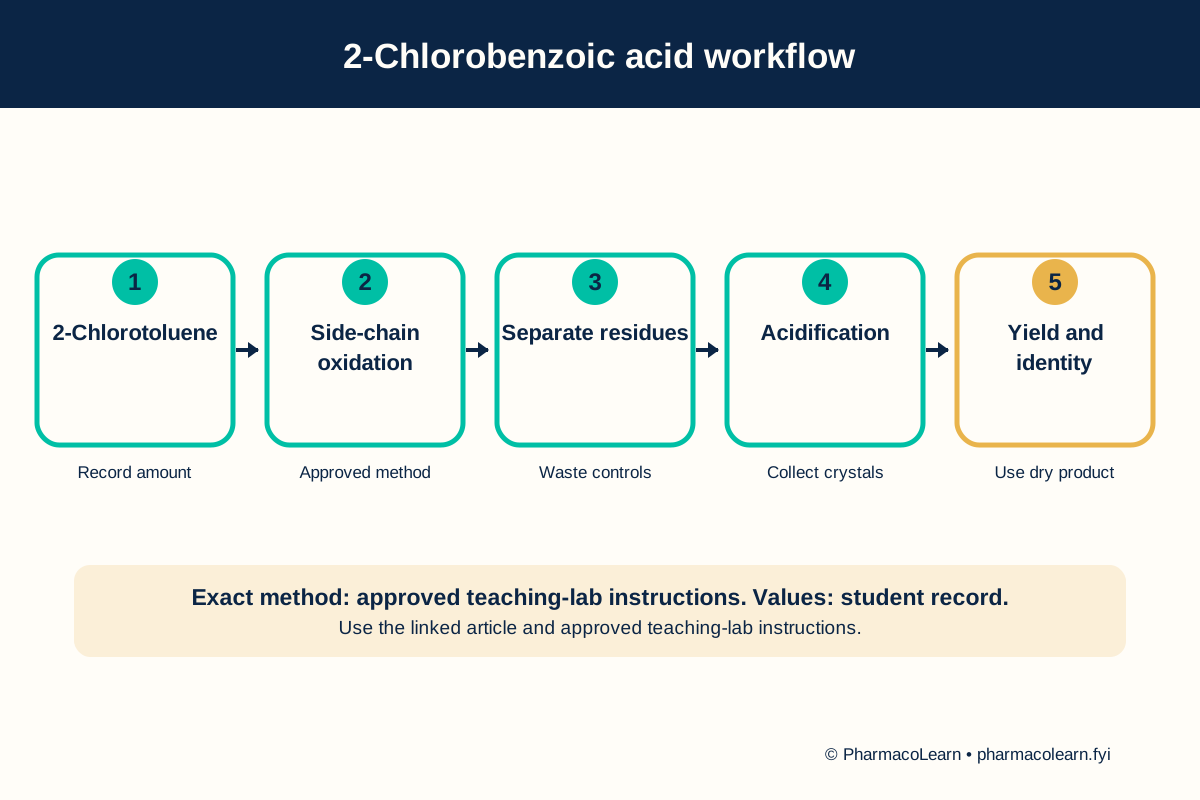
- Confirm the assigned PCI experiment, local recipe, hood, heating method, and waste segregation with the instructor. [1, 2]
- Record the actual ortho-chlorotoluene and oxidant quantities. Reagent concentrations and volumes are to be recorded from the instructor-approved demonstration protocol or dataset in the student record. [2]
- Assemble the approved oxidation apparatus and check the condenser and temperature monitor before heating. Do not use an open flame near organic vapours. [2]
- Carry out the supervised reaction with the specified addition order and heating period. Record time, temperature, and visible changes. Endpoints are to be recorded from the instructor-approved demonstration protocol or dataset in the student record. [2]
- Cool and separate reaction residues in the approved sequence. Keep oxidant-containing and organic waste streams distinct. [2]
- Acidify the product-containing fraction as directed, cool, isolate the solid, and dry it to the method's endpoint. [2]
- Record mass and identity evidence, then calculate theoretical and percentage yield from the verified limiting starting amount. [2]
5. Calculation, graph, or images as appropriate
| Observation | Actual laboratory record |
|---|---|
| Ortho-chlorotoluene amount | Record here |
| Oxidation conditions | Record here |
| Acidification and product appearance | Record here |
| Dry acid mass and identity evidence | Record here |
Pre-assumed values for arithmetic only, not a reaction scale: Assume 0.500 g ortho-chlorotoluene is limiting and a hypothetical dry acid mass is 0.400 g. Its molar mass is 126.58 g/mol and 2-chlorobenzoic acid's is 156.57 g/mol. Starting amount = 0.500 ÷ 126.58 = 0.00395 mol. Theoretical acid mass = 0.00395 × 156.57 = 0.618 g. Percentage yield = 0.400 ÷ 0.618 × 100 = 64.7%, after rounding. These values are pre-assumed and are not a method instruction or observed result. [3, 4]
6. Result
Report the actual dry mass, calculated yield, appearance, and identity test. The experimental result must be recorded here. Safety note: The organic starting liquid, oxidant, acid, and hot apparatus require a supervised teaching lab, hood, controlled heating, suitable protection, and separate hazardous-waste collection. [2]
7. References
- Pharmacy Council of India. Pharm.D. Regulations, 2008, Pharmaceutical Organic Chemistry practical list.
- MiraCosta College. Chemistry 211 Experiments, Experiment VI, aromatic side-chain oxidation of ortho-chlorotoluene.
- National Library of Medicine, PubChem. 2-Chlorotoluene.
- National Library of Medicine, PubChem. 2-Chlorobenzoic Acid.
Back to Pharmaceutical Organic Chemistry practicals | Pharm.D. Year 1 Practicals · All Pharm D Practicals · Pharm D
Theory notes: Pharmaceutical Organic Chemistry