
← Pharmaceutical Organic Chemistry practicals | Pharm.D. Year 1 Practicals
Preparation of Cyclohexanone from Cyclohexanol
1. Aim
To prepare cyclohexanone by controlled oxidation of cyclohexanol, isolate the product, and calculate its percentage yield. This is Pharmaceutical Organic Chemistry synthesis item I.14 in the PCI Pharm.D. practical list. The institution's actual oxidant, work-up, and product criteria are to be recorded from the instructor-approved demonstration protocol or dataset in the student record. [1, 2]
2. Requirements
Cyclohexanol, an instructor-approved oxidant and reaction medium, thermometer, cooled reaction vessel, stirring apparatus, separation and drying equipment, balance, optional distillation equipment if specified, fume hood, coat, chemical-resistant gloves, eye protection, and designated waste containers are needed. Long Island University describes a hypochlorite oxidation route, but its bleach strength, acidification and isolation details are method-specific. The local reagent identity, concentration, quantity, temperature, addition order, time, work-up, and identity test are to be recorded from the instructor-approved demonstration protocol or dataset in the student record. [2]
3. Theory
Cyclohexanol is a secondary alcohol. Oxidation converts its alcohol-bearing carbon into a ketone, cyclohexanone, without changing the number of ring carbons. In an idealized mass balance, one mole of cyclohexanol gives one mole of cyclohexanone. The product is a liquid, so an isolated volume must be converted to mass using a measured or verified density before calculating a mass yield; a directly weighed mass is simpler. [2, 3, 4]
Reaction mixtures can contain residual cyclohexanol, oxidant, water, solvent, and byproducts. Colour change or odour does not establish that the product is cyclohexanone. A course-approved identity or purity method, such as a verified boiling-range or instrumental check, is needed before making that conclusion. The chosen oxidant also determines how the waste must be segregated. [2]
4. Procedure
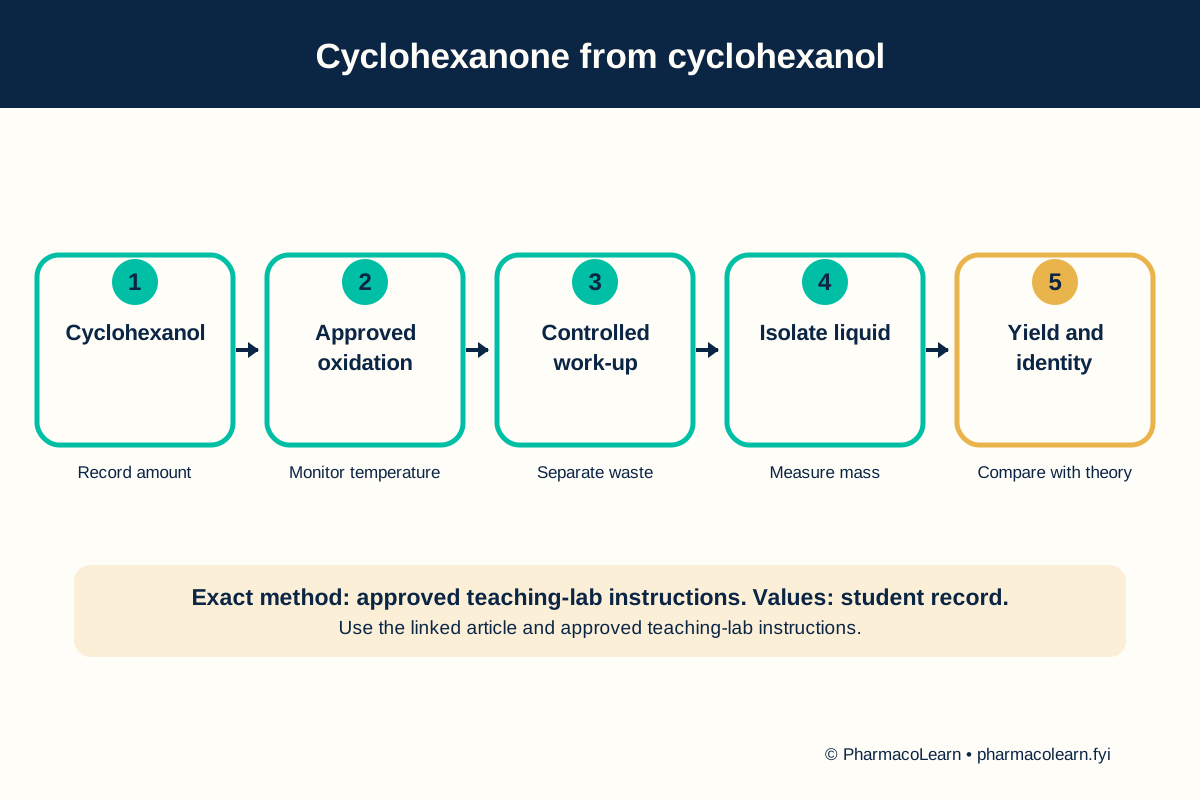
- Confirm the approved oxidation route and risk assessment with the instructor. Prepare the assigned hood, cooling method, protective equipment, and waste vessels. [1, 2]
- Record the actual cyclohexanol amount and the approved oxidant and medium. Exact concentrations and volumes are to be recorded from the instructor-approved demonstration protocol or dataset in the student record. [2]
- Set up the reaction vessel and thermometer. Add reagents only in the authorized order, controlling heat and monitoring the recorded temperature. [2]
- Continue the reaction for the stated period and record observations. Reaction endpoint and allowable temperature range are to be recorded from the instructor-approved demonstration protocol or dataset in the student record. [2]
- Carry out the instructor-approved quench and phase separation. Keep oxidant-containing and organic residues apart as directed. [2]
- Dry and isolate the product by the assigned method. Record its actual mass or measured volume with a verified density, and any identity or purity evidence. [2]
- Determine the limiting reagent and calculate theoretical and percentage yield. Submit the complete measurement and waste record. [2]
5. Calculation, graph, or images as appropriate
| Observation | Actual laboratory record |
|---|---|
| Cyclohexanol amount | Record here |
| Oxidant, medium, time, temperature | Record here |
| Product mass or volume and verified density | Record here |
| Identity or purity check | Record here |
Pre-assumed values for arithmetic only, not a reagent recipe: Assume cyclohexanol is limiting at 1.00 g and the hypothetical dry or solvent-free cyclohexanone mass is 0.650 g. Cyclohexanol has molar mass 100.16 g/mol, and cyclohexanone 98.15 g/mol. Starting amount = 1.00 ÷ 100.16 = 0.00998 mol. Theoretical cyclohexanone mass = 0.00998 × 98.15 = 0.980 g. Percentage yield = 0.650 ÷ 0.980 × 100 = 66.3%, after rounding. These are illustrative values, not measured results. [2, 3, 4]
6. Result
Report the actual isolated mass, yield, and identity evidence. Record the experimental result here when a real record is available. Safety note: Oxidant and organic liquids require qualified teaching-lab supervision, temperature control, a hood, and suitable protective equipment. Never mix hypochlorite with acid outside the approved method because hazardous chlorine-containing vapours may form. Use the designated waste route. [2]
7. References
- Pharmacy Council of India. Pharm.D. Regulations, 2008, Pharmaceutical Organic Chemistry practical list.
- Long Island University, Department of Chemistry. Experiment 8: Preparation of Cyclohexanone by Hypochlorite Oxidation.
- National Library of Medicine, PubChem. Cyclohexanol.
- National Library of Medicine, PubChem. Cyclohexanone.
Back to Pharmaceutical Organic Chemistry practicals | Pharm.D. Year 1 Practicals · All Pharm D Practicals · Pharm D
Theory notes: Pharmaceutical Organic Chemistry