
← Pharmaceutical Organic Chemistry practicals | Pharm.D. Year 1 Practicals
Preparation of Benzoic Acid from Toluene by Oxidation
1. Aim
To prepare benzoic acid by oxidation of the side chain of toluene and calculate percentage yield. This covers the benzoic acid from toluene option under PCI Pharmaceutical Organic Chemistry synthesis item I.8, which also offers oxidation of anthracene to anthraquinone or benzoic acid from benzaldehyde. The selected option for the local class must follow your college lab manual and instructor's method sheet. [1, 2]
2. Requirements
Toluene, an instructor-approved oxidant such as potassium permanganate, the specified alkaline medium and acid for work-up, water, reflux apparatus, controlled heat source, filtration equipment, thermometer, balance, drying equipment, fume hood, coat, eye protection, suitable gloves, and separated organic, oxidant, manganese-containing, and acid waste vessels are needed. Exact reagent concentrations, quantities, reflux time, temperature, acidification endpoint, wash, and drying conditions are to be recorded from the instructor-approved demonstration protocol or dataset in the student record. [2]
3. Theory
Strong oxidation can convert the methyl side chain of toluene into a carboxyl group, leaving the aromatic ring as the benzoic acid framework. In alkaline permanganate methods, a benzoate salt forms first; acidification then produces benzoic acid, which can crystallize on cooling. Permanganate can also form manganese-containing solids that must be separated before product isolation. One mole of toluene can give one mole of benzoic acid in the idealized yield calculation. [2]
The procedure's appearance changes do not prove complete oxidation or product purity. A verified identity check and dry mass are needed for a defensible report. Toluene is volatile and flammable, while oxidant and acid create additional hazards; apparatus design and work-up therefore follow the approved supervised method. [2, 3]
4. Procedure
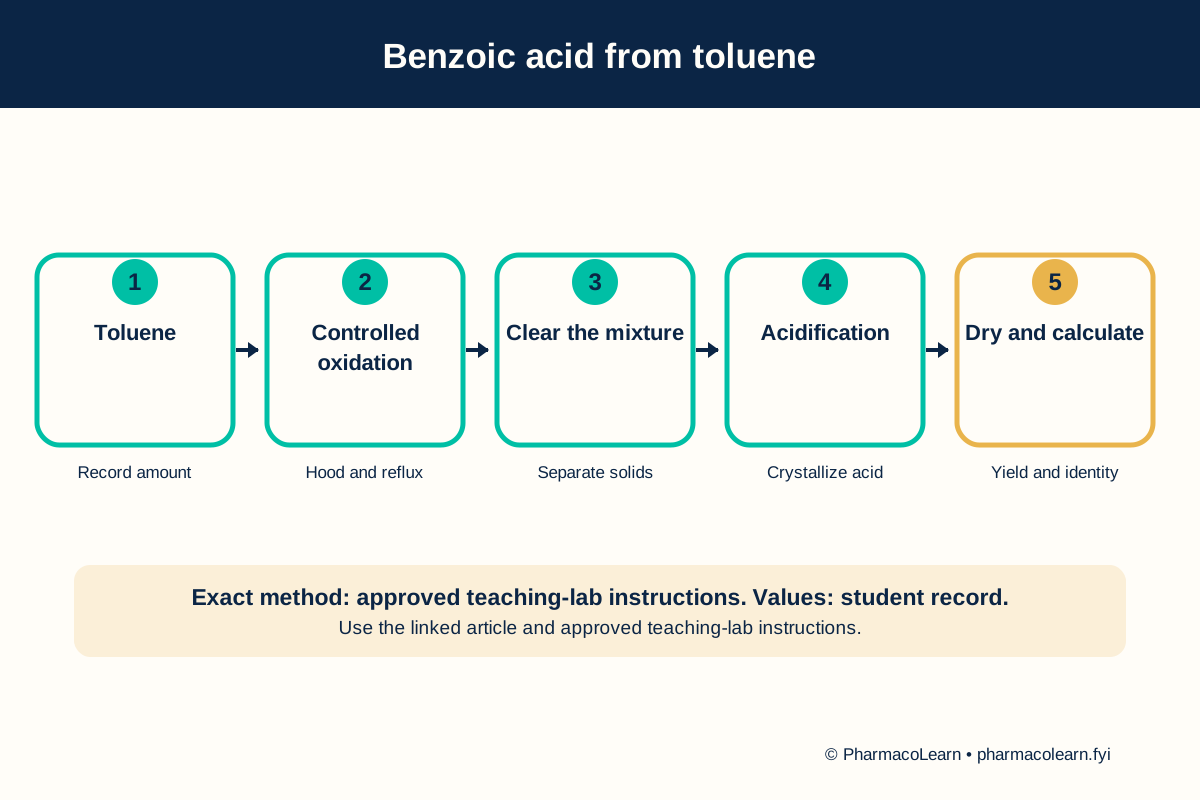
- Confirm that the assigned I.8 option is toluene oxidation, then review the local method, safety data, reflux setup, and waste segregation with the instructor. [1, 2]
- Record the actual toluene, oxidant, base, and water quantities. Exact concentrations and volumes are to be recorded from the instructor-approved demonstration protocol or dataset in the student record. [2]
- Assemble and check the reflux apparatus in a hood using the approved controlled heating method. Keep ignition sources away from toluene. [2, 3]
- Carry out the instructor-approved oxidation, monitoring time, temperature, and appearance. The addition sequence and endpoint are to be recorded from the instructor-approved demonstration protocol or dataset in the student record. [2]
- Cool and separate manganese-containing solids as prescribed. Do not discard them with general waste. [2]
- Acidify the cleared solution under supervision to the verified endpoint, cool to crystallize benzoic acid, then filter, wash, and dry the product. [2]
- Measure dry mass and any assigned identity result. Calculate theoretical and percentage yield from the limiting reagent and submit the waste record. [2]
5. Calculation, graph, or images as appropriate
| Observation | Actual laboratory record |
|---|---|
| Toluene amount | Record here |
| Oxidant and reflux conditions | Record here |
| Solid separation and acidification | Record here |
| Dry benzoic acid mass | Record here |
| Identity or purity evidence | Record here |
Pre-assumed values for calculation only, not a reagent recipe: Assume toluene is limiting at 1.00 g and the hypothetical dry benzoic acid mass is 0.900 g. With molar masses 92.14 g/mol for toluene and 122.12 g/mol for benzoic acid, toluene amount = 1.00 ÷ 92.14 = 0.0109 mol. The 1:1 theoretical acid mass = 0.0109 × 122.12 = 1.33 g. Percentage yield = 0.900 ÷ 1.33 × 100 = 67.9%, after rounding. The assumed amounts are not measured results or an operational scale. [3, 4]
6. Result
Report the actual isolated dry mass, calculated yield, appearance, and identity evidence. The experimental result must be recorded here. Safety note: This is a supervised teaching-lab reaction. Toluene is flammable, permanganate is a strong oxidant, acid can burn, and reflux equipment becomes hot. Use the approved hood and heating setup and retain each waste stream for designated disposal. [2, 3]
7. References
- Pharmacy Council of India. Pharm.D. Regulations, 2008, Pharmaceutical Organic Chemistry practical list.
- Uttarakhand Open University. Laboratory Courses III, section on preparation of benzoic acid from toluene.
- National Library of Medicine, PubChem. Toluene.
- National Library of Medicine, PubChem. Benzoic Acid.
Back to Pharmaceutical Organic Chemistry practicals | Pharm.D. Year 1 Practicals · All Pharm D Practicals · Pharm D
Theory notes: Pharmaceutical Organic Chemistry