
← Pharmaceutical Organic Chemistry practicals | Pharm.D. Year 1 Practicals
Preparation of Aspirin by Acetylation
1. Aim
To prepare aspirin from salicylic acid, isolate the solid product, and calculate its percentage yield. This article covers the aspirin option in Pharmaceutical Organic Chemistry practical item I.1, which the PCI lists as “Acetanilide / aspirin (Acetylation).” The approved local version, exact quantities, and acceptance criteria are to be recorded from the instructor-approved demonstration protocol or dataset in the student record. [1, 2]
2. Requirements
Salicylic acid, acetic anhydride, an instructor-approved catalyst, water and ice, a small reaction vessel, stirring equipment, controlled water bath, vacuum filtration apparatus, balance, drying surface or apparatus, labelled waste vessels, laboratory coat, eye protection, and suitable gloves are required. A melting-point apparatus may be used if the course requires a purity check. Michigan State University describes alternative catalysts and conditions; the institution's selected catalyst, reagent quantities, times, temperatures, and purification solvent are to be recorded from the instructor-approved demonstration protocol or dataset in the student record before practical work. [2]
3. Theory
Aspirin, or acetylsalicylic acid, forms when the phenolic hydroxyl group of salicylic acid is acetylated by acetic anhydride. One mole of salicylic acid can produce one mole of aspirin. An acid or other approved catalyst can accelerate the reaction. Water added after the reaction consumes remaining anhydride and helps the product crystallize as the mixture cools. Collected crystals must be dried before weighing; retained water or reagents would inflate the apparent yield. [2, 3]
Percentage yield compares the dry mass obtained with the theoretical mass from the limiting reagent. This mass comparison alone does not prove identity or purity. Melting behavior or another locally specified identification test may provide supporting evidence, but its method and acceptance limit are to be recorded from the instructor-approved demonstration protocol or dataset in the student record. [2]
4. Procedure
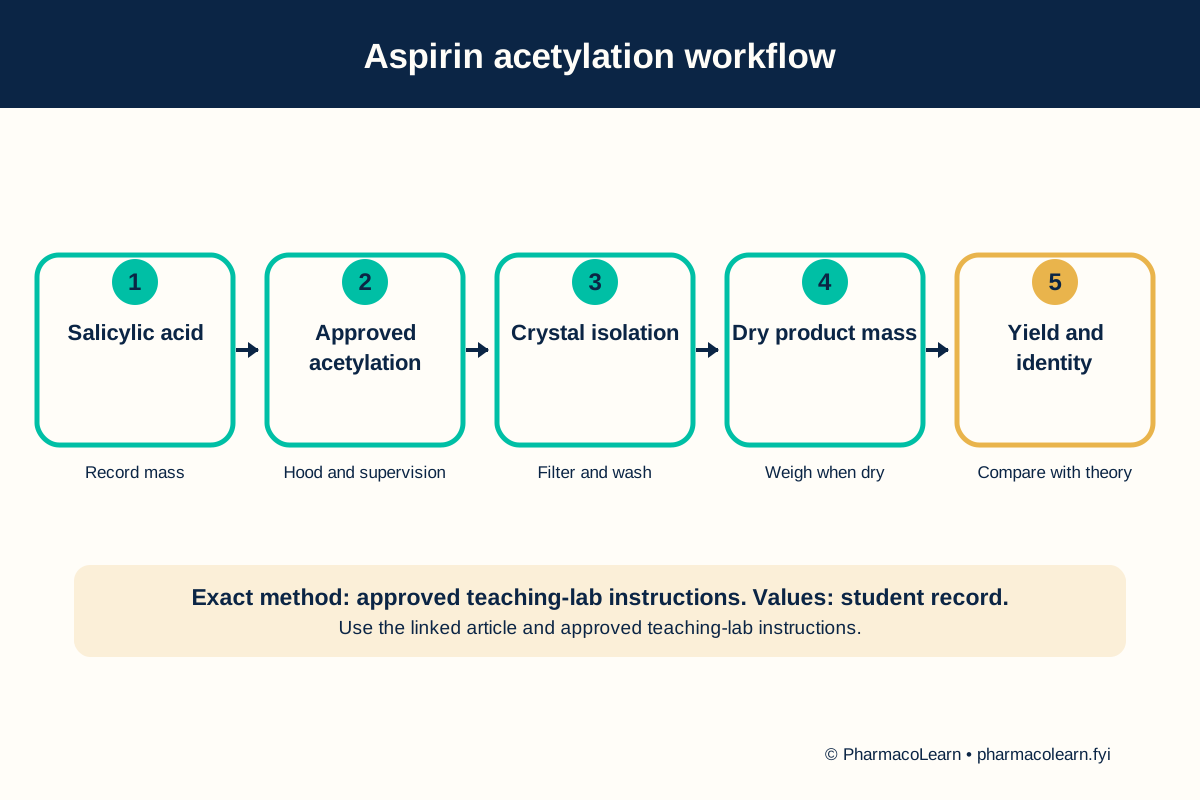
- Read the approved method and safety data with the instructor. Record the selected catalyst, planned reaction conditions, and waste route. All exact quantities are to be recorded from the instructor-approved demonstration protocol or dataset in the student record. [2]
- Label the reaction vessel and weigh the assigned salicylic acid. Record its actual mass and batch identity. [2]
- In a fume hood, combine the assigned acetic anhydride and catalyst with the salicylic acid in the sequence specified by the approved method. Add slowly while stirring; do not substitute catalysts without approval. [2]
- Maintain the specified mixing and temperature conditions, using a controlled water bath if required. Record time and observations. The target temperature and duration are to be recorded from the instructor-approved demonstration protocol or dataset in the student record. [2]
- After instructor confirmation, add the prescribed water in the approved manner to quench remaining anhydride and promote crystallization. Cool as directed. [2]
- Collect the crystals by vacuum filtration, wash using the assigned liquid and volume, and dry to the method's stated criterion. These details must follow your college lab manual and instructor's method sheet. [2]
- Weigh the dry product, record its appearance, and perform any assigned identity or purity check. Calculate theoretical mass and percentage yield from the limiting reagent. [2, 3]
5. Calculation, graph, or images as appropriate
| Observation | Actual laboratory record |
|---|---|
| Salicylic acid mass and batch | Record here |
| Acetic anhydride quantity and catalyst | Record here |
| Reaction time and temperature | Record here |
| Dry aspirin mass and appearance | Record here |
| Identity or purity check | Record here |
Pre-assumed values for calculation only, not experimental data: Assume salicylic acid is limiting and its mass is 1.00 g. Its molar mass is 138.12 g/mol, so the amount is 1.00 ÷ 138.12 = 0.00724 mol. The 1:1 relationship gives 0.00724 mol theoretical aspirin. Using aspirin's molar mass of 180.16 g/mol, theoretical mass = 0.00724 × 180.16 = 1.30 g. If a hypothetical dry product mass is 0.90 g, percentage yield = 0.90 ÷ 1.30 × 100 = 69.0% after rounding. The assumed acetic anhydride excess is a calculation condition, not a reagent instruction. [3, 4]
6. Result
Record the actual dry aspirin mass, percentage yield, and any identity or purity observation. For this unsupplied teaching run, the actual result must be recorded here. Safety note: Acetic anhydride and catalysts can injure skin and eyes, and the reaction may release heat. Handle reagents only under teaching-lab supervision, in the specified hood and protective equipment. Collect acidic and organic waste in assigned containers. Never taste or use the laboratory product as medicine. [2]
7. References
- Pharmacy Council of India. Pharm.D. Regulations, 2008, Pharmaceutical Organic Chemistry practical list.
- Michigan State University. Cooperative Organic Chemistry Student Laboratory Manual: Synthesis and Analysis of Painkillers, Planning Scenario and Background.
- National Library of Medicine, PubChem. Salicylic Acid.
- National Library of Medicine, PubChem. Aspirin.
Back to Pharmaceutical Organic Chemistry practicals | Pharm.D. Year 1 Practicals · All Pharm D Practicals · Pharm D
Theory notes: Pharmaceutical Organic Chemistry