
← Pharmaceutical Microbiology Practicals
Microbiological Assay of Antibiotics by Cup Plate Method
1. Aim
To compare an antibiotic test preparation with a reference standard using a validated cylinder-plate or cup-plate assay record. Antibiotic identity and potency are specified in your college lab manual and instructor's method sheet.
2. Requirements
Instructor-supplied plate images and zone measurements, reference-standard certificate, test dilution log, validated assay design, calibration record, USP <81>, protective equipment. Test organism, medium, standard range, cup geometry, incubation, and acceptance criteria are to be recorded from the assigned current monograph or approved college method in the student record.
3. Theory
An antibiotic diffuses into inoculated agar from a cup or cylinder and creates an inhibition zone. Under a validated design, zone size is related to activity and can be compared with a reference standard. The relationship depends on organism response, agar conditions, dose range, and plate layout. A zone diameter alone is not a potency percentage. USP <81> supplies the applicable microbial-assay framework; the specific monograph and validated calculation must govern any reportable potency.
4. Procedure
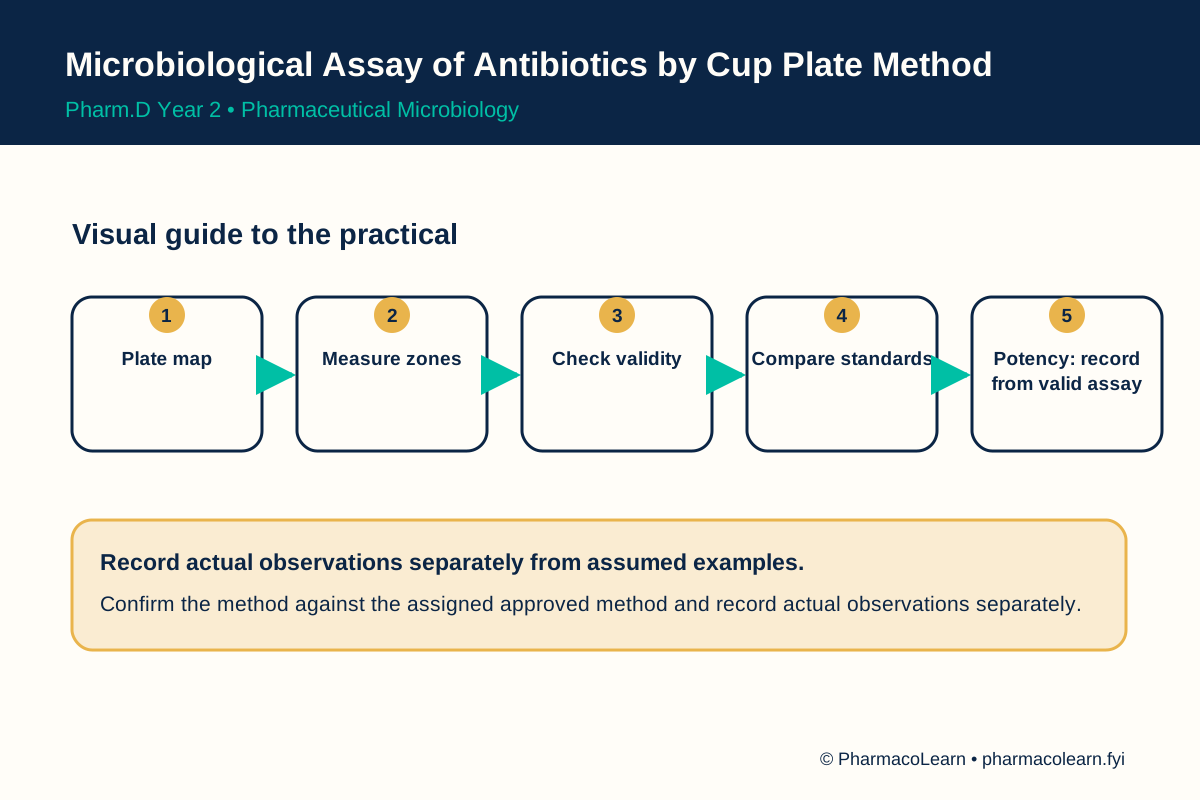
- Verify the antibiotic monograph, reference standard, test identity, plate map, and suitability controls.
- Identify the labelled standard and sample positions on each supplied plate image.
- Measure each complete inhibition zone according to the validated reading rule and record anomalies.
- Check replicate behaviour and the assay-validity criteria before fitting or applying the approved response calculation.
- Use only the verified calculation sheet to obtain potency and its units; otherwise record Record here.
5. Observation and calculation
| Student record field | Entry |
|---|---|
| Case or product | Record here |
| Method | Record here |
| Observation | Record here |
| Inference | Record here |
| Supervisor check | Record here |
| Outcome | Record here |
Assumed values for practice only: an assumed standard cup produces an assumed 18 mm zone and an assumed test cup produces an assumed 19 mm zone. These invented measurements show a table entry, not a potency calculation. Potency must be entered in the student record because a validated calibration model and dilution record are missing.
6. Output or final result
Give the assay-validity decision and calculated potency only when the approved model and controls are present. Actual potency: Record here.
Teaching-lab safety: Use recorded plates or an institution-approved low-risk assay organism. Antibiotic powders and cultures require supervised handling and controlled disposal.
This page is a supervised-activity guide; it does not report a completed case.
7. Sources
- PharmacoLearn Pharm.D Year 2 syllabus
- PCI Pharm.D Regulations and Syllabus
- USP <81>, Antibiotics: Microbial Assays
- ASM Guidelines for Biosafety in Teaching Laboratories
Back to Pharmaceutical Microbiology Practicals · All Pharm D Practicals · Pharm D
Theory notes: Pharmaceutical Microbiology