
← Medicinal Biochemistry practicals | Pharm.D. Year 1 Practicals
Quantitative Estimation of Urine Sugar by Benedict's Reagent Method
1. Aim
To describe and calculate a source-based Benedict quantitative titration of urine reducing sugar. This historical method is listed in the PCI Medicinal Biochemistry practical syllabus. The reported result is a reducing-sugar equivalent under a verified calibration, not a glucose-specific clinical diagnosis. [1, 2]
2. Requirements
The college manual names Benedict quantitative reagent, anhydrous sodium carbonate, a urine specimen, burette, pipette, conical flask, heat source, and porcelain chips. A current institutional method must specify reagent composition, standardization, aliquot size, endpoint, specimen dilution, replicate rule, and protective controls. The manual's reagent-preparation text is internally unclear, so no reagent should be prepared from it alone. Reagent composition and all working conditions must follow your college lab manual and instructor's method sheet. A worksheet with authenticated titration data can be used instead of heating a biological specimen. [2]
3. Theory
Benedict quantitative reagent contains copper ions that are reduced by reducing substances in the specimen. The endpoint in the cited procedure is loss of the blue color while the solution is hot. Because other reducing compounds can also react, the result must be described as reducing-sugar equivalent unless glucose specificity has been established by another method. The manual's explanation contains chemically inconsistent wording about copper oxidation state and a reagent recipe that needs checking. Its claimed factor of 100 mg glucose equivalent per 50 mL reagent is a historical calibration statement, not a universal property of every Benedict reagent bottle. [2]
Titration volume is inversely related to apparent reducing-sugar concentration under a fixed reagent aliquot and valid calibration. A smaller urine volume needed to reach the endpoint suggests more reducing capacity in that specimen, but color, interfering substances, dilution, and reagent instability can distort the result. The user of the result needs the blank or standard check and the sample dilution recorded. Modern clinical assessment should use a validated glucose-specific method and clinical context. [2, 3]
4. Procedure
- Confirm the specimen identity and biosafety controls. If using supplied data, label the worksheet as a calculation exercise. [2]
- Obtain a current standard operating procedure and the reagent's verified factor. Record method version, reagent lot, expiry, specimen dilution, and calibration here until documented. [2]
- Under instructor supervision, set up the approved titration apparatus and protective measures for a hot alkaline reagent. The exact reagent and specimen volumes must follow your college lab manual and instructor's method sheet against that procedure. [2]
- Run the prescribed blank or standard check. If it fails, do not calculate a specimen result. [2]
- Record each specimen titre and the observed endpoint without rounding away disagreement. The manual expects repeat titrations; the local concordance rule must follow your college lab manual and instructor's method sheet. [2]
- Calculate a reducing-sugar equivalent using the verified factor, titre, and any specimen dilution. Preserve the original units and show the conversion to the chosen reporting unit. [2]
- Review the calculation with the instructor. reserve clinical interpretation for qualified review and record any glucose-specific confirmation from the approved laboratory method. Dispose of heated chemical and biological waste through approved streams. [2, 3]
5. Calculation, graph, or images as appropriate
| Record item | Source or worksheet value | Status |
|---|---|---|
| Reagent calibration in manual | 100 mg glucose equivalent per 50 mL reagent [2] | Reagent-specific factor Record here |
| Manual aliquot | 10 mL reagent [2] | Current method aliquot Record here |
| Specimen titre | Actual reading Record here | Replicate agreement Record here |
| Specimen dilution | Record here | Include in final calculation |
| Final reducing-sugar equivalent | Record here | Do not label glucose-specific |
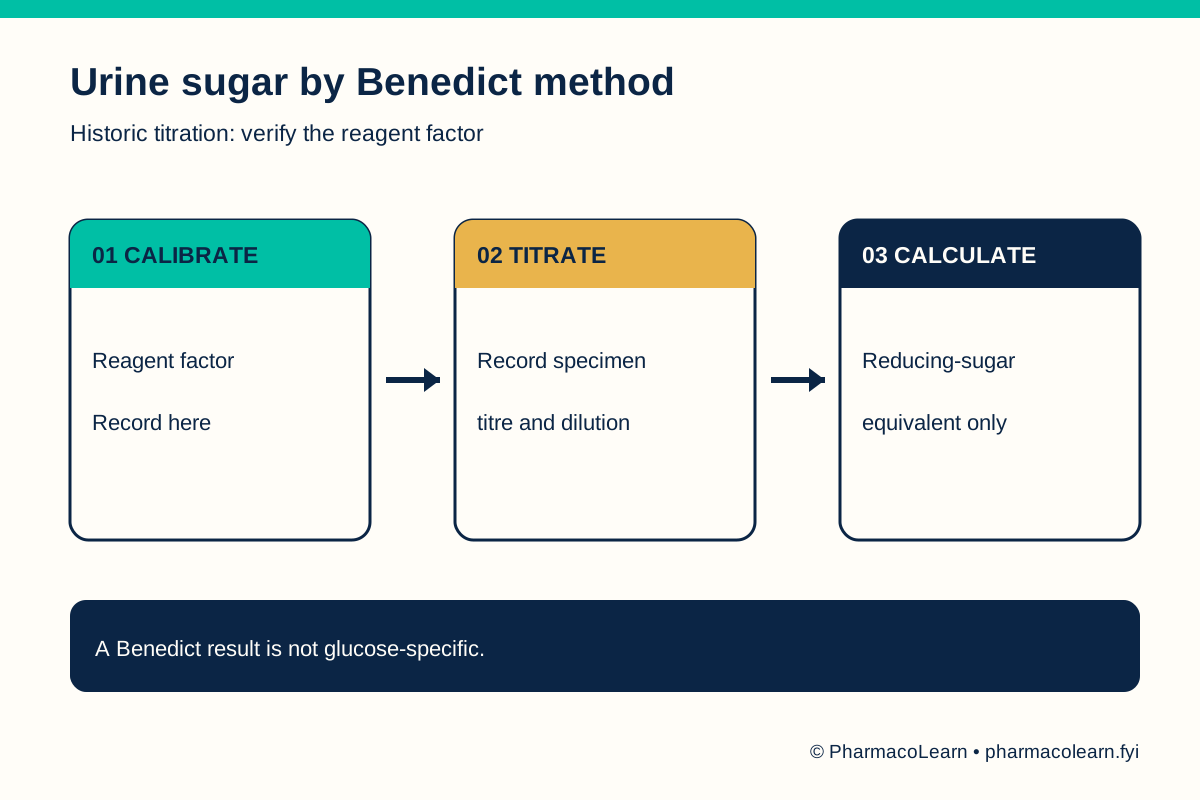
Worked source-factor calculation: The manual states a 50 mL reagent amount equivalent to 100 mg of glucose. On that stated basis only, a 10 mL aliquot corresponds to (100 mg ÷ 50 mL) × 10 mL = 20 mg glucose equivalent. If a verified specimen titre is called V mL and the dilution factor is D, the conditional report is (20 mg ÷ V mL) × 100 mL × D in mg per 100 mL of original specimen. The measured V, D, and reagent factor must be recorded here; therefore no patient result is invented. [2]
6. Result
Report the actual titre, standardization status, dilution, calculation, and units only when supplied and checked. State that the historical result represents reducing capacity expressed as glucose equivalent. The clinical glucose result and interpretation must be recorded here. [2, 3]
7. References
- Pharmacy Council of India. Pharm.D. Regulations, 2008, Medicinal Biochemistry practical list.
- East Point College of Pharmacy. Medicinal Biochemistry Practical Manual, Benedict quantitative experiment. Supplies the historical method and factor; its reagent description requires verification.
- National Library of Medicine, MedlinePlus. Urinalysis. Provides clinical context for urine screening.
Back to Medicinal Biochemistry practicals | Pharm.D. Year 1 Practicals · All Pharm D Practicals · Pharm D
Theory notes: Medicinal Biochemistry