
← Medicinal Biochemistry practicals | Pharm.D. Year 1 Practicals
Quantitative Estimation of Urine Chloride by Volhard's Method
1. Aim
To explain a Volhard back titration for urine chloride and calculate the specimen fraction represented by the manual's filtrate aliquot. A chloride concentration is reported only when standardized titrant data and a valid blank are available. [1, 2]
2. Requirements
The college manual lists a urine specimen, standard silver nitrate, ammonium thiocyanate, ferric alum indicator, nitric acid, pipettes, volumetric flask, filter paper, burette, and conical flasks. The current method must define titrant concentration, standardization, specimen volume, dilutions, endpoint rule, blank, and waste handling. Concentrated nitric acid and silver salts need controlled handling and appropriate protective equipment. All unsupplied concentrations and measured titres must be recorded here. [2]
3. Theory
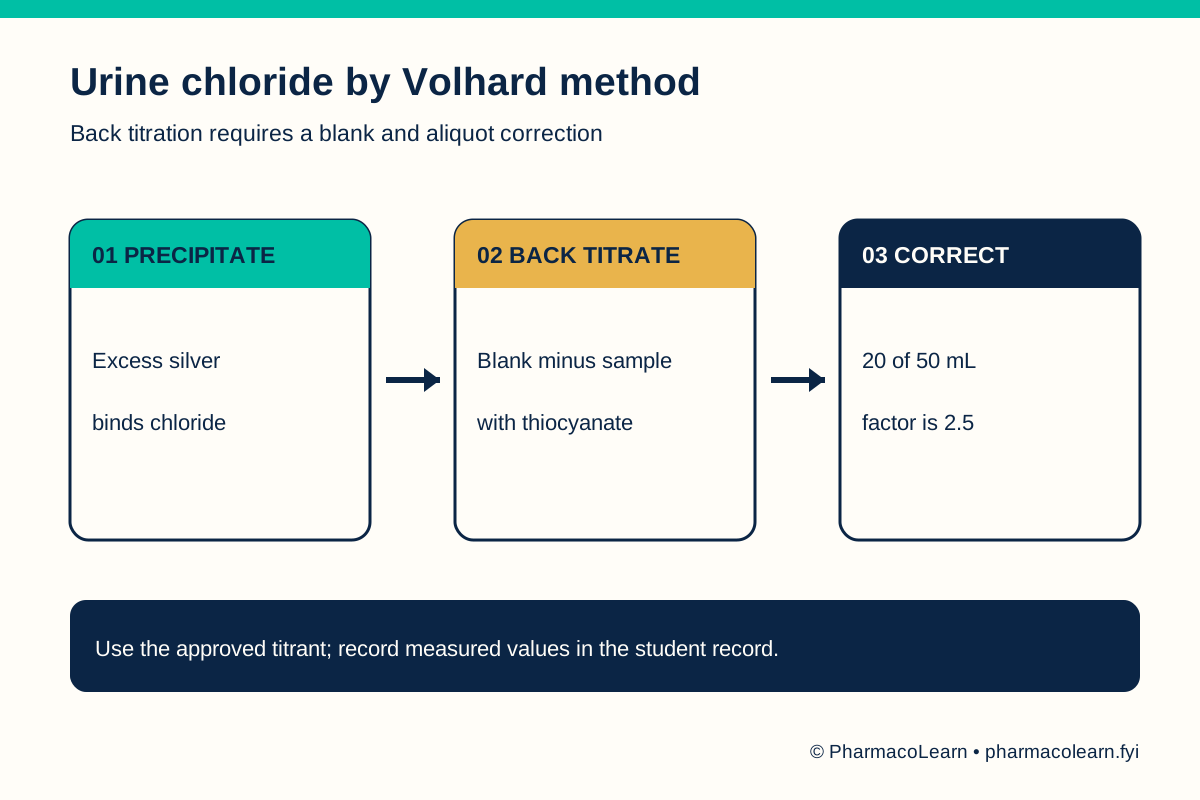
In the Volhard approach, an excess of silver ion precipitates chloride. The unreacted silver ion is then measured by titration with thiocyanate in an acid medium. Ferric ion gives a persistent reddish endpoint once thiocyanate remains in slight excess. A blank records how much silver would remain without urine chloride; the difference between blank and specimen titration reflects silver consumed by chloride, provided both aliquots and titrants are comparable. [2]
The manual prepares a diluted filtrate and titrates only a portion. That fraction must be carried into any final concentration. The manual's printed calculation appears to confuse the sample and blank labels and does not transparently account for all dilution steps. The safest student record shows raw titres, standardized concentrations, aliquot fraction, and units separately. No normal urinary chloride value is assigned here: excretion varies with diet, collection period, kidney function, and clinical circumstances. Any reference interval must follow your college lab manual and instructor's method sheet for the actual specimen and laboratory. [2, 3]
4. Procedure
- Confirm the specimen identity, collection type, and handling conditions. A spot specimen and timed collection have different reporting needs. Record absent data as blank fields in the student record. [2, 3]
- Obtain the approved method and standardized titrant records. Check blank plan, filtration method, acid handling controls, and endpoint description. [2]
- Under supervision, have the specified urine aliquot reacted with a measured excess of silver nitrate in the required acid conditions. Use only the current written method; the manual values are historical teaching data. [2]
- Complete the specified dilution and filtration without losing or relabeling material. Record the total filtrate volume and the portion selected for titration. [2]
- Titrate the filtrate aliquot with standardized thiocyanate to the approved persistent endpoint. Record initial and final burette readings. [2]
- Repeat with the blank and with specimen replicates as the method requires. If the blank or standardization fails, withhold the concentration result. [2]
- Calculate the chloride amount from the blank-minus-sample difference and the verified stoichiometry, then correct for the filtrate aliquot and original specimen volume. Have the instructor check the final units. [2]
5. Calculation, graph, or images as appropriate
| Record item | Manual setup [2] | Actual record |
|---|---|---|
| Original urine aliquot | 10 mL | Record here |
| Final filtrate volume | 50 mL | Record here |
| Portion titrated | 20 mL | Record here |
| Sample thiocyanate titre | Not given | Record here |
| Blank thiocyanate titre | Not given | Record here |
| Standardized thiocyanate concentration | Not specified clearly | Record here |
| Chloride result and units | Dependent on data | Record here |
Worked aliquot calculation: The manual dilutes a 10 mL urine aliquot to 50 mL and titrates 20 mL of that filtrate. The fraction of the diluted sample titrated is 20 ÷ 50 = 0.40. That aliquot represents 0.40 × 10 mL = 4 mL of the original urine, assuming quantitative transfer and uniform dilution. An amount measured in the titrated portion must be multiplied by 50 ÷ 20 = 2.5 to estimate the amount in the full original 10 mL aliquot. The blank-minus-sample titre and titrant concentration must follow your college lab manual and instructor's method sheet, so no chloride concentration is claimed. [2]
6. Result
Record sample and blank titres, verified titrant concentration, aliquot correction, and final unit if valid data are supplied. Without those values the chloride result must be recorded here. Interpretation requires the relevant collection type and laboratory reference information. [2, 3]
7. References
- Pharmacy Council of India. Pharm.D. Regulations, 2008, Medicinal Biochemistry practical list.
- East Point College of Pharmacy. Medicinal Biochemistry Practical Manual, Volhard urine chloride experiment. Supplies the historical apparatus and aliquots.
- National Library of Medicine, MedlinePlus. Chloride: urine test. Explains clinical context and specimen collection.
Back to Medicinal Biochemistry practicals | Pharm.D. Year 1 Practicals · All Pharm D Practicals · Pharm D
Theory notes: Medicinal Biochemistry