
← Medicinal Biochemistry practicals | Pharm.D. Year 1 Practicals
Qualitative Analysis of Abnormal Constituents of Urine
1. Aim
To screen a teaching urine specimen for selected abnormal constituents and document the limits of each qualitative result. The PCI syllabus lists this as the second Medicinal Biochemistry practical. A teaching result is not a diagnosis. [1, 2, 3]
2. Requirements
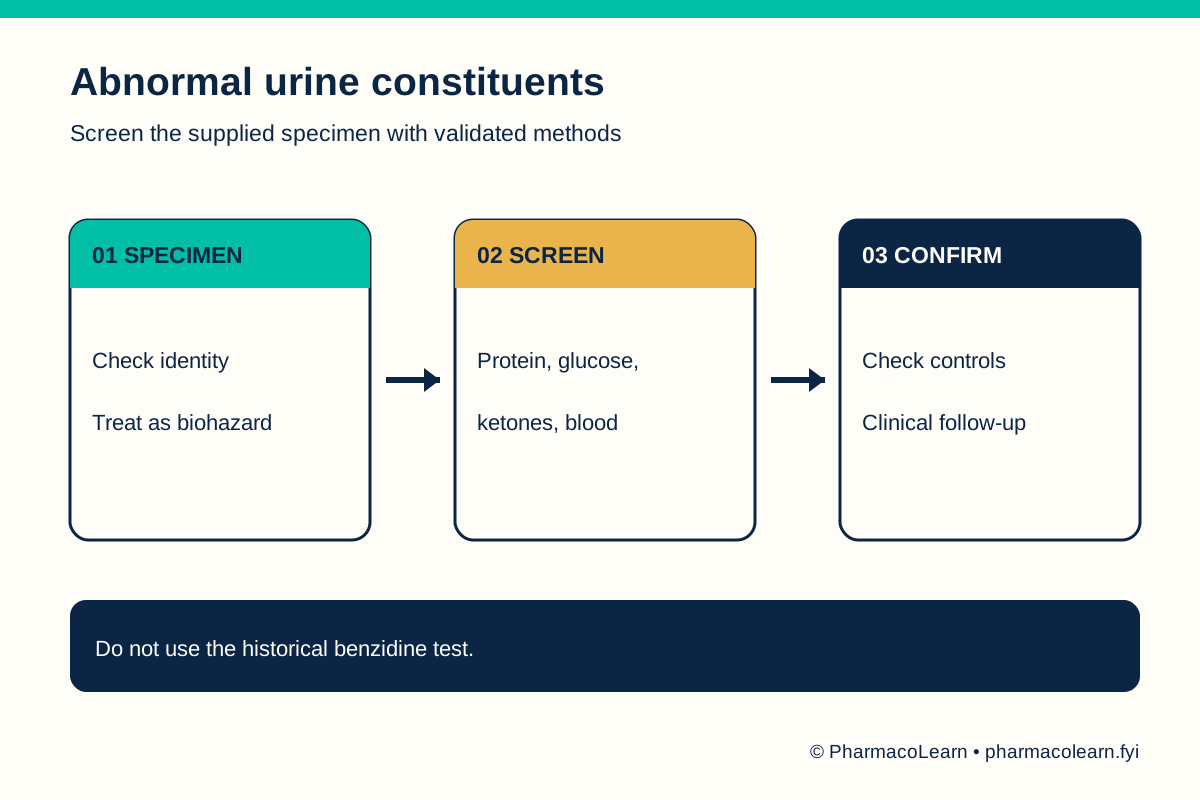
Use an instructor-approved control or deidentified specimen, labelled test tubes or validated test strips, appropriate controls, timer, gloves, coat, eye protection, and a result sheet. The college manual discusses protein, reducing sugar, ketone bodies, bile pigments, bile salts, and blood. It also includes a historical benzidine blood test. Because benzidine is a recognized carcinogen, do not use that test; choose a locally approved modern method for blood detection. Exact strip brand, reagent composition, volumes, timing, and decision thresholds must follow your college lab manual and instructor's method sheet. [2, 4]
3. Theory
Urinalysis may detect substances such as excess protein, glucose, ketones, bilirubin, and blood. Different tests answer different questions. Benedict's reaction detects reducing substances and does not specifically identify glucose. A glucose oxidase test is more specific for glucose. Protein tests may have interference from urine conditions, and a positive blood strip cannot by itself distinguish intact red cells from free hemoglobin or myoglobin. A single abnormal screen therefore requires confirmation and clinical context. [2, 3]
The manual includes several chemical tube tests. Some use strong acid, ammonia, or heat. For this article, the selected panel is performed only under a written current laboratory method, preferably with prepared controls. Record the method actually used rather than copying a historical procedure. If specimen identity, expiry of a reagent, or control result is unknown, the finding must be recorded here. The common language of positive and negative applies only to the chosen method's cutoff; it does not prove presence or absence at every concentration. [2, 3]
4. Procedure
- Confirm the teaching specimen identity, collection and storage details, and whether the sample is a control. Missing information must be recorded here. [2, 3]
- Select a locally approved panel for protein, glucose or reducing substances, ketones, bilirubin, and blood. Record which target each method actually detects. Do not use benzidine. [2, 4]
- Check reagent or strip expiry, lot, controls, reading time, and specimen volume against the local procedure. Enter your college lab manual and instructor's method sheet for any unspecified value. [2]
- Perform each authorized test on a separate aliquot or specified strip pad, following the current written method and its protective controls. [2, 3]
- At the specified time, record the observed color, turbidity, or instrument reading in the observation column before writing an interpretation. [2]
- Compare the response with both positive and negative controls. Mark a failed-control test invalid, even if the sample changed color. [2, 3]
- Record any presumptive positive for instructor review and follow the instructor-approved confirmatory method. Dispose of specimen and chemical waste through local channels. [2, 3]
5. Calculation, graph, or images as appropriate
| Target | Method selected | Control status | Sample observation | Inference |
|---|---|---|---|---|
| Protein | Record here | Record here | Record here | Record here |
| Glucose or reducing substances | Record here | Record here | Record here | Record here |
| Ketones | Record here | Record here | Record here | Record here |
| Bilirubin | Record here | Record here | Record here | Record here |
| Blood or heme signal | Approved method Use approved local method | Record here | Record here | Record here |
Worked record calculation: A five-target panel with one sample reading and two control readings for each target requires 5 × 3 = 15 entries. If one target lacks a valid control, only four targets can be interpreted, and that target's result must be recorded here. This arithmetic checks record completeness; it does not establish a clinical cutoff. [2]
6. Result
Report each target as presumptive positive, presumptive negative, indeterminate, or invalid, with the observed response and control status. Do not equate a reducing-substance result with confirmed glucose. Qualified review is required for clinical meaning; record the assigned confirmatory test from the approved method. [2, 3]
7. References
- Pharmacy Council of India. Pharm.D. Regulations, 2008, Medicinal Biochemistry practical list.
- East Point College of Pharmacy. Medicinal Biochemistry Practical Manual, abnormal urine constituent section.
- National Library of Medicine, MedlinePlus. Urinalysis.
- National Institute for Occupational Safety and Health. Benzidine. Documents the occupational hazard of the historical test reagent.
Back to Medicinal Biochemistry practicals | Pharm.D. Year 1 Practicals · All Pharm D Practicals · Pharm D
Theory notes: Medicinal Biochemistry