
← Medicinal Biochemistry practicals | Pharm.D. Year 1 Practicals
Quantitative Estimation of Urine Creatinine by Jaffe's Method
1. Aim
To calculate urine creatinine from a blank-corrected colorimetric comparison with a verified standard. This is the fifth Medicinal Biochemistry practical in the PCI order. No result is assigned to an unsupplied specimen. [1, 2]
2. Requirements
The college manual lists urine, creatinine standard, picric acid, sodium hydroxide, water, pipettes, volumetric vessels, cuvettes, and a colorimeter. Use only a supervised institutional method with calibrated equipment, a documented standard concentration, reagent lot, blank, dilution, and quality control. Exact current reagent concentrations, volumes, incubation, and acceptance criteria must follow your college lab manual and instructor's method sheet. Treat urine as potentially infectious and alkaline picrate as a controlled chemical reagent. [2, 3]
3. Theory
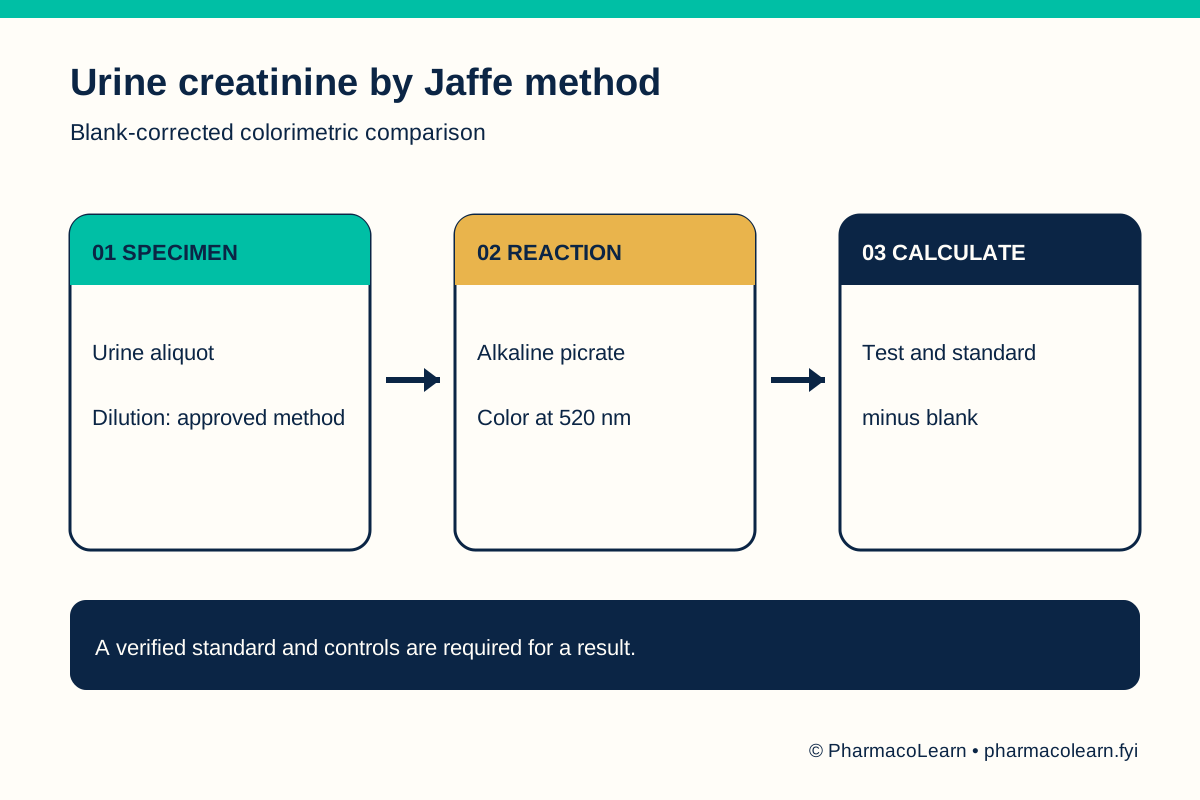
In the Jaffe reaction, creatinine produces an orange-red color with picrate in alkaline solution. The optical response is compared with a known standard after subtracting the blank. The manual specifies an observation near 520 nm and describes separate test, standard, and blank mixtures. A color intensity is not inherently a concentration; the standard factor and any dilution must be included. The classic Jaffe reaction also has non-creatinine interferences, so a teaching result cannot be used as an independent clinical decision. [2, 3]
The manual's calculation passage changes between mass, concentration, and a final 50 mL volume without keeping the original urine aliquot clear. A valid computation should label each vessel and track the original urine volume explicitly. The same manual later has a serum-creatinine section whose procedural table says urine, making source verification especially important. This article concerns urine only. [2]
4. Procedure
- Confirm the urine sample identity, collection type, storage, and any predilution. Leave unknowns blank in the student record until confirmed. [2, 3]
- Review the approved Jaffe method, standard certificate, wavelength, measurement time, and quality-control limits. Record the method version. [2]
- Under instructor supervision, label separate blank, standard, and test vessels. Add the appropriate matrix and reagents according to the verified local procedure. Do not rely on the manual's ambiguous final-volume calculation. [2]
- Allow the reaction to develop for the specified time and read each vessel with the same instrument settings. The current timing and wavelength must follow your college lab manual and instructor's method sheet. [2]
- Record raw absorbance values and subtract the blank. If the corrected standard response is zero or a quality control fails, withhold the result. [2]
- Calculate specimen creatinine using the verified standard concentration, sample-to-standard volume relationship, and specimen dilution factor. Keep mg/dL distinct from mg per total collection. [2, 3]
- Submit the calculation and any interference or specimen-quality concerns for instructor review. Dispose of biological and picrate-containing waste as directed locally. [2]
5. Calculation, graph, or images as appropriate
| Record field | Source or actual value | Status |
|---|---|---|
| Blank absorbance | Measured value Record here | Required for correction |
| Standard absorbance and concentration | Use approved local method | Verify certificate and units |
| Urine absorbance | Record here | Record raw value |
| Urine predilution | Record here | Apply only if documented |
| Original urine aliquot | Manual table says 2.5 mL [2] | Current method Record here |
| Final result | Record here | Specify concentration and collection type |
Worked source-volume check: The manual's test table uses a 2.5 mL urine portion and makes the reaction mixture to 50 mL. The reaction-vessel dilution from this step is 50 ÷ 2.5 = 20. Because the standard is treated in a parallel vessel, this common reaction dilution does not automatically mean the urine result is multiplied by 20. A separate specimen predilution must follow your college lab manual and instructor's method sheet. The conditional absorbance ratio is (test minus blank) ÷ (standard minus blank); no concentration is calculated without actual readings and a verified standard. [2]
6. Result
Report a measured urine creatinine concentration only with valid blank, standard, controls, original specimen volume, and units. Record supplied readings here. Clinical interpretation requires qualified review; this page does not interpret findings. A teaching colorimetric estimate does not replace a validated laboratory result. [2, 3]
7. References
- Pharmacy Council of India. Pharm.D. Regulations, 2008, Medicinal Biochemistry practical list.
- East Point College of Pharmacy. Medicinal Biochemistry Practical Manual, urine creatinine by Jaffe method.
- National Library of Medicine, MedlinePlus. Creatinine Test. Explains urine and blood creatinine testing.
Back to Medicinal Biochemistry practicals | Pharm.D. Year 1 Practicals · All Pharm D Practicals · Pharm D
Theory notes: Medicinal Biochemistry