
← Medicinal Biochemistry practicals | Pharm.D. Year 1 Practicals
Quantitative Estimation of Urine Calcium by Precipitation
1. Aim
To explain precipitation of urine calcium as calcium oxalate and calculate a source-based calcium factor for a subsequent permanganate titration. This is the sixth Medicinal Biochemistry practical listed by PCI. [1, 2]
2. Requirements
The college manual names urine, ammonium oxalate, ammonia, methyl red, sulfuric acid, potassium permanganate, centrifuge tube, pipette, water bath, and burette. Use a current institutional procedure for reagent concentrations, precipitation and wash conditions, centrifuge balance, standardized titrant, blank, and waste disposal. The manual gives a 2 mL urine aliquot and a 0.01 N permanganate factor, but actual reagent identity, standardization, and measured titres must be recorded here. [2]
3. Theory
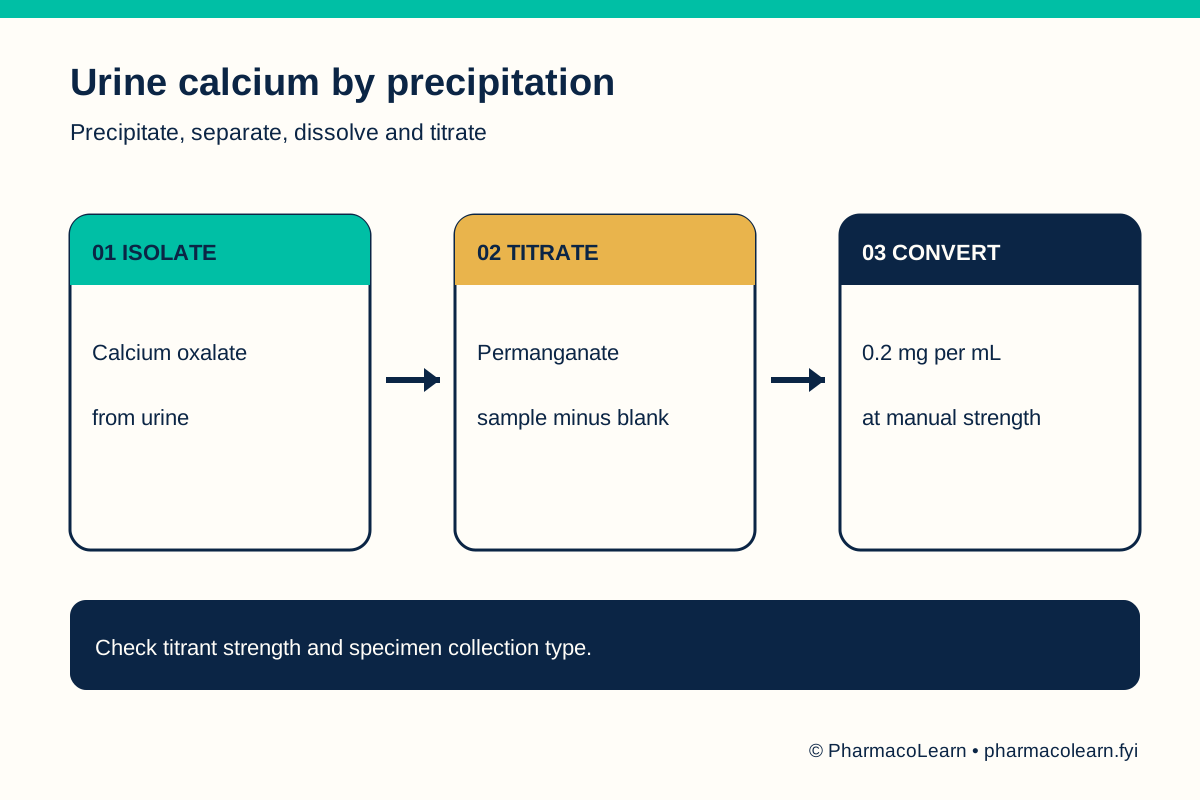
Calcium can be isolated from a urine aliquot as calcium oxalate under controlled conditions. After separating and washing the precipitate, acid releases an oxalate equivalent that can be titrated with permanganate. The measured permanganate consumption is related stoichiometrically to calcium in the aliquot. Incomplete precipitation, loss of precipitate, retained soluble oxalate, or an unsuitable blank can distort the answer. [2]
The manual gives a factor of 0.2 mg calcium for each milliliter of 0.01 N permanganate. This is consistent with calcium's equivalent mass and a permanganate normality of 0.01 N, but the factor is valid only for standardized titrant and the described chemistry. A spot urine concentration is not the same as calcium excreted during a full-day collection. Clinical interpretation depends on collection type, diet, medications, and the laboratory's validated reference information. [2, 3]
4. Procedure
- Confirm specimen identity, collection type, urine aliquot, and biosafety controls. Record unknown details Record here. [2, 3]
- Check the current procedure for reagent identity, concentrations, precipitation pH, standing time, and centrifuge settings. Verify that the centrifuge tubes are balanced. [2]
- Under supervision, add the urine aliquot and approved precipitating reagents in the required order. Record any visible precipitate, but do not infer calcium amount from its appearance. [2]
- Separate and wash the precipitate as the approved method specifies. Keep the blank and sample processing matched. [2]
- Dissolve the precipitate in the specified acid under the method's heat and splash controls. Record any incomplete dissolution. [2]
- Titrate with standardized permanganate to the approved persistent endpoint. Record sample and blank titres. [2]
- Subtract the blank, apply the verified factor and original urine volume, then report the units. Have the instructor review the arithmetic and quality controls. [2, 3]
5. Calculation, graph, or images as appropriate
| Record item | Manual or worksheet | Actual value |
|---|---|---|
| Original urine aliquot | 2 mL [2] | Record here |
| Permanganate nominal strength | 0.01 N [2] | Standardization Record here |
| Calcium factor | 0.2 mg per mL at 0.01 N [2] | Applicability Record here |
| Sample titre | Not supplied | Record here |
| Blank titre | Not supplied | Record here |
| Calcium result | Depends on corrected titre | Record here |
Worked factor conversion: At the manual's factor, each 1 mL of blank-corrected titre represents 0.2 mg calcium in the 2 mL urine aliquot. Expressed per 100 mL, that is 0.2 mg × (100 ÷ 2) = 10 mg per 100 mL for each corrected milliliter. Therefore the conditional result is 10 × (sample titre minus blank titre) mg/dL. The actual titre difference and titrant standardization must be recorded here, so this is not a specimen result. [2]
6. Result
Record the precipitate observation, corrected titre, verified factor, calculated calcium concentration, collection type, and any quality-control problem. Where actual readings are absent, report Record here. Do not interpret a spot teaching result as full-day excretion. [2, 3]
7. References
- Pharmacy Council of India. Pharm.D. Regulations, 2008, Medicinal Biochemistry practical list.
- East Point College of Pharmacy. Medicinal Biochemistry Practical Manual, urine calcium by precipitation.
- National Library of Medicine, MedlinePlus. Calcium in Urine Test. Describes collection and interpretation limits.
Back to Medicinal Biochemistry practicals | Pharm.D. Year 1 Practicals · All Pharm D Practicals · Pharm D
Theory notes: Medicinal Biochemistry