
← Medicinal Biochemistry practicals | Pharm.D. Year 1 Practicals
Quantitative Estimation of Serum Cholesterol by Liebermann-Burchard's Method
1. Aim
To examine the principle of the historical Liebermann-Burchard color reaction and audit the standard calculation before a serum cholesterol value is reported. PCI lists this as the seventh Medicinal Biochemistry practical. The cited college manual spells the name “Libermann Burchard”; this page uses the conventional spelling while preserving the syllabus identity. [1, 2]
2. Requirements
Use the syllabus, manual, calculator, blank observation sheet, and instructor-supplied absorbance readings or spectra. The manual's historical wet method names serum, cholesterol standard, alcohol, ether, chloroform, acetic anhydride, sulfuric acid, pipettes, centrifuge, and colorimeter. Ether is highly flammable, chloroform has exposure hazards, and the acid mixture is corrosive. A physical demonstration requires an approved controlled laboratory method; none is instructed here. Standard identity, instrument calibration, reagent handling, and valid absorbance data must follow your college lab manual and instructor's method sheet. [2, 3]
3. Theory
The historical method extracts cholesterol-containing material from serum and produces a green color in the Liebermann-Burchard reaction. The blank-corrected color intensity of a test is compared with a prepared standard under matched conditions. The manual states a reading at 680 nm. An absorbance ratio is meaningful only if the standard's amount, extraction recovery, blank, reaction timing, and optical response are valid. This is a historical teaching method, not a replacement for a current clinical lipid assay. [2, 4]
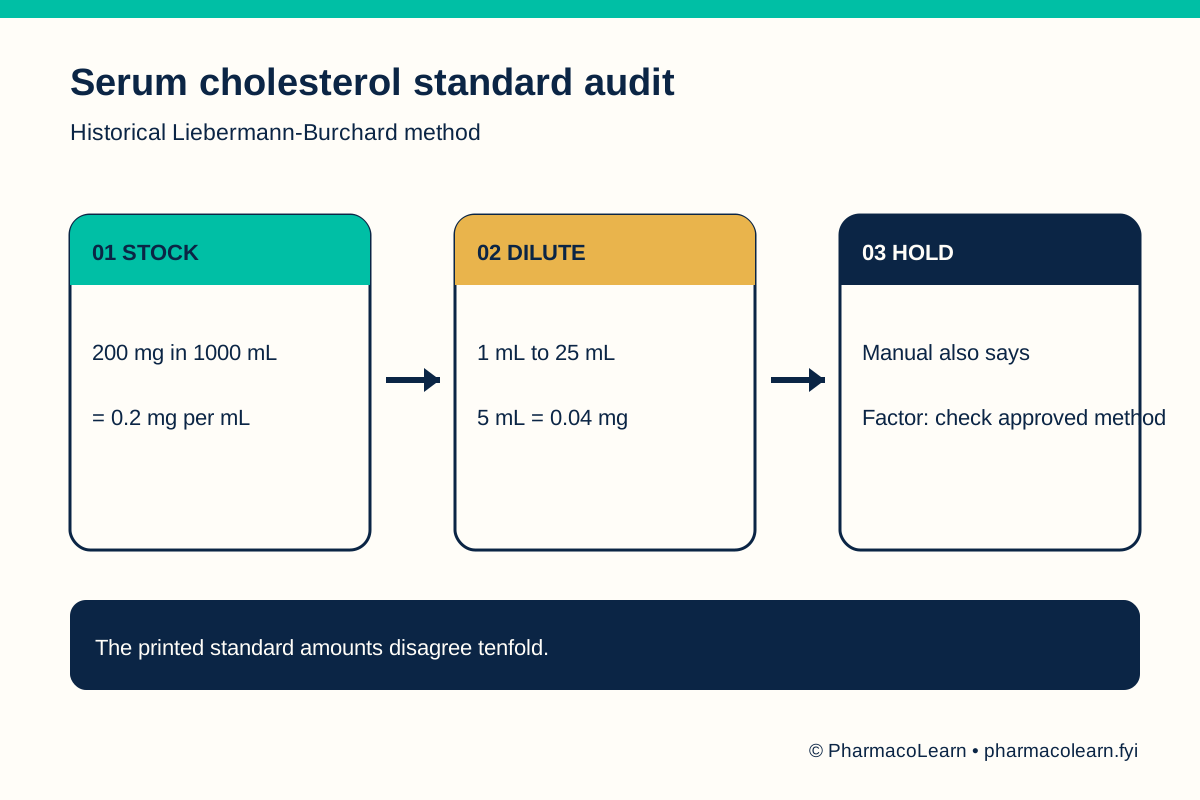
The manual has a material standard discrepancy. Its reagent section says 200 mg cholesterol in 1000 mL, then 1 mL of that stock diluted to 25 mL. Five milliliters of that working standard therefore contains 0.04 mg cholesterol. A nearby sentence says 0.4 mg, while the later calculation shows 0.04 mg. This tenfold conflict must be resolved against an authenticated standard preparation record before any concentration is computed. The manual's broad “normal” range is not used here because interpretation depends on the current clinical context and laboratory reporting standard. [2, 4]
4. Procedure
- Confirm that the exercise uses supplied data or a separately approved supervised method. Do not prepare the solvent and acid mixtures from this article. [2, 3]
- Transcribe the stock and working-standard descriptions into the calculation record. Check mass and volume units independently. Flag the 0.4 mg versus 0.04 mg conflict. [2]
- If using supplied measurements, identify which reading is blank, standard, and test. Check whether all were processed under matched conditions and at the documented wavelength. [2]
- Subtract the blank absorbance from standard and test. A zero or negative corrected standard response invalidates the simple ratio. [2]
- Record serum aliquot, standard amount, extraction factor, and instrument quality controls here until documented. [2]
- Only after the standard conflict is resolved, calculate the serum concentration using the verified standard amount and the ratio of corrected absorbances. Show each unit conversion. [2]
- Reserve clinical interpretation for qualified review and submit the record to the instructor. Any physical specimen and solvent waste stay under institutional controls. [2, 3, 4]
5. Calculation, graph, or images as appropriate
| Standard or reading | Manual entry [2] | Audit finding |
|---|---|---|
| Stock | 200 mg in 1000 mL | 0.2 mg/mL |
| Working standard | 1 mL stock to 25 mL | 0.008 mg/mL |
| Five milliliters working standard | Sentence says 0.4 mg | Arithmetic gives 0.04 mg |
| Blank, standard, test absorbance | Not supplied | Record here |
| Serum aliquot and recovery | Requires authenticated record | Record here |
Worked standard check: 200 mg ÷ 1000 mL = 0.2 mg/mL. A 1 mL stock aliquot contains 0.2 mg. Diluting it to 25 mL gives 0.2 ÷ 25 = 0.008 mg/mL. Five milliliters then contains 0.008 × 5 = 0.04 mg, one-tenth of the manual sentence's 0.4 mg claim. The correct standard record must be recorded here; no serum result is calculated. [2]
6. Result
Record the tenfold source discrepancy and withhold any serum cholesterol concentration until the standard is authenticated and blank-corrected readings are supplied. Report the method as a historical teaching example, with specimen results recorded here; clinical interpretation requires qualified review; this page does not interpret findings. [2, 4]
7. References
- Pharmacy Council of India. Pharm.D. Regulations, 2008, Medicinal Biochemistry practical list.
- East Point College of Pharmacy. Medicinal Biochemistry Practical Manual, serum cholesterol by Libermann Burchard method. Contains the conflicting standard entries.
- National Institute for Occupational Safety and Health. Pocket Guide: Chloroform. Documents a hazard of the historical extraction solvent.
- National Library of Medicine, MedlinePlus. Cholesterol Levels. Explains clinical lipid testing and interpretation.
Back to Medicinal Biochemistry practicals | Pharm.D. Year 1 Practicals · All Pharm D Practicals · Pharm D
Theory notes: Medicinal Biochemistry