
← Medicinal Biochemistry practicals | Pharm.D. Year 1 Practicals
Preparation of Two Standard Buffer Solutions and Measurement of Their pH
1. Aim
To prepare two instructor-specified buffer solutions and measure each pH with a calibrated meter. PCI lists “any two” standard buffer solutions as practical 19 in Medicinal Biochemistry. The college manual discusses an acid phosphate system and an alkaline borate system, but it does not establish complete target pH specifications for the final mixtures; both targets must follow your college lab manual and instructor's method sheet. [1, 2]
2. Requirements
Use authenticated buffer formulations or certified components, analytical balance, volumetric glassware, clean beakers, calibrated pH meter and electrode, thermometer, approved pH calibration standards, water of specified quality, gloves, coat, eye protection, and chemical-waste containers. The manual names potassium dihydrogen phosphate, sodium hydroxide, boric acid, and potassium chloride. The two selected formulations, ingredient grades, masses, final volumes, target pH values, temperature, calibration points, and acceptance tolerance must follow your college lab manual and instructor's method sheet from the local standard procedure. [2, 3]
3. Theory
A buffer resists a modest pH change because it contains an acid-base pair that can consume added hydrogen or hydroxide ions. Buffer pH depends on the component ratio, temperature, ionic strength, and actual reagent purity. The Henderson-Hasselbalch relation is a planning aid for a suitable conjugate pair, but a final prepared buffer must be measured and adjusted according to its certified recipe. A pH meter converts an electrode potential into pH after calibration with appropriate standards. [2, 3]
The college manual presents phosphate and borate examples but gives stock-solution instructions without a complete final mixing table or target pH for each finished buffer. A student cannot derive a unique finished composition from stock recipes alone. The article therefore sets out a complete verification and measurement workflow while leaving each final recipe your college lab manual and instructor's method sheet. The prepared teaching buffers are not automatically suitable for sterile products, biological assays, or pH-meter calibration; such uses require separately certified specifications. [2]
4. Procedure
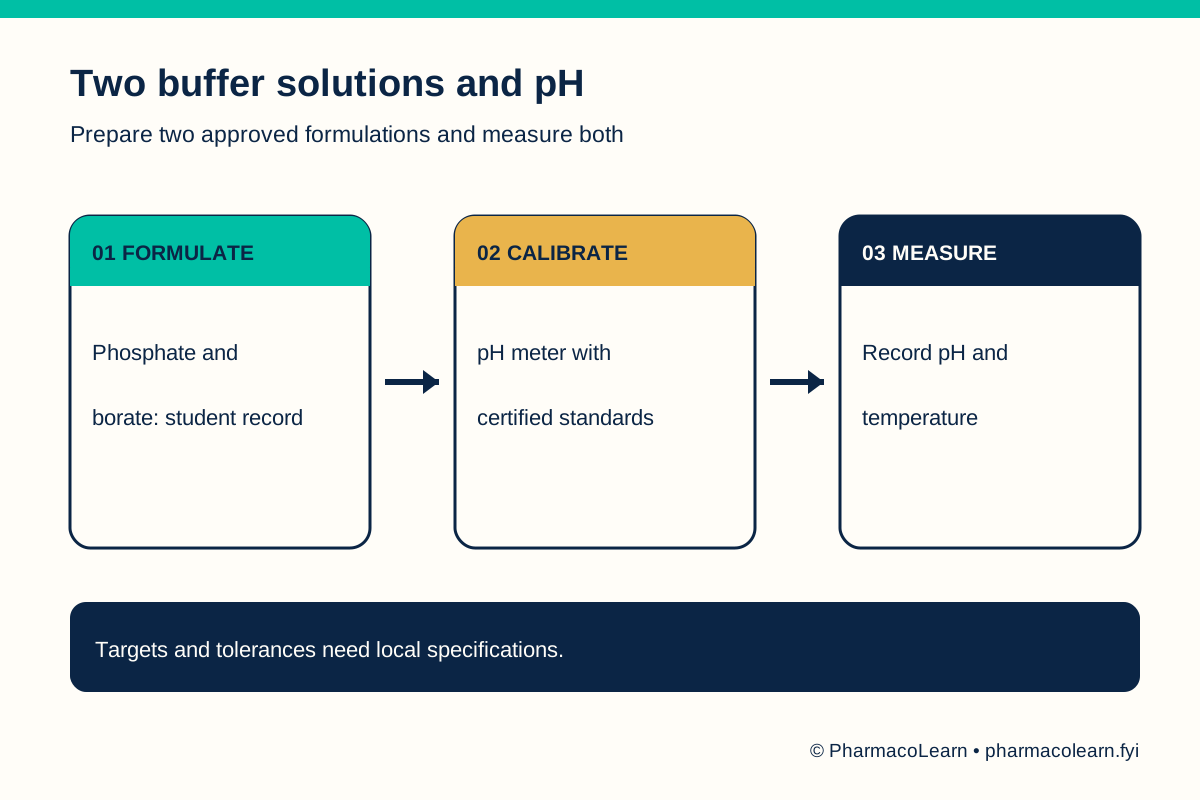
- Select two buffer types from the instructor's approved list. For this source-based exercise, record them as phosphate buffer A and borate buffer B, with the target pH and recipe entered from the approved local method sheet. [1, 2]
- Check component certificates, water specification, glassware calibration, protective controls, and the written formulation for each solution. Do not infer final mixing volumes from the college manual's stock descriptions. [2]
- Prepare each buffer separately under the authenticated procedure. Label vessel, component lot, final volume, intended pH, and preparation date. [2]
- Calibrate the pH meter with suitable certified standards that bracket the expected sample pH, following the meter's instructions. Record temperature and calibration outcome. [3]
- Rinse and handle the electrode as directed, then measure buffer A after the reading stabilizes. Record the displayed pH and temperature. [3]
- Rinse between samples and measure buffer B by the same procedure. Repeat measurements if the local method requires them. [3]
- Compare each measured pH with its authenticated target and tolerance. If a result is outside limits, investigate preparation, calibration, temperature, and electrode condition before adjusting or remaking it. [2, 3]
5. Calculation, graph, or images as appropriate
| Buffer | Authenticated target pH | Measured pH | Temperature | Difference and disposition |
|---|---|---|---|---|
| A: phosphate | Record here | Record here | Record here | Record here |
| B: borate | Record here | Record here | Record here | Record here |
| Meter calibration | Standard values Use approved local method | Observed values Record here | Record here | Pass or fail Record here |
Worked relation: For a suitable weak-acid and conjugate-base pair, pH = pKa + log(base concentration ÷ acid concentration). If the two concentrations are equal, the ratio is 1 and log(1) = 0, so the planned pH equals pKa at the specified temperature. This is a limiting algebra example, not a recipe for either named buffer. For a measured sample, pH difference = measured pH minus authenticated target pH; actual values and acceptance tolerance must be recorded here. [2]
6. Result
Report both buffer identities, preparation records, measured pH values, temperatures, calibration status, and whether each met its verified tolerance. Until the recipes and targets are supplied, both results must be recorded here. Do not label a teaching preparation as a certified standard buffer. [2, 3]
7. References
- Pharmacy Council of India. Pharm.D. Regulations, 2008, Medicinal Biochemistry practical list.
- East Point College of Pharmacy. Medicinal Biochemistry Practical Manual, preparation of buffer and pH experiment.
- Purdue University, Chemistry Education. Calibrating the pH Meter. Describes calibration and electrode reading practice.
Back to Medicinal Biochemistry practicals | Pharm.D. Year 1 Practicals · All Pharm D Practicals · Pharm D
Theory notes: Medicinal Biochemistry