
← Medicinal Biochemistry practicals | Pharm.D. Year 1 Practicals
Experiment on Lipid Profile Tests
1. Aim
To identify the measured components of a serum lipid profile and practice one conditional calculation of estimated LDL cholesterol from a complete, verified result set. This is item 20 in the PCI Medicinal Biochemistry practical list. The available East Point manual does not provide a dedicated lipid-profile procedure, so assay details must follow your college lab manual and instructor's method sheet. [1, 2, 3]
2. Requirements
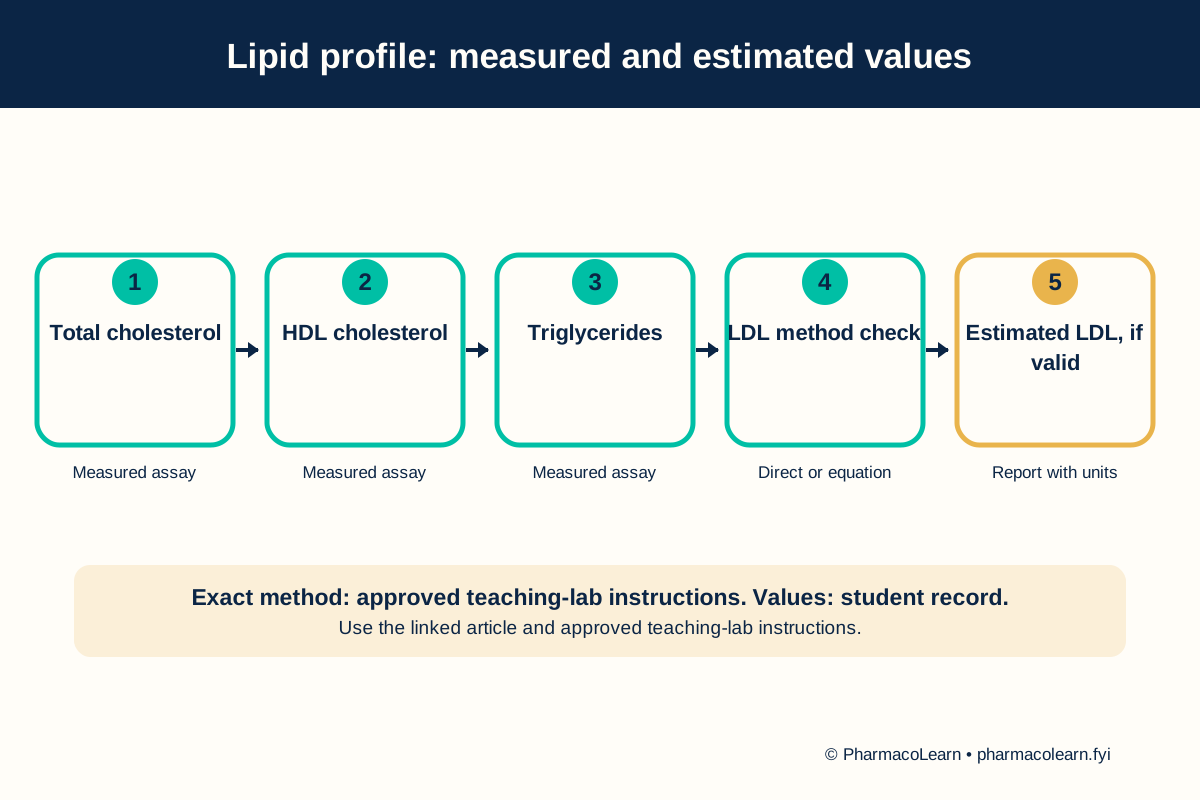
Use an instructor-supplied deidentified lipid-panel report or serum control, approved analyzer or assay instructions, calibration and quality-control records, calculator, observation sheet, gloves, coat, eye protection, and biological-waste containers. A panel commonly includes total cholesterol, HDL cholesterol, triglycerides, and an LDL cholesterol value that may be calculated or directly measured. The specimen conditions, methods, units, flags, and LDL reporting rule for the local laboratory must follow your college lab manual and instructor's method sheet. [2, 3]
3. Theory
Lipid profile components describe different aspects of circulating lipids and lipoproteins. Total cholesterol and HDL cholesterol are measured by their respective assays; triglycerides are measured by a triglyceride assay. LDL cholesterol can be reported by a direct method or estimated from the other values under a specified equation. The historical Friedewald equation in mg/dL is LDL cholesterol = total cholesterol minus HDL cholesterol minus triglycerides divided by 5. The triglycerides divided by 5 term approximates VLDL cholesterol and is not universally valid. Current laboratories may use other equations or direct methods. [3, 4]
This is a panel interpretation exercise, not a diagnosis or treatment recommendation. A calculated LDL value is only as reliable as the underlying assays and the equation's validity conditions. The panel must also identify whether measurements refer to serum or plasma, whether a specimen was acceptable, and whether quality controls passed. Do not infer a fasting requirement or a normal range from the formula alone. [2, 3, 4]
4. Procedure
- Under teaching-lab supervision, confirm that the deidentified report or teaching control has an identifier, collection context, units, and method information. If handling serum, use the approved protective equipment and biological-waste route. Leave missing details blank in the student record until confirmed. [2]
- Record total cholesterol, HDL cholesterol, and triglycerides in separate rows with their units and whether each is measured or calculated. [3]
- Verify the laboratory's LDL method. If the report uses a calculation, check the exact equation and its permitted triglyceride and specimen conditions. [4]
- Check calibration, control status, specimen quality flags, and any reportable-range flags. Do not calculate LDL from a failed or incomplete panel. [2, 4]
- If the verified method uses the Friedewald equation in mg/dL, calculate it with matched units and record the result as estimated LDL cholesterol. [4]
- Compare your arithmetic with the report, noting any rounding difference. A clinically relevant discrepancy is referred to the instructor or laboratory. [3, 4]
- Report the complete panel and its limitations as a teaching exercise. Interpretation and any treatment decision require qualified clinician review; this page makes neither. [3]
5. Calculation, graph, or images as appropriate
| Panel component | Type | Actual teaching record |
|---|---|---|
| Total cholesterol | Measured | Record here |
| HDL cholesterol | Measured | Record here |
| Triglycerides | Measured | Record here |
| LDL cholesterol | Directly measured or estimated, method Use approved local method | Record here |
| Quality-control and specimen status | Required before reporting | Record here |
Pre-assumed values for arithmetic only, not a patient result: Assume total cholesterol 200 mg/dL, HDL cholesterol 50 mg/dL, and triglycerides 150 mg/dL. For a valid Friedewald calculation, estimated VLDL cholesterol is 150 ÷ 5 = 30 mg/dL. Estimated LDL cholesterol is 200 − 50 − 30 = 120 mg/dL. These numbers are invented solely to show the calculation; they are not source measurements, normal values, or a clinical assessment. The actual values and equation eligibility must be recorded here. [4]
6. Result
Record each measured component and the method used for LDL cholesterol. A calculated LDL value should be labelled estimated and reported only when the validated equation applies. For a real specimen, all measurements, controls, and interpretation must follow your college lab manual and instructor's method sheet. [3, 4]
7. References
- Pharmacy Council of India. Pharm.D. Regulations, 2008, Medicinal Biochemistry practical list.
- East Point College of Pharmacy. Medicinal Biochemistry Practical Manual. Its contents were checked; no dedicated lipid-panel method was found.
- National Library of Medicine, MedlinePlus. Cholesterol Levels.
- Centers for Disease Control and Prevention. NHANES laboratory procedures for lipids in serum or plasma. Documents the historical Friedewald calculation and laboratory controls.
Back to Medicinal Biochemistry practicals | Pharm.D. Year 1 Practicals · All Pharm D Practicals · Pharm D
Theory notes: Medicinal Biochemistry