
← Medicinal Biochemistry practicals | Pharm.D. Year 1 Practicals
Estimation of Urea in Serum
1. Aim
To review the historical diacetyl monoxime color method for serum urea and audit its standard and specimen-dilution calculations before reporting a concentration. This is practical 13 in the PCI Medicinal Biochemistry list. [1, 2]
2. Requirements
Use the syllabus, college manual, calculator, observation sheet, and instructor-supplied absorbance data if available. The manual names serum or a Folin-Wu filtrate, a urea standard, diacetyl monoxime, an acid reagent, pipettes, tubes, a heated bath, and a colorimeter. Its historical standard preparation includes phenylmercuric acetate, a mercury compound. Do not prepare that reagent from this article. A supervised physical exercise requires a current approved method, safer validated reagents where available, documented specimen matrix, standard concentration, controls, protective equipment, and waste plan, all your college lab manual and instructor's method sheet. [2, 3]
3. Theory
The historical method develops a colored response from urea with diacetyl monoxime under acidic heated conditions, then compares a test with a known standard. The college manual states a 540 nm reading. The color-to-concentration calculation requires blank correction and a known standard mass in the reaction tube. The method's specimen matrix matters: serum directly and a deproteinized whole-blood filtrate have different dilution bases. [2]
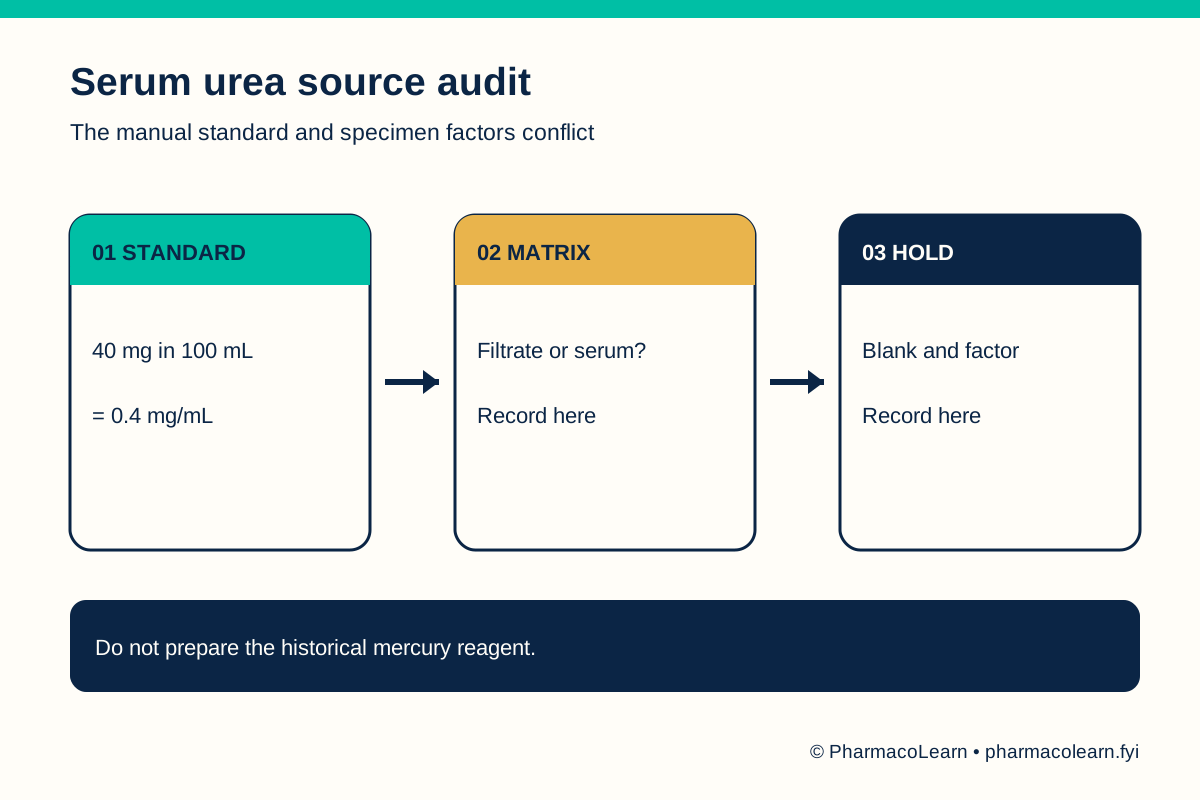
The source has two numerical conflicts. It describes dissolving 40 mg urea to 100 mL, then later calls that concentration 40 mg/mL. Arithmetic gives 0.4 mg/mL, a hundredfold difference. It also states that 10 mL Folin-Wu filtrate represents 1 mL blood, so 0.2 mL filtrate would represent 0.02 mL blood, while a nearby sentence says 0.2 mL blood. Neither conflict can be ignored. Serum urea is also distinct from blood urea nitrogen, or BUN; the reporting convention must be explicit. [2, 4]
4. Procedure
- Confirm whether the specimen is serum, whole blood, or Folin-Wu filtrate. Record collection and storage details. Mark missing information Record here. [2]
- Obtain the approved assay method and a certified urea standard. Check whether the historical mercury-containing reagent has been replaced. [2, 3]
- Audit the manual's standard mass and dilution before using any number. Record the 40 mg per 100 mL versus 40 mg/mL conflict. [2]
- Audit the sample dilution and original specimen equivalent, including whether a filtrate is used. Do not transfer a blood-filtrate factor to serum without a validated method. [2]
- If valid readings are supplied, label blank, standard, and test, then subtract the blank from both measured responses. [2]
- Calculate urea mass from the corrected response ratio and certified standard amount, then divide by the verified original specimen equivalent. Report the units clearly. [2, 4]
- Submit the record for instructor review. Any supervised physical test must follow local chemical and biological safety controls; this page supplies no reagent recipe. [2, 3]
5. Calculation, graph, or images as appropriate
| Calculation item | Manual statement [2] | Audit |
|---|---|---|
| Standard preparation | 40 mg in 100 mL | 0.4 mg/mL by arithmetic |
| Later stated standard concentration | 40 mg/mL | Conflicts by factor of 100: Record here |
| Folin-Wu relationship | 10 mL filtrate represents 1 mL blood | Matrix and recovery Record here |
| Test aliquot | 0.2 mL filtrate | Nominally 0.02 mL blood |
| Test, standard, blank absorbance | Not supplied | Record here |
| Urea versus BUN reporting | Not made clear | Record here |
Worked source audit: 40 mg ÷ 100 mL = 0.4 mg/mL, not 40 mg/mL. For the stated filtrate ratio, 0.2 mL × (1 mL blood ÷ 10 mL filtrate) = 0.02 mL nominal blood equivalent. These two arithmetic checks expose source errors; they do not prove recovery or yield a patient concentration. The authenticated standard and specimen method must follow your college lab manual and instructor's method sheet. [2]
6. Result
Record the two source discrepancies and withhold a serum urea value until standard concentration, specimen matrix, blank, and dilution have been verified. Report urea or BUN only according to the authenticated method. Clinical interpretation requires qualified review; this page does not interpret findings. [2, 4]
7. References
- Pharmacy Council of India. Pharm.D. Regulations, 2008, Medicinal Biochemistry practical list.
- East Point College of Pharmacy. Medicinal Biochemistry Practical Manual, serum urea experiment.
- National Institute for Occupational Safety and Health. Phenylmercuric acetate hazard discussion. Describes occupational toxicity of the historical reagent component.
- National Library of Medicine, MedlinePlus. BUN (Blood Urea Nitrogen). Explains the distinct BUN reporting concept.
Back to Medicinal Biochemistry practicals | Pharm.D. Year 1 Practicals · All Pharm D Practicals · Pharm D
Theory notes: Medicinal Biochemistry