
← Medicinal Biochemistry practicals | Pharm.D. Year 1 Practicals
Estimation of SGPT (ALT) in Serum
1. Aim
To examine a kinetic serum alanine aminotransferase assay, traditionally called SGPT, and calculate a time-normalized absorbance change. This is practical 12 in the PCI Medicinal Biochemistry list. A result in U/L is withheld until the actual kit factor and quality controls are known. [1, 2]
2. Requirements
Use a labelled serum control or deidentified sample, an approved ALT assay kit, calibrated micropipettes, cuvettes, timer, temperature-controlled instrument, protective coat, gloves, eye protection, and biological-waste containers. The college manual calls for kit reagents I and II, but their formulation, calibration factor, blank, reportable range, and acceptance rules are absent. Those details, together with the exact current volumes and timing, must follow your college lab manual and instructor's method sheet from the kit insert. [2]
3. Theory
ALT transfers an amino group from alanine to an acceptor, producing pyruvate. In a common coupled assay, pyruvate is converted to lactate while NADH is consumed. NADH absorption near 340 nm falls as the reaction proceeds. The slope of that fall, multiplied by an assay-specific factor, gives ALT activity. The source manual describes readings at 340 nm but does not document a conversion factor, so the trace cannot by itself supply U/L. [2]
ALT is found mainly in liver cells and is commonly considered with other test results. It is still an enzyme activity measurement, not a diagnosis. Hemolysis, storage, timing, temperature, and instrument settings may influence the value. The source paragraph ends by naming SGOT where SGPT is intended; this is a transcription error to flag, not a reason to exchange the two assays. The reaction identity and kit instructions must be checked before any measurement. [2, 3]
4. Procedure
- Confirm the serum sample identity and handling history. If these are missing, mark them your college lab manual and instructor's method sheet. Treat human material as potentially infectious. [2]
- Obtain the current ALT kit insert and record reagent composition, lot, expiry, sample and reagent amounts, wavelength, temperature, blanking method, activity factor, and quality-control range. [2]
- Set up and check the instrument using the approved controls. Do not analyze a patient specimen if the controls fail. [2]
- Follow the kit's exact mixing and timing sequence under instructor supervision. The manual's reagent labels alone do not define an interchangeable method. [2]
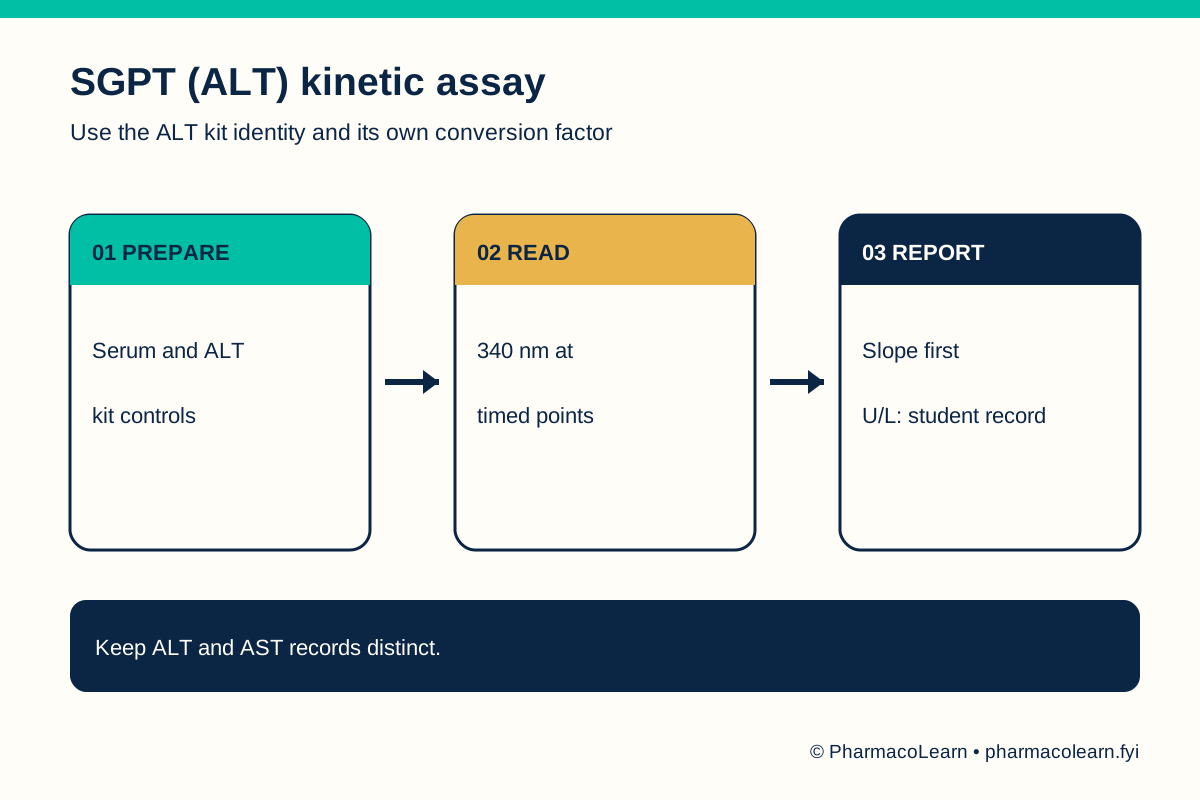
- Read absorbance at the specified series of time points and record the raw trace. Check that the direction and linearity match the method. [2]
- Calculate absorbance change per minute over the valid interval, then apply the verified factor if available. Keep the original time points with the record. [2]
- Report the teaching result and the source's SGOT wording error for instructor review. Do not use the exercise for patient management. [2, 3]
5. Calculation, graph, or images as appropriate
| Record item | Observation or verification |
|---|---|
| First timed absorbance at 340 nm | Record here |
| Second timed absorbance at 340 nm | Record here |
| Third timed absorbance at 340 nm | Record here |
| Blank and control status | Record here |
| Valid linear interval | Record here |
| ALT kit factor and U/L result | Use approved local method |
Worked time calculation: The manual describes readings at the first, second, and third minutes. Between the first and third readings, 3 minus 1 = 2 minutes elapse. Divide the observed absorbance fall across that interval by 2 to obtain mean change per minute. For example as a symbolic calculation, if the readings are A1 and A3, the rate is (A1 minus A3) ÷ 2. Actual readings and the conversion factor must be recorded here. [2]
6. Result
Record the trace and rate only from supplied valid measurements. Report ALT activity in U/L only after kit calibration and quality-control checks. Otherwise leave the activity result blank in the student record. Clinical interpretation requires qualified review; this page does not interpret findings. [2, 3]
7. References
- Pharmacy Council of India. Pharm.D. Regulations, 2008, Medicinal Biochemistry practical list.
- East Point College of Pharmacy. Medicinal Biochemistry Practical Manual, SGPT experiment.
- National Library of Medicine, MedlinePlus. ALT Blood Test.
Back to Medicinal Biochemistry practicals | Pharm.D. Year 1 Practicals · All Pharm D Practicals · Pharm D
Theory notes: Medicinal Biochemistry