
← Medicinal Biochemistry practicals | Pharm.D. Year 1 Practicals
Estimation of Proteins in Serum by the Biuret Method
1. Aim
To construct a source-based protein standard series for the Biuret color reaction and explain how a serum protein concentration would be read from a verified calibration curve. This corresponds to practical 14, Estimation of Proteins in Serum, in the PCI Medicinal Biochemistry list. [1, 2]
2. Requirements
Use a certified protein standard, approved Biuret reagent, labelled blank and standard tubes, an instructor-approved serum control or deidentified specimen, calibrated pipettes, cuvettes, colorimeter, timer, protective equipment, and biological and chemical waste containers. The college manual names a 5 mg/mL albumin standard and absorbance reading at 540 nm. The actual standard certificate, serum dilution, reagent composition, timing, reportable range, blank, and quality-control limits must follow your college lab manual and instructor's method sheet from the current method. [2]
3. Theory
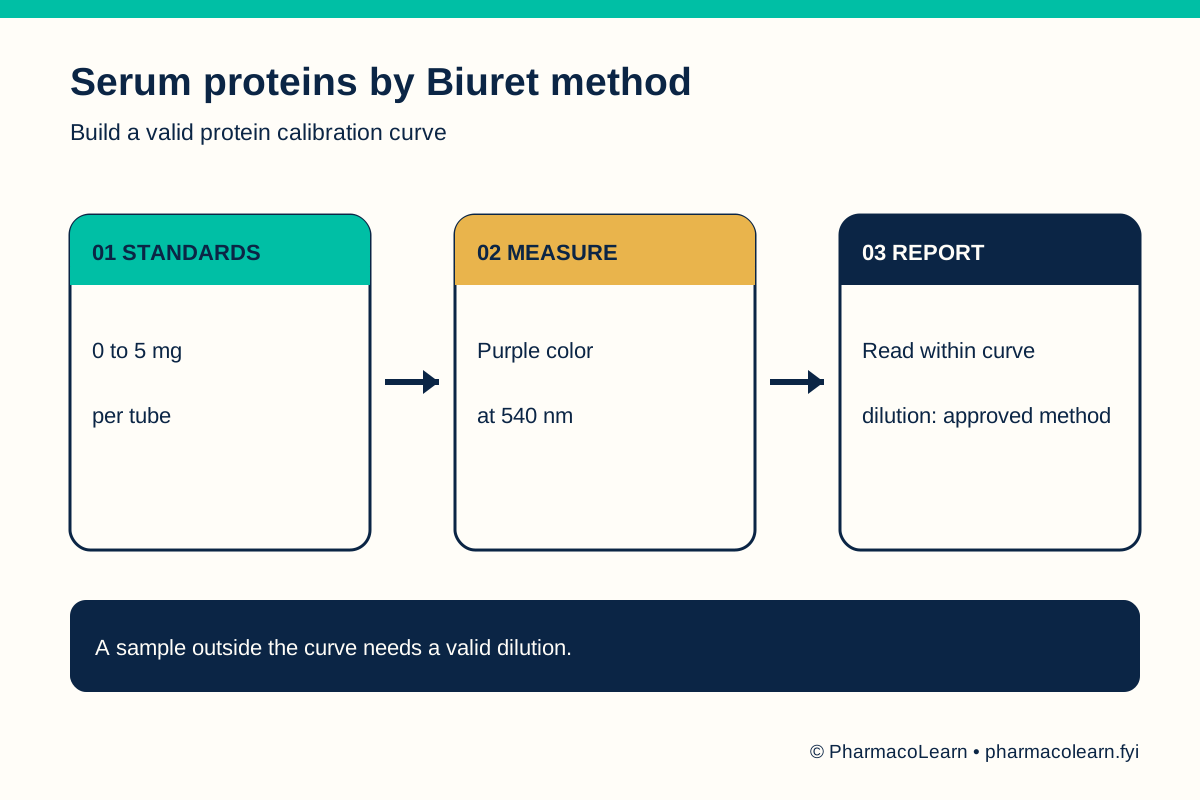
In alkaline conditions, copper in Biuret reagent forms a purple complex with peptide bonds. The color is compared with a series of known protein amounts. Plotting blank-corrected absorbance against the amount of standard protein gives a calibration curve over its validated linear range. A sample outside that range must be diluted and rerun rather than estimated by stretching the line beyond measured points. [2]
The college manual prepares standards with increasing volumes of a 5 mg/mL albumin solution. It then adds a serum test without clearly establishing whether that sample falls within the same calibrated amount range or needs dilution. It also describes the result as “mg protein/ml,” whereas clinical total serum protein is commonly reported with a specified laboratory unit and method. Albumin is used as the calibrator; that does not mean the serum contains only albumin. Interpretation of total protein requires other clinical information. [2, 3]
4. Procedure
- Confirm the specimen and standard identities, lot numbers, storage, and protective controls. Missing information must be recorded here. [2]
- Check the current Biuret method for standard concentration, blank, reagent amount, incubation, wavelength, calibration model, and quality-control rules. [2]
- Label a blank, a series of standards, and a test tube. Prepare them only under the approved method, using calibrated pipettes and matched final volumes before adding color reagent. [2]
- Read all tubes after the specified reaction period with the instrument set according to the validated method. Record raw absorbances rather than only the final number. [2]
- Subtract the blank and plot standard protein amount on the horizontal axis against corrected absorbance on the vertical axis. Check whether the points support the required fit. [2]
- Locate the sample within the validated standard range. If it is outside, follow the approved dilution and repeat rules. Do not extrapolate. [2]
- Apply the documented serum dilution factor, report a concentration with units, and submit quality-control data for instructor review. No teaching result is used for patient management. [2, 3]
5. Calculation, graph, or images as appropriate
| Standard tube | Manual standard volume [2] | Protein mass at 5 mg/mL | Corrected absorbance |
|---|---|---|---|
| Blank | 0 mL | 0 mg | Record here |
| S1 | 0.2 mL | 1 mg | Record here |
| S2 | 0.4 mL | 2 mg | Record here |
| S3 | 0.6 mL | 3 mg | Record here |
| S4 | 0.8 mL | 4 mg | Record here |
| S5 | 1.0 mL | 5 mg | Record here |
| Serum test | Actual aliquot and dilution Record here | Read from valid curve | Record here |
Worked standard calculation: At the manual's 5 mg/mL standard concentration, S1 contains 0.2 mL × 5 mg/mL = 1 mg protein. S5 contains 1.0 mL × 5 mg/mL = 5 mg. Thus the stated series spans 0 to 5 mg per tube. No serum concentration can be read until absorbances establish a curve and a serum dilution places the test within that range. [2]
6. Result
Report the standard curve, control status, sample absorbance, dilution, and final concentration only when measured and validated. Otherwise the serum protein result must be recorded here. The albumin-standard calibration does not provide separate albumin and globulin concentrations. [2, 3]
7. References
- Pharmacy Council of India. Pharm.D. Regulations, 2008, Medicinal Biochemistry practical list.
- East Point College of Pharmacy. Medicinal Biochemistry Practical Manual, Biuret protein experiment.
- National Library of Medicine, MedlinePlus. Total Protein and Albumin/Globulin Ratio.
Back to Medicinal Biochemistry practicals | Pharm.D. Year 1 Practicals · All Pharm D Practicals · Pharm D
Theory notes: Medicinal Biochemistry