
← Medicinal Biochemistry practicals | Pharm.D. Year 1 Practicals
Estimation of SGOT (AST) in Serum
1. Aim
To study the kinetic estimation of serum aspartate aminotransferase, traditionally called SGOT, and calculate the absorbance-change rate from a timed series. This is practical 11 in the PCI Medicinal Biochemistry list. Enzyme activity in U/L requires the assay kit's verified factor. [1, 2]
2. Requirements
Use an instructor-supplied serum control or deidentified specimen, an approved AST kit, calibrated micropipettes, cuvette, timer, temperature-controlled bath or analyzer, UV spectrophotometer, gloves, coat, eye protection, and biological-waste containers. The college manual calls its reagents I and II without identifying their full composition or conversion factor. Current kit identity, volumes, temperature, wavelength, blank, time points, linearity limits, and quality-control ranges must follow your college lab manual and instructor's method sheet from its instructions. [2]
3. Theory
AST transfers an amino group from aspartate to an acceptor, producing oxaloacetate. In a common coupled kinetic assay, oxaloacetate is converted to malate while NADH is consumed. NADH absorbs at about 340 nm, so a fall in absorbance over time can be related to AST activity. The manual identifies the 340 nm kinetic approach but does not give a complete kit-specific conversion factor. A falling trace alone cannot be reported as U/L. [2]
AST occurs in liver and other tissues, including muscle. A result therefore cannot diagnose a particular organ condition in isolation. Hemolysis, specimen handling, assay timing, instrument calibration, and kit-specific blanking may affect the measurement. The article teaches how to record a kinetic trace and check it for a reasonably linear interval. Patient interpretation belongs to a validated clinical laboratory and clinician. [2, 3]
4. Procedure
- Confirm specimen identity, condition, collection time, and biosafety controls. Use a control or deidentified material; no student blood collection is implied. [2]
- Read the exact AST kit instructions. Record reagent lot, expiry, temperature, wavelengths, sample and reagent volumes, blank, and U/L factor. Mark unavailable details Record here. [2]
- Set the instrument and temperature control using the approved method. Check that the reagent blank and quality controls pass before reading a test. [2]
- Under supervision, prepare the reaction using the verified kit sequence. Start timing at the method-defined event, since an uncertain start changes the slope. [2]
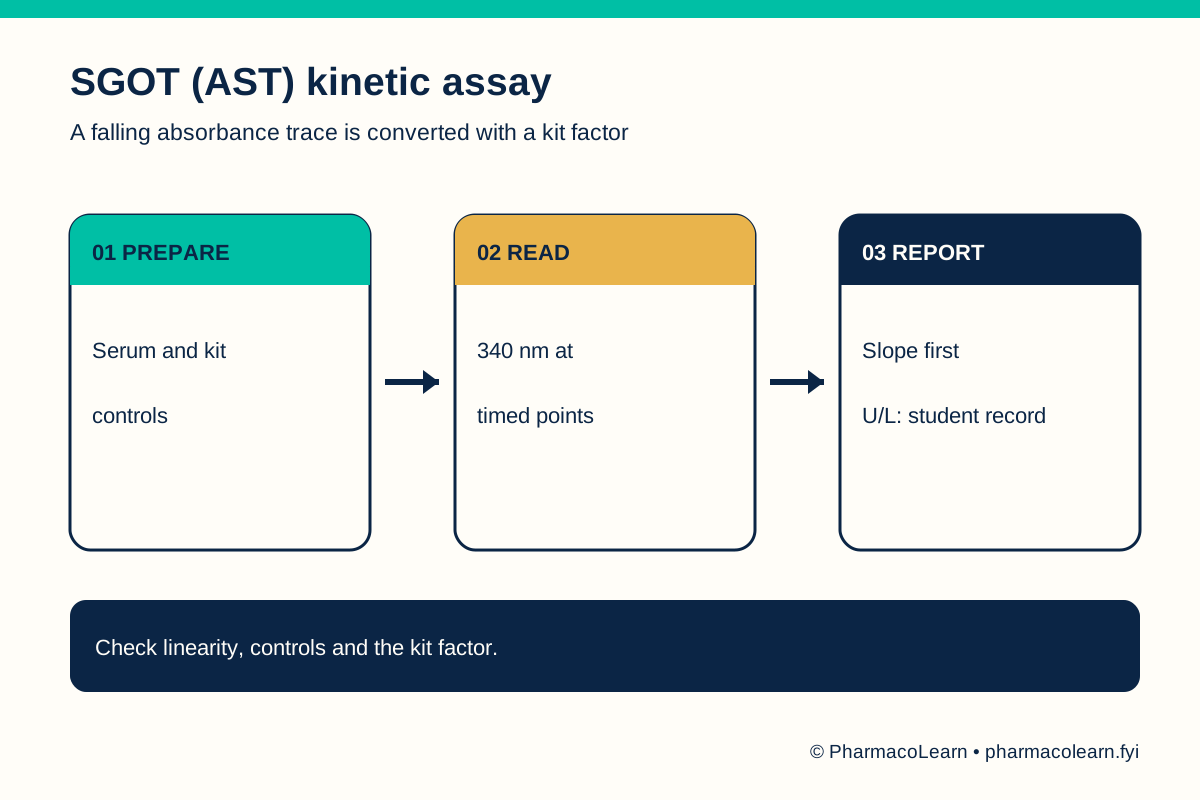
- Record absorbance at the scheduled times, preserving raw values and units. The college manual describes readings over a short 340 nm series. [2]
- Inspect the trace for an acceptable direction and linear interval. Calculate the mean change in absorbance per minute over the valid interval. Do not force a rate from an irregular trace. [2]
- Apply the kit's verified U/L factor only after controls and linearity pass. Record all deviations and submit the result for instructor review. [2, 3]
5. Calculation, graph, or images as appropriate
| Time after method-defined start | Absorbance at 340 nm | Quality note |
|---|---|---|
| First scheduled reading | Record here | Timing Record here |
| Second scheduled reading | Record here | Direction Record here |
| Third scheduled reading | Record here | Linearity Record here |
| Reagent blank and control | Record here | Acceptance record from the assigned current monograph, approved method, or supervised case |
Worked time calculation: The manual describes first, second, and third minute readings. The elapsed interval between the first and third readings is 3 minus 1 = 2 minutes. If their measured absorbances are A1 and A3, the average fall is (A1 minus A3) divided by 2 absorbance units per minute. The individual readings and the kit conversion factor must follow your college lab manual and instructor's method sheet, so no U/L value is invented. [2]
6. Result
Report the valid absorbance trace and calculated rate if readings are supplied. Report AST activity in U/L only with a verified kit factor and passing quality controls. A missing factor or failed trace means the activity cannot be reported; record the missing information here. Clinical meaning requires qualified review; this page does not interpret the result. [2, 3]
7. References
- Pharmacy Council of India. Pharm.D. Regulations, 2008, Medicinal Biochemistry practical list.
- East Point College of Pharmacy. Medicinal Biochemistry Practical Manual, SGOT experiment.
- National Library of Medicine, MedlinePlus. AST Test.
Back to Medicinal Biochemistry practicals | Pharm.D. Year 1 Practicals · All Pharm D Practicals · Pharm D
Theory notes: Medicinal Biochemistry