
← Medicinal Biochemistry practicals | Pharm.D. Year 1 Practicals
Quantitative Estimation of Blood Sugar by the Folin-Wu Tube Method
1. Aim
To study the historical Folin-Wu colorimetric method for blood sugar and show how a blank-corrected standard comparison would be calculated. This is practical 10 in the PCI Medicinal Biochemistry list. No patient glucose concentration is reported without a verified standard and specimen record. [1, 2]
2. Requirements
The college manual names a Folin-Wu blood filtrate, glucose standard, alkaline copper reagent, phosphomolybdic acid reagent, water bath, tubes, pipettes, cuvettes, and a colorimeter. The preceding filtrate practical names sodium tungstate and sulfuric acid. The standard concentration, reagent composition, specimen identity, actual volumes, instrument calibration, quality controls, and waste procedure must be recorded here against the local method. Blood and its filtrate are treated as potentially infectious. Heating acidic and alkaline reagents requires supervised laboratory controls. [2]
3. Theory
The Folin-Wu sequence first removes much of the blood protein. Reducing substances in the filtrate then reduce the copper reagent during heating. A subsequent phosphomolybdic reaction produces a blue color that is compared with a standard. The manual specifies an optical reading at 530 nm. The color depends on the reaction conditions and reducing substances, so an unverified historical result must not be presented as a modern glucose-specific clinical measurement. Current blood-glucose testing uses validated methods and defines the specimen and collection context. [2, 3]
The college manual labels a test aliquot “serum (Follin-wu)” even though the previous stage describes a whole-blood filtrate. It also gives no clear glucose-standard concentration in this experiment. These are material gaps: a test-to-standard absorbance ratio yields a mass only when the amount of glucose in the standard tube is known. The dilution from original blood to filtrate, the volume used in the reaction tube, and any recovery correction must also be established. [2]
4. Procedure
- Confirm the sample identity and whether the supplied material is whole-blood filtrate, serum, or a teaching control. Resolve the manual's matrix wording in the student record. [2]
- Obtain the authenticated Folin-Wu filtrate method, glucose standard certificate, reagent instructions, and quality-control criteria. Check the filtrate's source volume and actual recovery. [2]
- Under a separately approved supervised method, label blank, standard, and test tubes. Use the approved reaction sequence and heat controls. The historical manual's volumes are not a substitute for current instructions. [2]
- Record the blank, standard, and test optical readings at the verified wavelength and reaction time. Missing readings must be recorded here. [2]
- Subtract the blank response from both the standard and the test. If the corrected standard is zero, negative, or outside its valid range, withhold the calculation. [2]
- Calculate a glucose-equivalent mass using the verified standard amount, then correct for the original blood fraction and any validated dilution or recovery. Preserve units throughout. [2]
- Record the method limits and submit the result to the instructor. Do not use a teaching sample for diagnosis or treatment. [2, 3]
5. Calculation, graph, or images as appropriate
| Record item | Historical manual or required record | Status |
|---|---|---|
| Original blood and filtrate relationship | Source preparation record [2] | Record here |
| Reaction test aliquot | Manual lists 0.2 mL filtrate [2] | Actual aliquot Record here |
| Blank absorbance | Not supplied | Record here |
| Standard absorbance and glucose mass | Concentration not established in experiment [2] | Record here |
| Test absorbance | Not supplied | Record here |
| Final blood sugar result | Requires all preceding data | Record here |
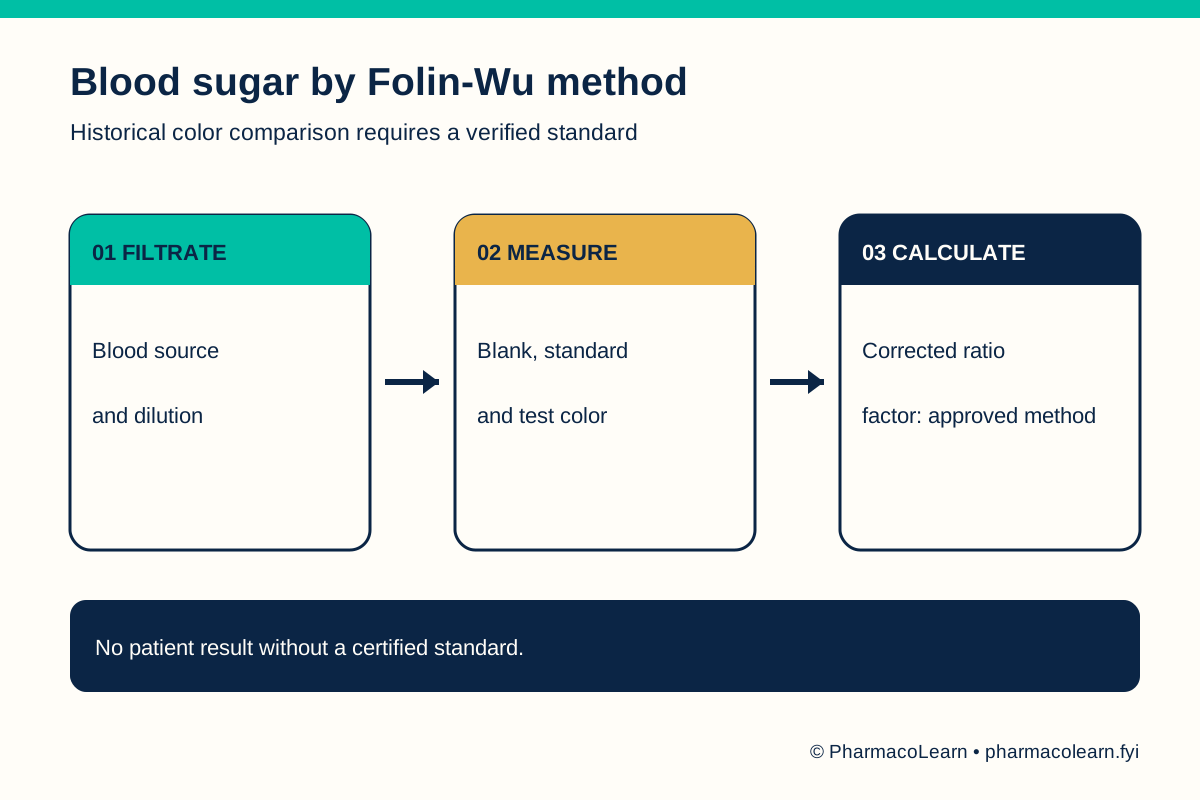
Worked response calculation: Three optical readings are required. First calculate corrected test response as Atest minus Ablank and corrected standard response as Astandard minus Ablank. Divide the first by the second to obtain a dimensionless test-to-standard response ratio. Multiplying that ratio by the verified glucose mass in the standard tube would give the glucose-equivalent mass in the test tube. The manual gives a 0.2 mL test aliquot but does not establish the standard mass, so the numerical concentration must follow your college lab manual and instructor's method sheet. [2]
6. Result
Report the recorded absorbances, blank correction, verified standard mass, and dilution basis if these are available. Without them, state that the historical method was reviewed and the blood-sugar result must be recorded here. Clinical interpretation needs a validated laboratory test. [2, 3]
7. References
- Pharmacy Council of India. Pharm.D. Regulations, 2008, Medicinal Biochemistry practical list.
- East Point College of Pharmacy. Medicinal Biochemistry Practical Manual, Folin-Wu blood sugar experiment.
- National Library of Medicine, MedlinePlus. Blood Glucose Test.
Back to Medicinal Biochemistry practicals | Pharm.D. Year 1 Practicals · All Pharm D Practicals · Pharm D
Theory notes: Medicinal Biochemistry