
← Medicinal Biochemistry practicals | Pharm.D. Year 1 Practicals
Preparation of Folin-Wu Filtrate from Blood
1. Aim
To explain how a deproteinized blood filtrate is obtained for historical Folin-Wu colorimetric work and record the calculation and quality checks for a source-based teaching setup. This is the eighth Medicinal Biochemistry practical in the PCI list. [1, 2]
2. Requirements
The college manual lists blood, water, sodium tungstate solution, sulfuric acid, pipettes, a mixing vessel, filter, and funnel. A current institution-approved procedure must specify sample source, anticoagulant, reagent strength, volumes, mixing, contact time, filtration, and disposal. The manual names sulfuric acid as 0.65 N in its requirement line and 0.66 N in its procedure. The acid specification must follow your college lab manual and instructor's method sheet before any physical work. A diagram and supplied observations can be used for a paper exercise. [2, 3]
3. Theory
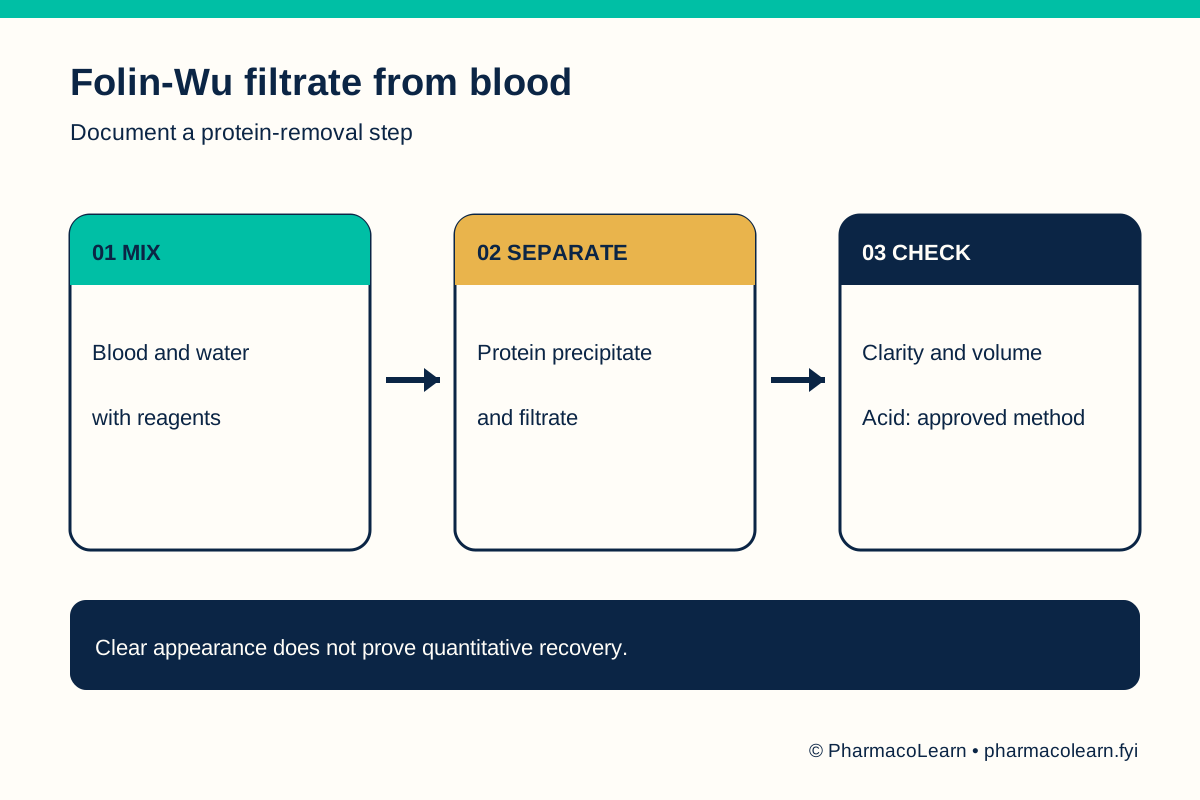
Blood proteins and color can interfere with subsequent optical measurements. In the historical Folin-Wu approach, sodium tungstate and acid form a protein precipitate; the filtrate is separated for later analysis. A clear filtrate is a process observation, not proof that all protein has been removed or that the analyte has been recovered quantitatively. The method depends on sample matrix and handling. [2]
The manual calls the product “Follin-wu” in some places and varies the stated acid normality. These spelling and concentration discrepancies are preserved as source issues rather than silently corrected. In teaching, the essential questions are whether the specimen and reagent identities are known, whether the precipitate was separated without contamination, and whether the subsequent assay accounts for the dilution. The filtrate itself is not a glucose or creatinine result. [2]
4. Procedure
- Confirm the syllabus entry and the instructor's approved procedure. Treat all blood as potentially infectious. No student blood collection is implied. [1, 2, 3]
- Record the specimen identity, anticoagulant, collection and storage conditions, and reagent labels. Mark missing data Record here. [2]
- Compare the manual's acid requirement and procedure lines. Request an authenticated acid specification; do not choose 0.65 N or 0.66 N by assumption. [2]
- If a supervised preparation is authorized, follow the local method to combine the blood and protein-precipitating reagents. Use the institution's acid and splash controls. [2, 3]
- Allow the specified precipitation period, then separate the precipitate with the approved filtration method. Actual time and filtration criteria must follow your college lab manual and instructor's method sheet. [2]
- Record filtrate clarity, color, volume, and any visible carryover. Do not call a merely clear filtrate protein free without a validated check. [2]
- Label the filtrate for the intended downstream teaching assay, including the source sample and theoretical dilution basis. Dispose of blood and chemical waste under local rules. [2, 3]
5. Calculation, graph, or images as appropriate
| Record item | Manual [2] | Actual record |
|---|---|---|
| Blood portion | 1 mL | Record here |
| Water portion | 7 mL | Record here |
| Sodium tungstate portion | 1 mL | Record here |
| Acid portion | 1 mL | Strength conflict: Record here |
| Total nominal mixed volume | 10 mL | Recovered filtrate volume Record here |
| Filtrate appearance | Described as clear | Record here |
Worked mixture calculation: The four printed volumes sum to 1 + 7 + 1 + 1 = 10 mL nominal mixture. The blood portion is 1 ÷ 10 = one-tenth of that nominal mixed volume. Precipitation and filtration can change the recovered liquid volume, so this is only a planning ratio. A downstream assay must use its own validated dilution and recovery rule; those values must follow your college lab manual and instructor's method sheet. [2]
6. Result
Report whether a supervised preparation or paper review was performed. Record the actual filtrate appearance and recovered volume only if observed. Follow the college lab manual and instructor's method sheet for acid strength, sample handling, filtrate-quality checks, and downstream assay suitability. [2, 3]
7. References
- Pharmacy Council of India. Pharm.D. Regulations, 2008, Medicinal Biochemistry practical list.
- East Point College of Pharmacy. Medicinal Biochemistry Practical Manual, preparation of Folin-Wu filtrate. Contains the 0.65 N versus 0.66 N acid discrepancy.
- National Institute for Occupational Safety and Health. Pocket Guide: Sulfuric acid. Documents chemical exposure hazards.
Back to Medicinal Biochemistry practicals | Pharm.D. Year 1 Practicals · All Pharm D Practicals · Pharm D
Theory notes: Medicinal Biochemistry