
← Medicinal Biochemistry practicals | Pharm.D. Year 1 Practicals
Determination of Sodium, Calcium, and Potassium in Serum
1. Aim
To study the measurement and reporting of serum sodium, calcium, and potassium as three distinct analytes in one PCI Medicinal Biochemistry practical. This is item 21 and the last listed experiment for that subject. The available college manual does not provide a dedicated combined procedure, so local assay methods must follow your college lab manual and instructor's method sheet. [1, 2]
2. Requirements
Use labelled deidentified serum or control material, an approved chemistry analyzer, certified calibrators and controls, method instructions for all three analytes, specimen-quality information, calculator, protective equipment, and appropriate waste containers. Sodium and potassium may be measured by an ion-selective electrode method. Total calcium may use a separate colorimetric method; ionized calcium is a different measurement and must be named explicitly if used. Exact specimen matrix, instrument, units, calibrations, controls, and acceptance limits are to be recorded from the assigned current monograph, approved method, or supervised case in the student record. [3, 4, 5]
3. Theory
Sodium and potassium are electrolytes whose blood concentrations are measured for different clinical reasons. An ion-selective electrode produces an electrical response related to the target ion's activity, and the analyzer uses calibration to report a concentration. The CDC serum sodium method provides one example of an indirect ion-selective electrode procedure. A raw voltage is not a concentration by itself. [3, 4]
Calcium in blood can be reported as total calcium or ionized calcium. Total calcium includes protein-bound and free fractions, while an ionized assay measures the free fraction. Those results are not interchangeable. Potassium is especially sensitive to some specimen problems, including cell damage during collection or handling. This exercise teaches separate records for the three analytes and their quality checks. It does not assign a diagnosis to a number. [5, 6]
4. Procedure
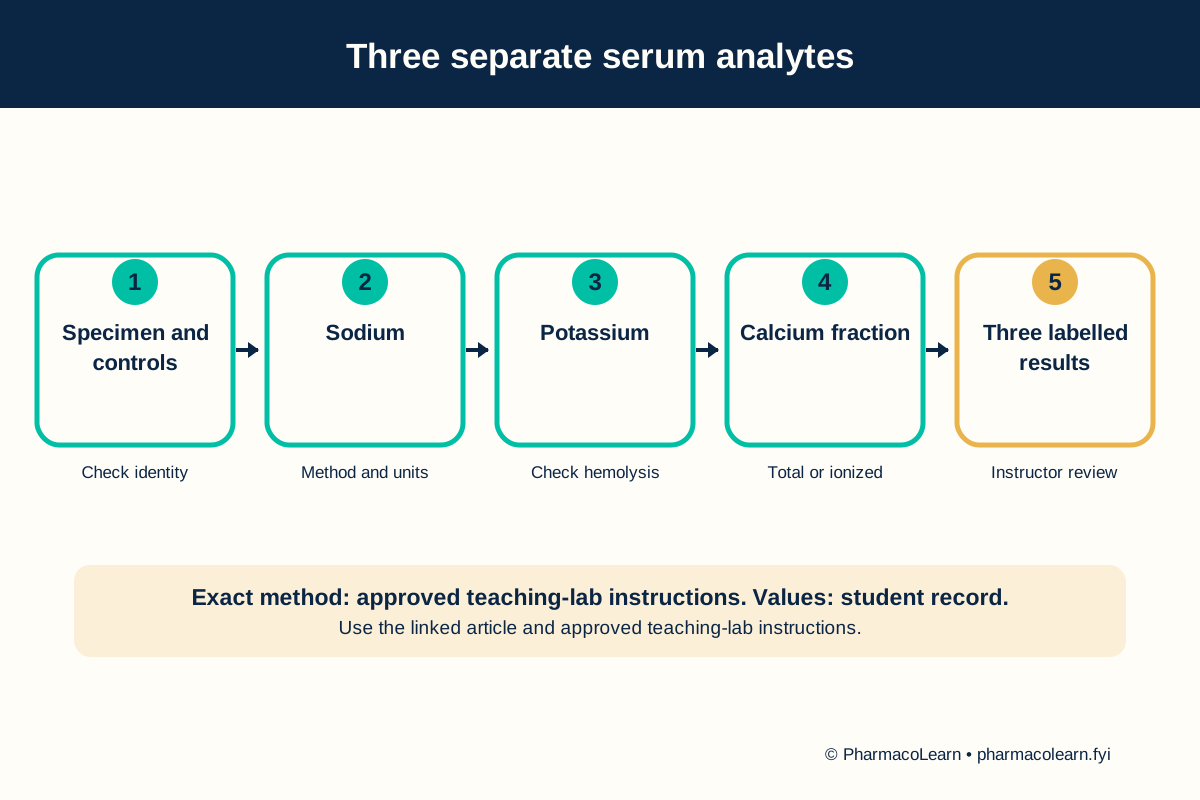
- Under teaching-lab supervision, confirm the specimen identity, collection time, matrix, and whether the material is a teaching control or deidentified serum. Treat all human material as potentially infectious, wear the approved protective equipment, and use the biological-waste route. [2]
- Obtain the local method sheets for sodium, potassium, and the particular calcium fraction. Obtain missing method information from the approved local method sheets. [3, 5]
- Check analyzer calibration, control results, reagent or electrode status, and specimen-quality flags before recording any result. [3]
- Run or review the sodium measurement according to its verified method. Record value, unit, and any dilution or analyzer flag. [3]
- Repeat the record review for potassium, paying attention to any hemolysis or specimen-quality indication. [4]
- Record whether calcium is total or ionized, then apply the correct method and units. Do not place a total-calcium result under an ionized-calcium label. [5]
- Compare the three entries with their own method-specific quality checks and submit the teaching report for instructor review. Any urgent patient result belongs to the clinical laboratory process. [3, 4, 5]
5. Calculation, graph, or images as appropriate
| Analyte | Measurement identity | Actual result and unit | Control or specimen flag |
|---|---|---|---|
| Sodium | Ion-selective electrode or local method Use approved local method | Record here | Record here |
| Potassium | Ion-selective electrode or local method Use approved local method | Record here | Record here |
| Calcium | Total or ionized Record here | Record here | Record here |
Pre-assumed values for unit conversion only, not a patient result: Assume a hypothetical total-calcium report of 2.50 mmol/L. Using calcium's molar mass of about 40.08 mg/mmol, 2.50 × 40.08 = 100.2 mg/L. Divide by 10 to express per 100 mL: 10.02 mg/dL. This arithmetic does not convert ionized calcium into total calcium and does not establish a normal value. No actual sodium, potassium, or calcium specimen reading is supplied. [5]
6. Result
Report sodium, potassium, and the stated calcium fraction separately, each with its unit, method, control status, and specimen-quality flags. Record actual results here when the laboratory record is available. Clinical interpretation requires qualified review; this page does not interpret findings. [3, 4, 5]
7. References
- Pharmacy Council of India. Pharm.D. Regulations, 2008, Medicinal Biochemistry practical list.
- East Point College of Pharmacy. Medicinal Biochemistry Practical Manual. Its contents were checked; no dedicated combined serum sodium, calcium, and potassium method was found.
- Centers for Disease Control and Prevention. NHANES Serum Sodium Laboratory Procedure Manual.
- Centers for Disease Control and Prevention. NHANES Serum Potassium Laboratory Procedure Manual.
- National Library of Medicine, MedlinePlus. Calcium Blood Test.
- National Library of Medicine, MedlinePlus. Potassium Blood Test.
Back to Medicinal Biochemistry practicals | Pharm.D. Year 1 Practicals · All Pharm D Practicals · Pharm D
Theory notes: Medicinal Biochemistry