
← Medicinal Biochemistry practicals | Pharm.D. Year 1 Practicals
Determination of Glucose by the Glucose Oxidase Method
1. Aim
To explain a glucose oxidase and peroxidase color assay and calculate a blank-corrected test-to-standard response ratio. This is experiment 16 in the PCI Medicinal Biochemistry list. The available college manual does not contain a dedicated procedure for this syllabus item, so the exact teaching method must follow your college lab manual and instructor's method sheet. [1, 2, 3]
2. Requirements
Use a labelled teaching glucose control or deidentified specimen, an approved glucose oxidase assay kit, certified glucose standard, blank, calibrated pipettes, cuvettes or analyzer, timer, protective equipment, and appropriate waste containers. The specimen type, reagent composition, standard concentration, volumes, incubation conditions, wavelength, quality-control rules, and reportable range must follow your college lab manual and instructor's method sheet from the actual kit insert. [2, 3]
3. Theory
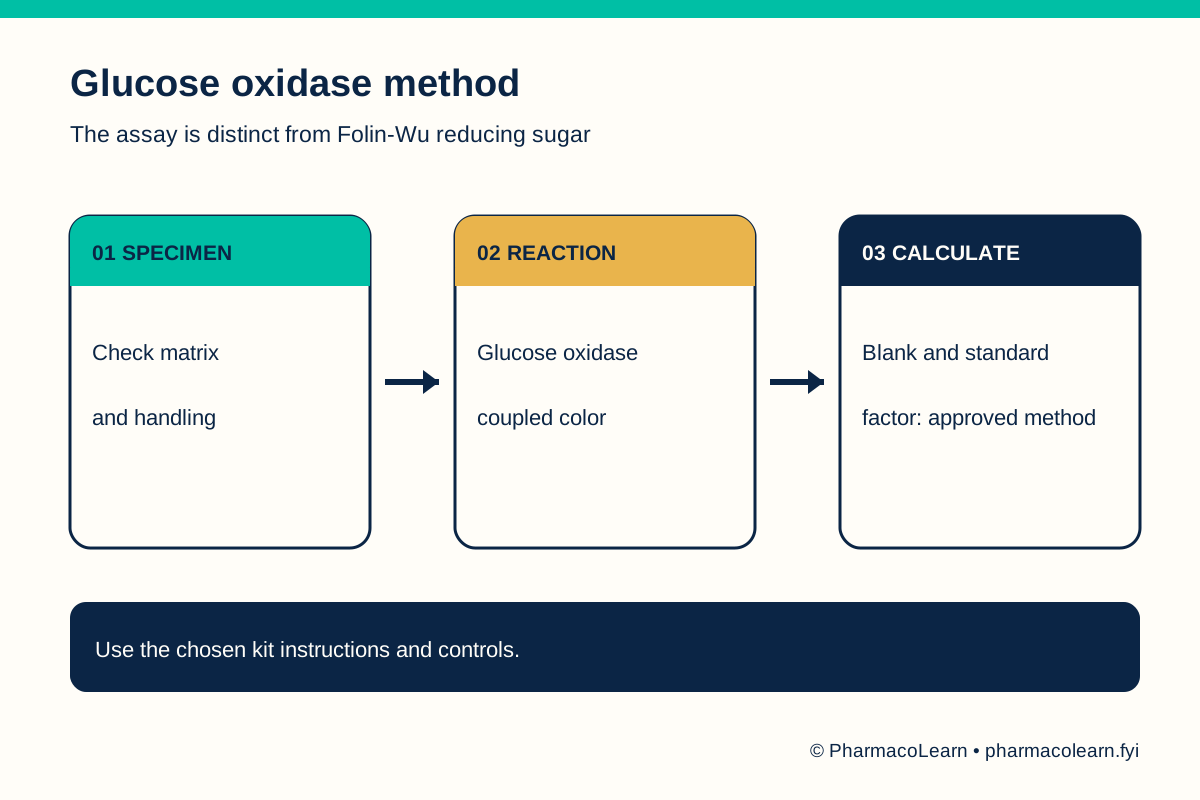
Glucose oxidase acts on glucose in the presence of oxygen, producing hydrogen peroxide. In a coupled color method, peroxidase uses that peroxide to form a colored product from a kit-specific indicator. Within the validated range, the blank-corrected color response can be compared with a glucose standard. The chemistry improves specificity compared with a general reducing-sugar test, but it is still subject to method-specific interference, specimen handling requirements, and calibration limits. [2]
The syllabus lists this method separately from the Folin-Wu blood-sugar practical. That distinction matters: Folin-Wu measures a historical reducing response, while glucose oxidase is an enzymatic glucose method. The assay kit may use different chromogens and wavelengths, so a number copied from a different method is unsafe. The available East Point manual covers Folin-Wu but omits this distinct experiment; the actual local protocol must be obtained. A teaching result does not diagnose diabetes or guide treatment. [1, 2, 3]
4. Procedure
- Confirm the sample identity, matrix, collection and storage conditions, and whether it is a control or deidentified human material. Missing details must be recorded here. [2, 3]
- Obtain the current glucose oxidase kit instructions. Record reagent lot, standard certificate, blank, wavelength, timing, temperature, quality-control limits, and permitted specimen matrix. [2]
- Label blank, standard, control, and test records separately. Check the analyzer or photometer calibration before a supervised assay. [2]
- Prepare or load the reactions only according to the selected validated method. Do not use Folin-Wu volumes or timing for this assay. [1, 2]
- Record the method-defined color or instrument response after the specified incubation. If a control is outside limits, stop and investigate rather than reporting a sample value. [2]
- Subtract the appropriate blank, compare test with standard, and apply the certified standard concentration and any specimen dilution. Check that the response lies within the reportable range. [2]
- Report the teaching calculation and its limits to the instructor. Any clinical glucose interpretation requires the correct collection context and a validated laboratory result. [3]
5. Calculation, graph, or images as appropriate
| Record item | Value or observation |
|---|---|
| Blank response | Record here |
| Certified standard concentration | Use approved local method |
| Standard response | Use approved local method |
| Test response and specimen dilution | Record here |
| Control within accepted range | Record here |
| Calculated glucose and unit | Record here |
Worked calculation structure: The corrected test response is test minus blank. The corrected standard response is standard minus blank. Divide corrected test by corrected standard to obtain a dimensionless ratio; multiply by the certified standard concentration and the documented sample dilution factor only if the kit uses that calibration form. The numerical answer must follow your college lab manual and instructor's method sheet because no actual standard, readings, or dilution were supplied. [2]
6. Result
Report specimen type, kit identity, control status, calibrated concentration, and units only when verified. Without those data, the result must be recorded here. Do not use the teaching record for patient decisions. [2, 3]
7. References
- Pharmacy Council of India. Pharm.D. Regulations, 2008, Medicinal Biochemistry practical list.
- Reljic R, Ries M, Anic N, and Ries B. New chromogen for assay of glucose in serum. Clinical Chemistry, 1992. Describes a glucose oxidase and peroxidase serum color assay.
- National Library of Medicine, MedlinePlus. Blood Glucose Test.
Back to Medicinal Biochemistry practicals | Pharm.D. Year 1 Practicals · All Pharm D Practicals · Pharm D
Theory notes: Medicinal Biochemistry