
← Medicinal Biochemistry practicals | Pharm.D. Year 1 Practicals
Enzymatic Hydrolysis of Glycogen or Starch by Amylases
1. Aim
To observe the disappearance of an iodine-positive starch reaction during amylase action and relate the observation time to relative hydrolysis under controlled teaching conditions. PCI lists glycogen or starch; the available college manual documents a starch demonstration only. A glycogen-specific method must follow your college lab manual and instructor's method sheet. [1, 2]
2. Requirements
Use a characterized starch substrate, an approved amylase source, iodine indicator, labelled tubes or spot plate, pipettes, timer, temperature control, protective equipment, and disposal containers. The college manual uses student saliva as an amylase source. A commercially supplied enzyme or instructor-prepared control is preferable for this article's routine route because a saliva specimen adds biological-exposure and variability concerns. Enzyme source, concentration, substrate strength, volumes, temperature, pH, and sample intervals must follow your college lab manual and instructor's method sheet against the approved local procedure. [2, 3]
3. Theory
Amylase cleaves starch into smaller carbohydrate fragments. Intact starch can give a blue-black response with iodine; as hydrolysis proceeds, that response weakens or disappears. The color change is a practical indicator of remaining iodine-reactive starch, not a direct quantitative measurement of every product formed. Different substrate preparation, enzyme activity, temperature, pH, and sampling technique can change the observed time. [2, 3]
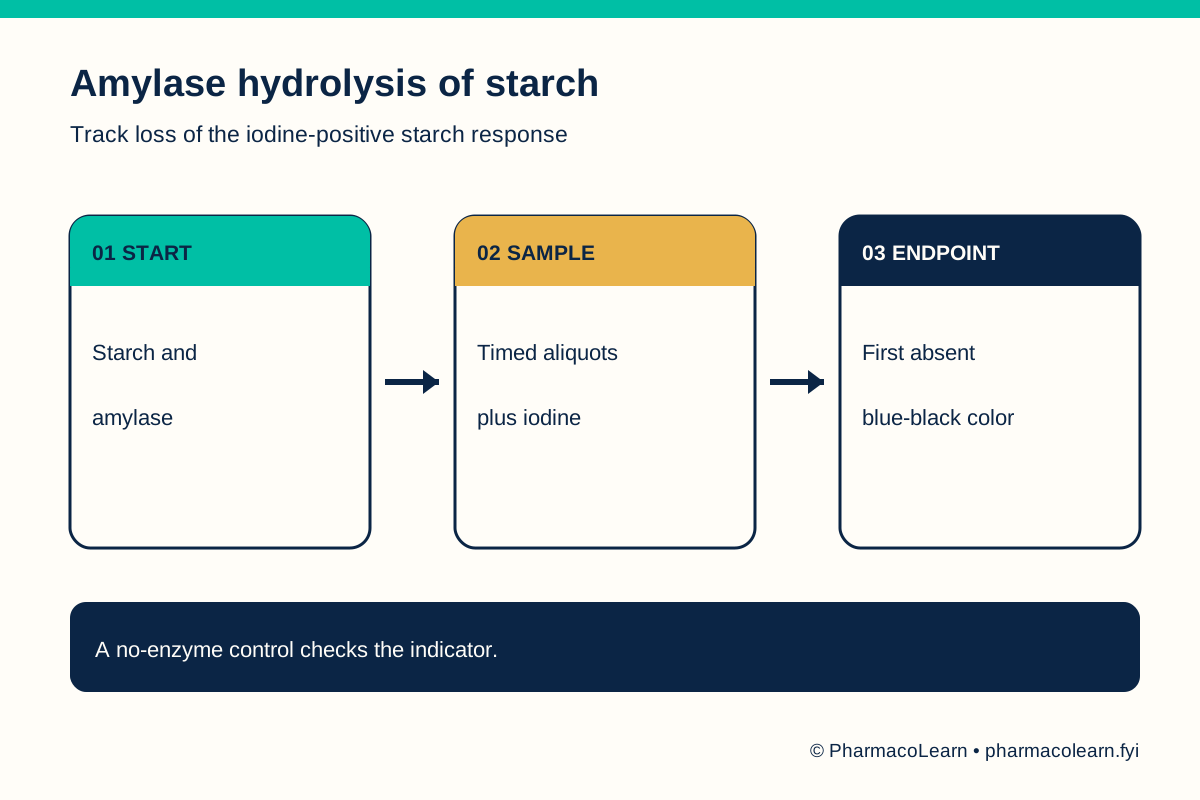
The college manual describes timing aliquots and testing each with iodine. It also suggests interpreting an earlier disappearance as higher relative activity under comparable conditions. That comparison is valid only when all conditions except the chosen variable are controlled. A failed or weak iodine response at time zero could mean the starch or indicator was unsuitable rather than complete hydrolysis. A no-enzyme control helps distinguish enzyme action from a reagent or substrate problem. Glycogen may react differently with iodine, so a starch endpoint must not be assumed for it without a separate validated method. [2]
4. Procedure
- Choose the starch route unless an instructor supplies a glycogen-specific method. Record the exact substrate and enzyme identities. [1, 2]
- Check the written method for enzyme and starch concentrations, buffer, temperature, aliquot volumes, time interval, and iodine safety. Enter missing values your college lab manual and instructor's method sheet. [2]
- Prepare a substrate-plus-enzyme test and a matched substrate-only control under supervision. If a biological enzyme source is used, apply the institution's specimen-handling procedure. [2]
- Start the timer at the documented mixing event. Take a baseline aliquot and apply it to iodine as the approved method directs. Record the initial color. [2]
- Continue sampling at the specified intervals, using clean transfer tools to avoid carryover. Record the color as seen instead of inferring a result immediately. [2]
- Identify the first scheduled observation without a blue-black starch response. Confirm that the control remains iodine-positive for the observation period. [2]
- Report the endpoint interval and any invalid control or timing problem. Do not interpret a single time as an absolute enzyme activity without calibration. [2, 3]
5. Calculation, graph, or images as appropriate
| Observation point | Test plus amylase | Substrate-only control | Inference |
|---|---|---|---|
| Baseline | Color Use approved local method | Color Record here | Reagent check Record here |
| First scheduled sample | Record here | Record here | Starch response Record here |
| Later scheduled sample | Record here | Record here | Endpoint Record here |
Worked timing calculation: The college manual describes observations at 2 minutes, 5 minutes, and then at 5-minute intervals. If the last iodine-positive sample is at time t and the next scheduled iodine-negative sample is at t plus 5 minutes, the disappearance time lies after t and no later than t plus 5 minutes. It is an interval, not an exact reaction time. Actual colors and times must follow your college lab manual and instructor's method sheet. [2]
6. Result
Record the substrate, enzyme source, control response, and interval in which iodine-positive starch disappeared. If the baseline or control failed, report the observation as invalid. Glycogen results and any quantitative activity must be recorded here. [1, 2]
7. References
- Pharmacy Council of India. Pharm.D. Regulations, 2008, Medicinal Biochemistry practical list.
- East Point College of Pharmacy. Medicinal Biochemistry Practical Manual, amylase hydrolysis of starch experiment.
- North Carolina State University. Enzymatic Digestion of Starch by Amylase: Lab Guide. Provides an independent teaching-lab approach.
Back to Medicinal Biochemistry practicals | Pharm.D. Year 1 Practicals · All Pharm D Practicals · Pharm D
Theory notes: Medicinal Biochemistry