
← Medicinal Biochemistry practicals | Pharm.D. Year 1 Practicals
Quantitative Estimation of Blood Creatinine
1. Aim
To analyze the source method for blood creatinine, calculate the blank-corrected standard-response ratio, and identify the specimen-matrix discrepancy in the college manual. PCI lists this as the ninth Medicinal Biochemistry practical. No patient concentration is reported from an ambiguous method. [1, 2]
2. Requirements
Use the PCI syllabus, college manual, calculator, test-standard-blank worksheet, and instructor-supplied absorbance data if available. The historical section names picric acid, sodium hydroxide, creatinine standard, water, pipettes, cuvettes, and a spectrophotometer. It calls the aim a serum test but lists a urine specimen in its requirements and procedure. The intended matrix, specimen volume, pretreatment, reagent concentration, wavelength, timing, standard concentration, and quality-control criteria must follow your college lab manual and instructor's method sheet. [2]
3. Theory
Creatinine is a muscle-metabolism waste product measured in blood or urine to help assess kidney function. In a Jaffe color reaction, alkaline picrate produces a measurable color with creatinine, but other substances can affect the response. A blank-corrected comparison with a verified standard estimates concentration only when sample and standard preparation are compatible and any dilution is known. Clinical laboratories may use methods with different interference profiles; a teaching colorimetric result is not enough to diagnose kidney disease. [2, 3]
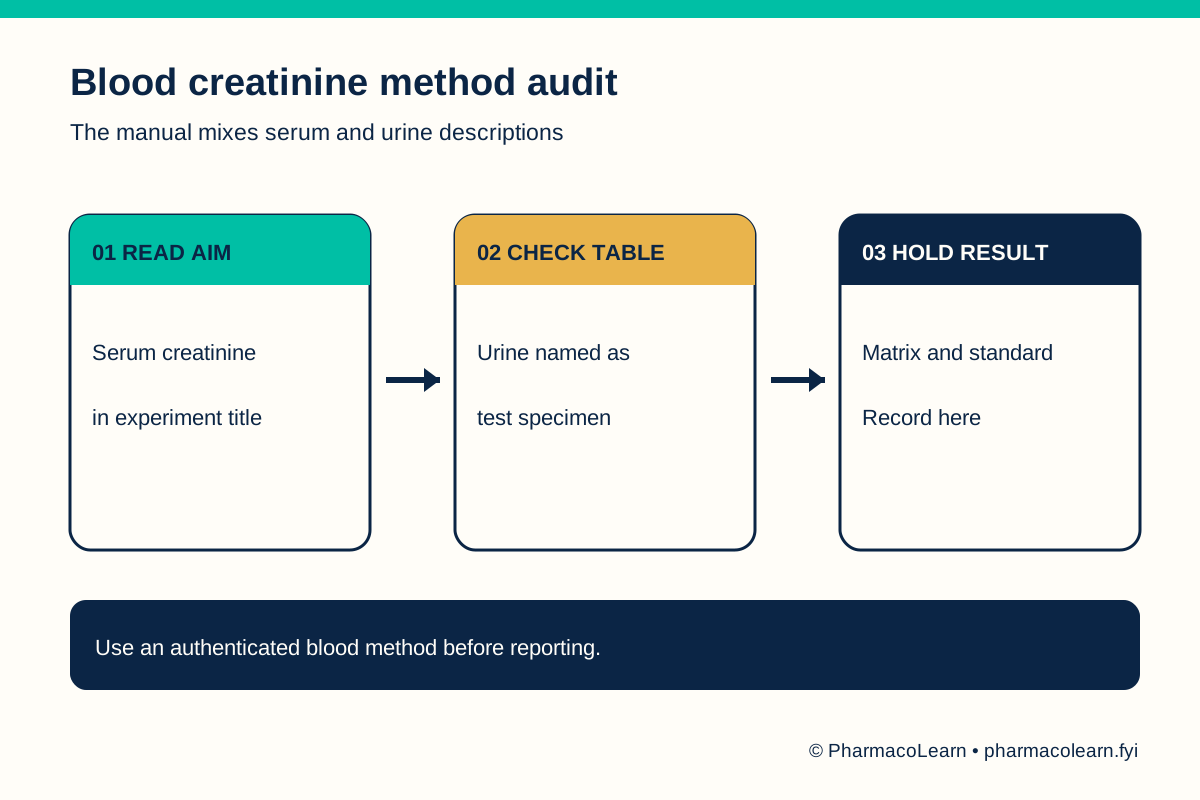
The college manual's “serum” experiment contains text copied from a urine experiment. The table labels the test aliquot “urine sample,” and the explanatory paragraph describes creatinine in urine. It is unsafe to silently treat that table as a serum procedure. The article therefore uses it only for a document and calculation review until an authenticated serum method is supplied. The later manual concentration formula also contains ambiguous volume terms. [2]
4. Procedure
- Check the PCI title, then compare the manual's aim, requirements, principle, and test table. Record each mention of serum, blood, or urine. [1, 2]
- Flag the matrix conflict and request an approved serum or plasma procedure. Do not substitute blood for urine in the printed table. [2]
- If instructor-supplied readings are available, label blank, standard, and test absorbance values and record their measurement conditions. Missing details must be recorded here. [2]
- Subtract the blank from the standard and test readings. A zero or negative corrected standard response invalidates the ratio. [2]
- Write the conditional response ratio and list the verified standard concentration, original specimen volume, and dilution factor needed for a concentration. Do not fill unknowns by analogy with the urine exercise. [2]
- Have the instructor resolve the matrix and calculation basis before any physical demonstration or result report. Biological sample handling and alkaline picrate waste require local controls. [2, 3]
- Record the outcome as an audited historical method, valid calculation with authenticated data, or unresolved source discrepancy. [2]
5. Calculation, graph, or images as appropriate
| Source field | Manual finding [2] | Status |
|---|---|---|
| Aim | Serum creatinine | Matches PCI blood-creatinine topic |
| Requirements and test table | Urine sample | Matrix conflict: Record here |
| Blank, standard, test absorbance | Not supplied | Record here |
| Standard concentration | Source passage ambiguous | Record here |
| Sample dilution and final units | Not reliably established | Record here |
Worked document check: The method has three optical vessels: blank, standard, and test. Two blank-corrected values are required, namely standard minus blank and test minus blank. The response ratio is (test − blank) ÷ (standard − blank). This expression can be evaluated only after the three readings are supplied; it becomes a concentration only after the serum method and standard factor are authenticated. No invented absorbance or normal range is used. [2]
6. Result
Report the matrix discrepancy and withhold a blood creatinine concentration. Record actual absorbances, corrected ratio, standard factor, and specimen identity here when available. Clinical interpretation requires qualified review; this page does not interpret findings. A qualified laboratory method is needed for a patient result. [2, 3]
7. References
- Pharmacy Council of India. Pharm.D. Regulations, 2008, Medicinal Biochemistry practical list.
- East Point College of Pharmacy. Medicinal Biochemistry Practical Manual, serum creatinine experiment. Contains the serum-versus-urine conflict.
- National Library of Medicine, MedlinePlus. Creatinine Test. Describes blood and urine creatinine testing and clinical limits.
Back to Medicinal Biochemistry practicals | Pharm.D. Year 1 Practicals · All Pharm D Practicals · Pharm D
Theory notes: Medicinal Biochemistry