
← Medicinal Biochemistry practicals | Pharm.D. Year 1 Practicals
Qualitative Analysis of Normal Constituents of Urine
1. Aim
To identify selected constituents expected in urine by recording the observations of approved qualitative tests. The PCI syllabus lists this as the first Medicinal Biochemistry practical. The work is for teaching and does not diagnose disease. [1, 2]
2. Requirements
Use a labelled, instructor-approved urine control or deidentified specimen, test tubes, rack, pipettes, record sheet, and protective equipment. The college manual describes tests for chloride, phosphate, sulphate, calcium, urea, and uric acid, among others. Reagents vary by test and include silver nitrate, nitric acid, barium chloride, ammonium oxalate, and other laboratory chemicals. Reagent grade, concentration, volume, timing, and disposal route for the selected tests must be specified in your college lab manual and instructor's method sheet against the current institutional procedure. [2]
3. Theory
Urine contains dissolved products of metabolism and kidney excretion. A qualitative test asks whether a substance is detectable under specified conditions. A visible precipitate or color change can support a presumptive identification, but it does not measure concentration. A negative result may reflect a low concentration, unsuitable specimen, expired reagent, or procedural error. The manual includes inorganic and organic constituents; this article uses a small panel as an example and requires a positive and negative control where the local method specifies them. [2]
The manual describes acidified silver nitrate for chloride, barium chloride for sulphate, ammonium oxalate for calcium, and a separate test for phosphate. These reactions can be affected by other ions and by pH. The interpretation therefore depends on the exact approved method and controls. Some historical manual tests use strong acid or heating; do not repeat them from memory. A routine urinalysis also considers appearance, specific gravity, pH, and microscopy, but these are distinct observations and are not proof of any one dissolved constituent. [2, 3]
4. Procedure
- Confirm specimen identity, collection time, storage, and whether it is a teaching control or deidentified human sample. Missing details must be recorded here. Treat all human urine as potentially infectious. [2, 3]
- Select the approved panel of normal-constituent tests. Obtain the current method sheet and safety data for each reagent. Record reagent concentrations and test volumes here until checked. [2]
- Label one tube or worksheet row for each target and control. Avoid placing unknown and control results in the same column. [2]
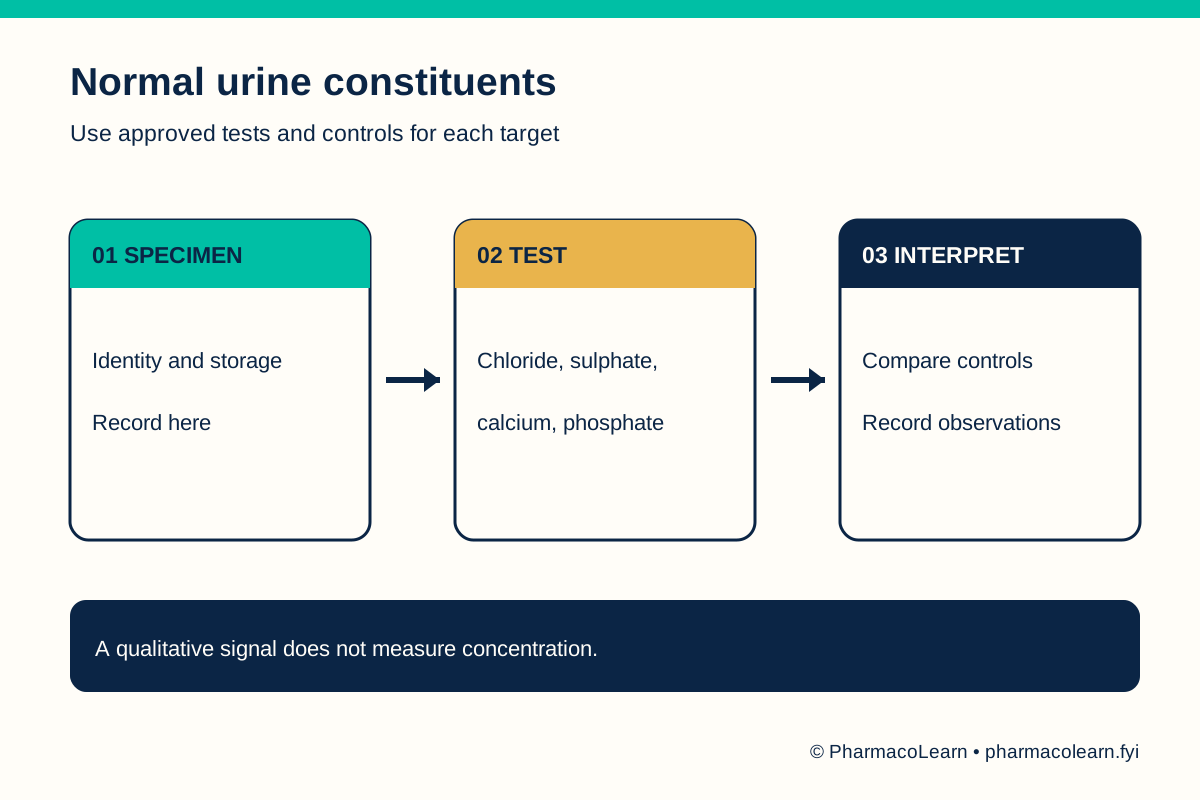
- For chloride, sulphate, calcium, and phosphate, follow the instructor's written sequence on separate aliquots. Record the observed appearance exactly; do not convert a faint change into a positive result without the control rule. [2]
- For any organic-constituent test chosen by the instructor, document the specific method name and its expected control response before proceeding. Those details must be specified in your college lab manual and instructor's method sheet here. [2]
- Compare sample observations with controls and record a presumptive present, absent, or indeterminate interpretation for each target. If a control fails, mark the test invalid. [2, 3]
- Dispose of urine and chemical waste through the designated streams. Submit the result sheet for instructor review; do not use it as a clinical report. [2]
5. Calculation, graph, or images as appropriate
| Target | Method named in manual [2] | Positive-control observation | Sample observation | Interpretation |
|---|---|---|---|---|
| Chloride | Acidified silver nitrate | Record here | Record here | Record here |
| Sulphate | Acidified barium chloride | Record here | Record here | Record here |
| Calcium | Ammonium oxalate | Record here | Record here | Record here |
| Phosphate | Ammonium molybdate method | Record here | Record here | Record here |
Worked record calculation: If four targets are selected, and the control and sample both require one separate observation per target, the minimum number of observation entries is 4 × 2 = 8. This is a worksheet check, not a concentration calculation. A missing control observation leaves that target's inference your college lab manual and instructor's method sheet. [2]
6. Result
List each target with its observed response and control status. Report a presumptive finding only when the controls and approved method support it. Record actual sample findings here. Compare with your laboratory's current reference interval. Clinical interpretation requires qualified review; this page does not interpret findings. The exercise is completed under teaching-lab supervision. [2, 3]
7. References
- Pharmacy Council of India. Pharm.D. Regulations, 2008, Medicinal Biochemistry practical list.
- East Point College of Pharmacy. Medicinal Biochemistry Practical Manual, normal urine constituent section.
- National Library of Medicine, MedlinePlus. Urinalysis. Explains the scope and limits of urine testing.
Back to Medicinal Biochemistry practicals | Pharm.D. Year 1 Practicals · All Pharm D Practicals · Pharm D
Theory notes: Medicinal Biochemistry