
Preparation of Simple Syrup I.P.
1. Aim
To prepare a teaching-lab sample of Simple Syrup I.P. by dissolving sucrose in purified water, then record the batch calculation and basic appearance checks. The edition and official monograph requirements used by the local laboratory must be specified in your college lab manual and instructor's method sheet. [1, 2]
2. Requirements
Sucrose and purified water; a clean, dry balance; weighing vessels; a heat-resistant beaker; glass stirring rod; water bath; thermometer if specified by the local method; tared final container; suitable filter if specified; and a clean, well-closed sample bottle. Wear a laboratory coat, eye protection, and gloves appropriate to the local procedure. The approved batch mass, ingredient grades, filtration method, container, and any preservative requirement must be specified in your college lab manual and instructor's method sheet. [2, 3]
3. Theory
Simple syrup is a concentrated solution of sucrose in purified water and serves as a sweetening vehicle in liquid dosage forms. The East Point College of Pharmacy practical manual gives an I.P. teaching formula of 667 g sucrose with purified water added to a final mass of 1000 g. This is 66.7% w/w, meaning 66.7 g sucrose per 100 g of finished syrup. It is a mass-based formula: 1000 g of finished syrup must not be treated as 1000 mL. Record the original I.P. edition from the approved monograph. Current applicability for compendial acceptance must be recorded from the assigned current monograph or approved college method in the student record. [2, 4]
Gentle warming can speed dissolution. Excess heating can darken syrup and change its quality, so follow the approved temperature and time limits, which must be specified in your college lab manual and instructor's method sheet. A clear appearance alone does not prove identity, concentration, microbial quality, or suitability for use. The finished teaching sample is not for patient use. [2, 3]
4. Procedure
- Confirm the instructor-approved formula, target mass, ingredient grades, and local safety instructions. Record the monograph edition and batch identifier here until provided. [2, 3]
- Clean the work surface, check the balance, and put on the specified protective equipment. Inspect the sucrose, water, and container labels. Reject any unlabeled or visibly contaminated material. [3]
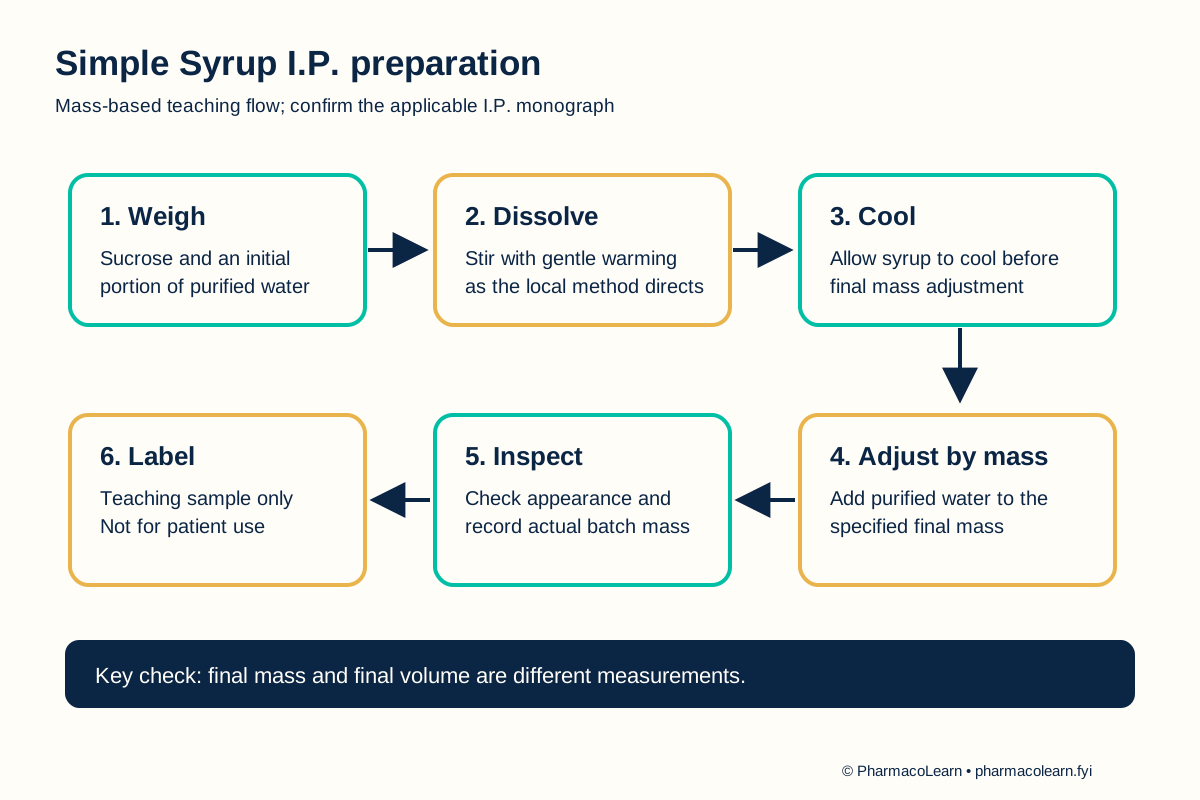
- Calculate the sucrose mass as 0.667 times the target final mass. Calculate the approximate initial water mass as target mass minus sucrose mass. Do not use volume as a substitute for either mass. [2]
- Tare a suitable beaker. Weigh the calculated sucrose and add a portion of purified water. Record the actual masses. The initial water portion must be specified in your college lab manual and instructor's method sheet. [2]
- Stir over a water bath as directed by the instructor until the sucrose dissolves. Avoid boiling or prolonged heating; the approved heat setting and duration must be specified in your college lab manual and instructor's method sheet. Use thermal protection when handling hot glassware. [2]
- Remove the beaker from the bath and allow it to cool as directed. If the approved method calls for filtration, use its specified filter and record that step here. [2]
- Weigh the cooled preparation in a tared vessel. Add purified water in small portions until the approved final mass is reached, mixing after each addition. Record the actual final mass. [2]
- Inspect for visible particles, discoloration, or undissolved sucrose. Transfer to the specified clean container and label it as a teaching-lab sample with its contents, batch record, date, and not for patient use. Storage and disposal instructions must be specified in your college lab manual and instructor's method sheet. [3]
5. Calculation, graph, or images as appropriate
| Record item | Planned value | Actual observation |
|---|---|---|
| Target final mass | Assumed practice batch: 100 g; adjust to assigned batch size | Record here |
| Sucrose mass | 66.7 g for the assumed 100 g practice batch; otherwise target mass × 0.667 | Record here |
| Purified water added | Sufficient to the assumed final mass of 100 g; adjust to assigned batch size | Record here |
| Appearance after cooling | Clear, without visible particles or marked discoloration | Record here |
| Final container and label | Use authenticated formula | Record here |
Worked calculation for an assumed 100 g practice batch: Sucrose = 100 g × 0.667 = 66.7 g. The remaining mass in the finished batch is 100 g − 66.7 g = 33.3 g, supplied by purified water. Water is added to a final batch mass of 100 g after cooling; this calculation does not prescribe an initial water volume. The local assigned batch mass and the actual weighed values must be recorded here. This example scales the college manual's mass formula; it does not establish a current I.P. release specification. [2]
6. Result
Mass of Simple Syrup I.P. teaching sample prepared, final appearance, and any deviations: Record here. Report whether the mass target was met. Do not claim compendial compliance until the applicable I.P. monograph and required tests are confirmed. [2, 3]
7. References
- Pharmacy Council of India. Pharm.D. Regulations, 2008, Appendix A. Lists Simple Syrup I.P. as the first Pharmaceutics practical.
- East Point College of Pharmacy. Pharmaceutics Practical Manual, Experiment 1: Simple Syrup. Provides the mass-based teaching formula and preparation method.
- United States Pharmacopeia. General Chapter 795: Pharmaceutical Compounding, Nonsterile Preparations. General quality framework for nonsterile compounding; it is not the I.P. formula.
- United States Pharmacopeia. Syrup monograph. Supports the general sucrose-in-purified-water definition; USP composition is not substituted for I.P.
Back to Pharmaceutics Practicals · All Pharm D Practicals · Pharm D
Theory notes: Pharmaceutics