
Preparation of Pediatric Simple Linctus BPC
1. Aim
To calculate and document the supervised dilution of a verified Simple Linctus BPC stock with a specified syrup vehicle for a Pediatric Simple Linctus BPC teaching exercise. The historical BPC source formula, stock composition, and local authorization must be specified in your college lab manual and instructor's method sheet. [1, 2]
2. Requirements
A verified Simple Linctus stock and approved syrup vehicle; calibrated measuring devices, clean beaker, stirring rod, funnel, specified filter if required, calibrated final container, label, and batch record. Wear a laboratory coat, eye protection, and appropriate gloves. The BPC edition, stock identity and composition, stock acceptance status, vehicle specification, target volume, final container, and storage conditions must be specified in your college lab manual and instructor's method sheet. The college manual's Simple Linctus stock includes chloroform spirit, so its use requires an authenticated formula and local chemical controls. [2, 3, 4]
3. Theory
The college teaching manual describes this pediatric-named linctus as a dilution of prepared Simple Linctus with syrup. Its listed teaching formula uses one part Simple Linctus in four parts of finished product by volume. The syrup is added to the target final volume, so the finished concentration of every stock ingredient depends on the verified stock concentration and the dilution factor. This is a formulation calculation, not a recommendation for a child to take the product. [2]
Diluting a stock does not remove an ingredient already in it. Because the source stock includes chloroform spirit, the inherited ingredient and the historical formulation must be reviewed before any wet-lab preparation. The applicable BPC monograph was not directly available. The word pediatric in the syllabus does not establish current pediatric suitability, dose, or safety. [2, 3, 4]
4. Procedure
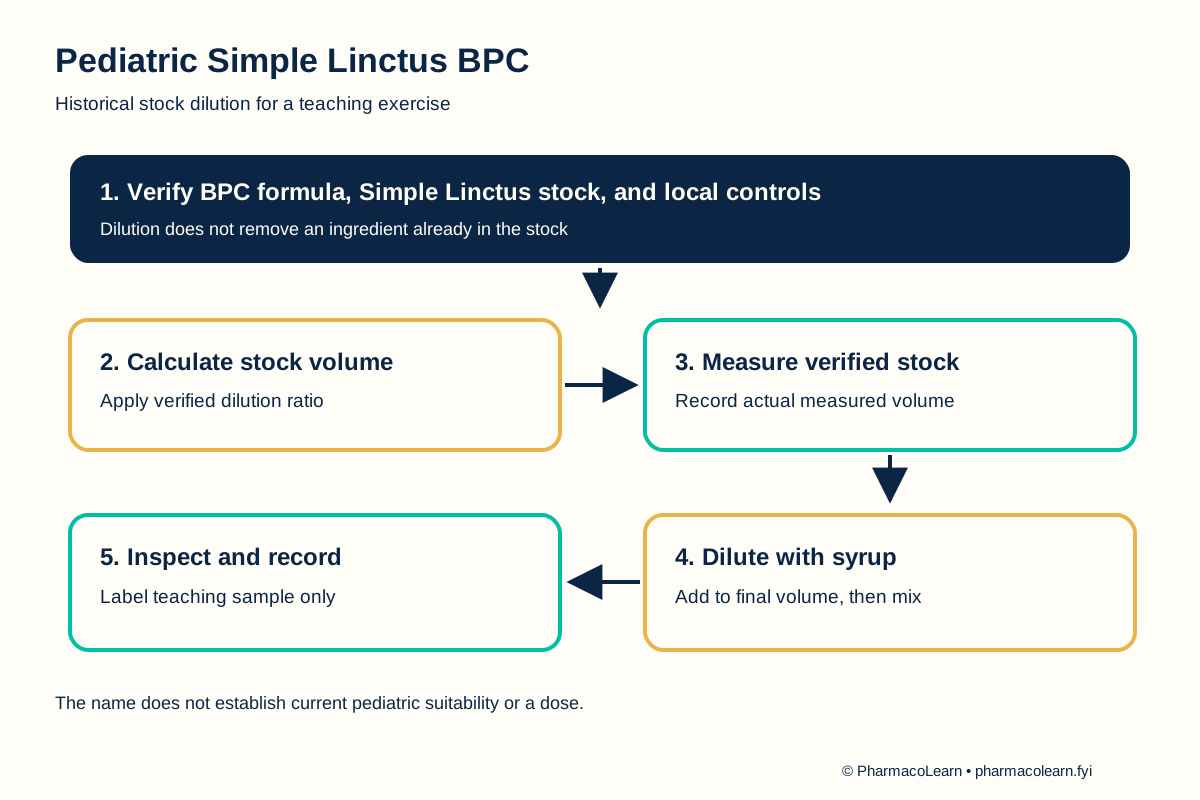
- Obtain the authenticated BPC formula and edition for both the stock and finished product. Confirm stock identity, composition, batch record, and any ingredient restrictions. The local approval and target volume must be specified in your college lab manual and instructor's method sheet. If the stock formula or safety controls are unresolved, complete only the paper calculation and diagram review. [2, 3, 4]
- Inspect the stock and vehicle labels, acceptance status, calibrated devices, protective equipment, and work area. Follow local controls for any inherited chloroform spirit. Record the safety check here, following the local method sheet. [3, 4]
- Calculate the required stock volume from the verified source ratio and assigned final volume. Have the calculation independently checked and record the actual values in the student record. [2, 3]
- If wet-lab work is approved, measure the verified Simple Linctus stock with a calibrated device and transfer it to a clean beaker. Record the actual stock volume. [2]
- Add a portion of the approved syrup vehicle and stir until uniform. Inspect for visible particles or separation. Filter only if the authenticated method requires it; the filter method must be specified in your college lab manual and instructor's method sheet. [2]
- Transfer the mixture to a calibrated final container and add syrup to the specified final volume. Mix and record the actual final volume. Do not add a full target volume of syrup in addition to the stock. [2]
- Record color, clarity, visible particles, and any separation here. The instructor's acceptance criteria are to be recorded from the assigned current monograph or approved college method in the student record. Do not taste a laboratory sample. [3]
- Label with the verified composition, batch record, date, and teaching sample, not for patient use. Follow local storage and disposal directions, which must be specified in your college lab manual and instructor's method sheet. [3, 4]
5. Calculation, graph, or images as appropriate
| Record item | Source or planned value | Calculated amount | Actual record |
|---|---|---|---|
| Verified Simple Linctus stock | Identity and composition from authenticated formula | Record here | Record here |
| Syrup vehicle | Sufficient to final volume | Record here | Record here |
| Final volume | Use authenticated formula | Record here | Record here |
| Dilution factor and appearance | Criteria record from the assigned current monograph or approved college method | Record here | Record here |
Worked calculation from the college manual: The teaching formula lists 250 mL of Simple Linctus in 1000 mL of finished product. For an assigned 20 mL teaching batch, stock volume = (250 mL ÷ 1000 mL) × 20 mL = 5 mL. Add the approved syrup vehicle to a final volume of 20 mL. The stock occupies one-quarter of the finished volume, so its ingredients would be at one-quarter of their stock concentrations if the volume relationship is confirmed. Record the authenticated BPC formula and stock composition from the assigned monograph; enter actual measurements in the student record. This worked example does not establish current compendial suitability. [2]
6. Result
State whether the exercise remained on paper or an authorized teaching sample was made. Stock identity, calculated and actual stock volume, final volume, appearance, and deviations must be recorded here. Do not claim pediatric suitability, BPC compliance, or dispensing readiness from this exercise. [2, 3]
7. References
- Pharmacy Council of India. Pharm.D. Regulations, 2008, Appendix A. Lists Pediatric simple Linctus BPC after Simple Linctus BPC.
- East Point College of Pharmacy. Pharmaceutics Practical Manual, Experiments 9 and 10: Simple and Pediatric Simple Linctus BPC. Gives the historical stock and dilution method; BPC attribution requires direct verification.
- United States Pharmacopeia. General Chapter 795: Pharmaceutical Compounding, Nonsterile Preparations. General quality framework, not a BPC pediatric formula.
- National Institute for Occupational Safety and Health. Pocket Guide to Chemical Hazards: Chloroform. Occupational hazard information for an ingredient listed in the source stock.
Back to Pharmaceutics Practicals · All Pharm D Practicals · Pharm D
Theory notes: Pharmaceutics