
Preparation of Aqueous Iodine Solution IP
1. Aim
To prepare a supervised teaching-lab sample of Aqueous Iodine Solution IP using a verified historical formula, then record the ingredient calculation, complete dissolution, final volume, and appearance. The applicable IP edition and local release criteria are to be recorded from the assigned current monograph or approved college method in the student record. [1, 2, 3]
2. Requirements
Iodine, potassium iodide, and purified water of the grades specified by the authenticated formula; calibrated balance, nonmetallic weighing and stirring tools, beaker or glass mortar, liquid measure, funnel, specified filter if needed, light-resistant iodine-compatible bottle, label, and batch record. Wear a laboratory coat, eye protection, and gloves selected for iodine handling. The ingredient grades, target batch volume, balance capacity, filter, bottle specification, and disposal route must be specified in your college lab manual and instructor's method sheet. [2, 3, 4]
3. Theory
Iodine dissolves only sparingly in plain water. Potassium iodide helps bring it into an aqueous solution by forming more water-soluble iodine and iodide species. Therefore the iodide is dissolved in a smaller portion of water before iodine is added, and purified water is used to reach the finished volume. The East Point College of Pharmacy teaching manuals give an IP 1966 aqueous formula of iodine 50 g and potassium iodide 100 g per 1000 mL final solution. This is 5% w/v iodine and 10% w/v potassium iodide. Direct confirmation against the applicable IP monograph remains your college lab manual and instructor's method sheet. [2, 3]
Names can be misleading across pharmacopoeias. The USP monograph titled Strong Iodine Solution describes a similar aqueous strength, while the separate historical Strong Solution of Iodine IP teaching exercise uses an alcoholic vehicle and a different formula. Identify the source by both name and edition, not by the word strong alone. The laboratory sample is not for self-administration or patient use. [2, 5]
4. Procedure
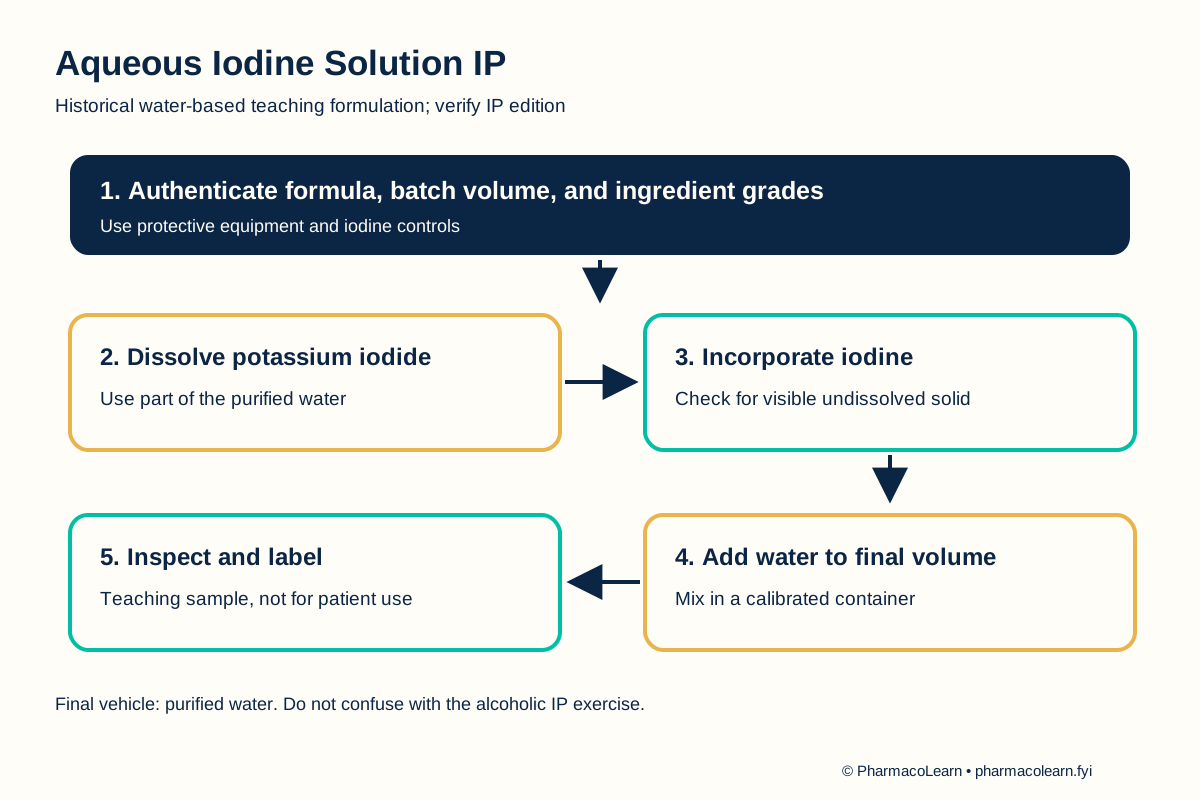
- Obtain the instructor-approved IP formula and edition, assigned final volume, ingredient grades, and local iodine safety instructions. Record the applicable source here until authenticated. [2, 3, 4]
- Prepare a clean work area and check the balance, liquid measure, bottle, and protective equipment. Avoid breathing iodine vapor or dust and prevent skin and eye contact. The local containment and spill method must be specified in your college lab manual and instructor's method sheet. [4]
- Calculate the iodine and potassium iodide masses from the verified master formula. Have the working calculation checked independently. The actual assigned volume and weighed masses must be specified in your college lab manual and instructor's method sheet. [2, 3]
- Measure a portion of purified water into a clean glass vessel. Dissolve the calculated potassium iodide in it. The initial water portion must be specified in your college lab manual and instructor's method sheet and must leave room for the final volume adjustment. [2, 3]
- Add the weighed iodine to the concentrated iodide solution in the order specified by the authenticated method. Stir until no visible iodine remains. Do not add iodine to a full batch volume of plain water. [2, 3]
- Transfer the solution to a calibrated container. Rinse the vessel with small portions of purified water if the method permits. Add purified water to the specified final volume and mix. [2]
- Inspect for visible crystals, sediment, and uniform color. Filter only if the verified method requires it and record any loss. The formal acceptance criteria and tests are to be recorded from the assigned current monograph or approved college method in the student record. [2, 3]
- Close the specified iodine-compatible, light-resistant bottle and label it with the source formula, batch record, date, and teaching sample, not for patient use. Follow local storage and disposal instructions, which must be specified in your college lab manual and instructor's method sheet. [3, 4]
5. Calculation, graph, or images as appropriate
| Record item | Historical teaching formula | Working quantity or observation |
|---|---|---|
| Iodine | 50 g per 1000 mL finished solution [2, 3] | Record here |
| Potassium iodide | 100 g per 1000 mL finished solution [2, 3] | Record here |
| Purified water | Sufficient to final volume [2, 3] | Record here |
| Appearance after mixing | Local criteria record from the assigned current monograph or approved college method | Record here |
| Applicable IP edition and tests | Use authenticated formula or method | Record here |
Worked calculation for a 20 mL teaching batch: The scale factor is 20 mL ÷ 1000 mL = 0.02. Iodine = 50 g × 0.02 = 1 g. Potassium iodide = 100 g × 0.02 = 2 g. Purified water is added to a final volume of 20 mL, not as a separate 20 mL addition. The local assigned volume, actual masses, and current monograph requirements must be recorded here. [2, 3]
6. Result
Record the authenticated formula, actual masses, final volume, appearance, and any undissolved material or deviations here. State whether the teaching sample met the instructor's criteria. Do not infer IP compliance or patient suitability from color and clarity alone. [2, 3]
7. References
- Pharmacy Council of India. Pharm.D. Regulations, 2008, Appendix A. Lists Aqueous Iodine Solution IP before Strong solution of Iodine IP.
- East Point College of Pharmacy. Pharmaceutics Practical Manual, Experiment 13: Aqueous Iodine Solution. Gives the teaching formula and sequence.
- East Point College of Pharmacy. Pharmaceutics Lab Manual, Aqueous Iodine Solution IP 1966. Independently identifies the historical IP edition and formula.
- National Library of Medicine, PubChem. Iodine: Safety and Hazards. Documents skin, eye, and inhalation hazards.
- United States Pharmacopeia. Strong Iodine Solution monograph. Shows why the pharmacopoeia and edition must accompany the formulation name; it is not used as the IP formula.
Back to Pharmaceutics Practicals · All Pharm D Practicals · Pharm D
Theory notes: Pharmaceutics