
← Pharmaceutical Organic Chemistry practicals | Pharm.D. Year 1 Practicals
Stereo Model Study: Ethylene (Ethene)
1. Aim
To use a stereo model to identify the planar arrangement around each carbon of ethylene, also called ethene, and explain restricted rotation at a double bond. Ethylene is the third named PCI section III model topic. The actual kit and observations must be recorded here. [1]
2. Requirements
Approved double-bond model pieces or a preassembled model, flat reference card, observation sheet, teaching supervisor, and any protective equipment required by the room. No ethylene gas or reagents are needed. Kit design and assessment criteria are specified in your college lab manual and instructor's method sheet. [2]
3. Theory
Each carbon in ethylene is connected to two hydrogens and the other carbon. The three bonding directions around each carbon lie in one plane in the idealized model. A double bond contains a component that prevents free rotation without disrupting the bonding arrangement. The model thus contrasts with ethane, where the single bond can rotate. Ethylene itself has two identical hydrogens at each carbon and does not form cis and trans isomers. It is a geometry example for later substituted alkene comparisons, not a cis-trans pair. [2]
4. Procedure
- Check the kit legend for its double-bond connector and select the appropriate pieces.
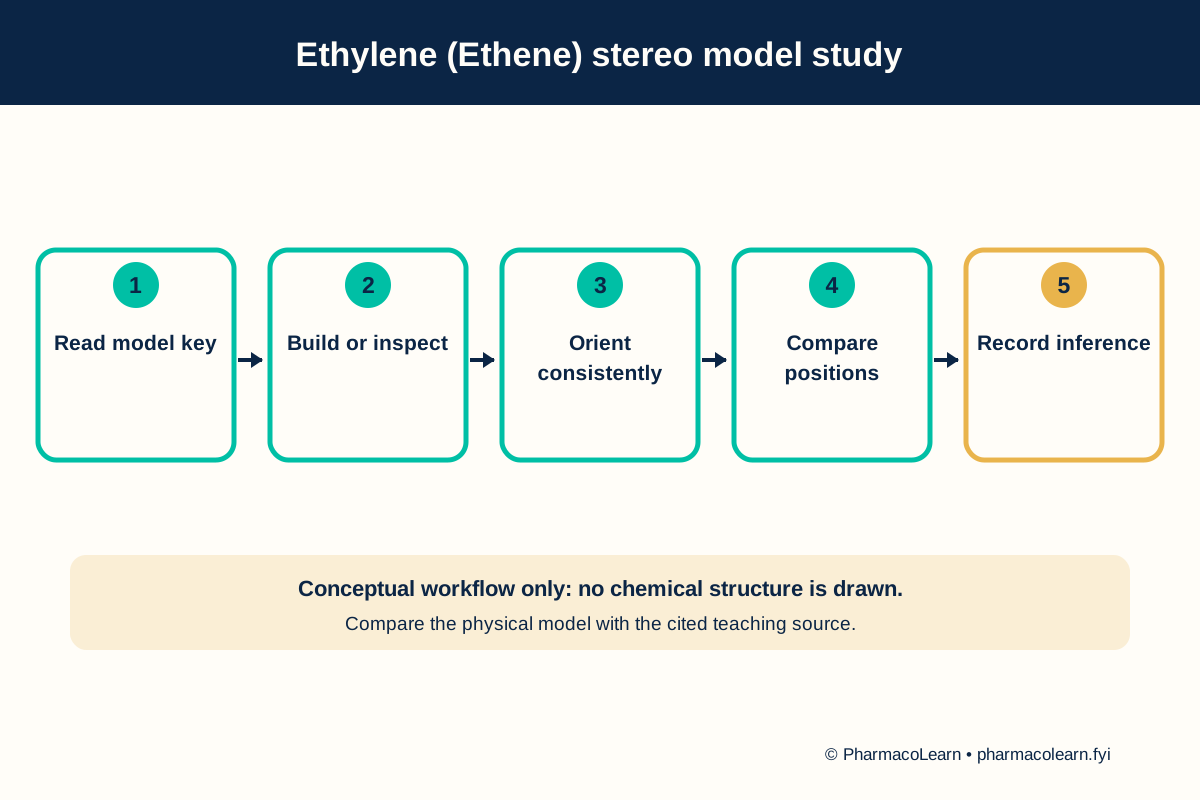
- Assemble or inspect the instructor-approved ethylene model without using gas.
- Place the model beside a flat reference card and inspect whether its main connections lie in one plane.
- Attempt only the gentle rotation permitted by the model design and record whether the double-bond arrangement stays intact.
- Compare the behaviour with the ethane single-bond model if available.
- Check whether either double-bond carbon has two different substituents; record the reason cis-trans labels do not apply to ethylene.
- Document the geometry and return all pieces.
5. Calculation, graph, or images as appropriate
| Model observation | Actual teaching record |
|---|---|
| Local geometry around each carbon | Record here |
| Planarity | Record here |
| Free rotation without disruption | Record here |
| Cis-trans possible for ethylene | Record here |
Pre-assumed observations for explanation only: a correct model is approximately planar, resists free rotation while the double-bond connection remains intact, and has duplicate hydrogens at each carbon. Cis-trans classification is therefore inapplicable. Actual kit observations must be recorded here. This section records shape or orientation rather than a synthesis yield. No reagent-volume or product-mass calculation is required.
6. Result
Report the named geometry or stereochemical relationship only after comparing the actual model with the cited reference and the instructor's labels. The submitted model result must be recorded here. Safety note: Use the physical model only; no ethylene gas is handled. Do not force rigid connectors or leave small parts loose.
7. References
- Pharmacy Council of India, Pharm.D. Regulations, 2008.
- OpenStax, Carbon and Molecular Geometry.
- Colorado State University, Molecular Shapes.
Back to Pharmaceutical Organic Chemistry practicals | Pharm.D. Year 1 Practicals · All Pharm D Practicals · Pharm D
Theory notes: Pharmaceutical Organic Chemistry